

Helpped or helped? It looks like a tiny question. Yet it trips up many writers every day. Here is the straight answer. Helped is the correct spelling. Helpped has one p too many. So if you typed it in a rush or doubted yourself, relax. You are in good company.
In this guide you will learn why helped is right and why helpped feels so tempting. First you will see the simple spelling rule behind the word. Next you will get clear examples for texts, emails and school work. Finally you will pick up easy tricks that lock the spelling in your memory.
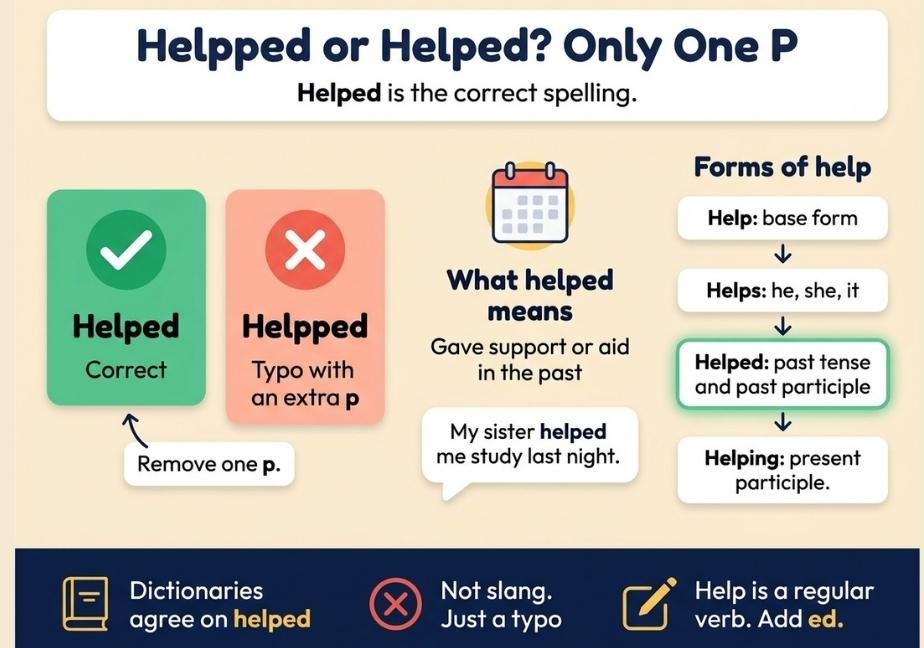
Helped is the correct spelling. It is the past tense and the past participle of the verb help. Helpped is a typo with an extra p and is not standard English. When a text says helpped, the writer almost always meant helped. Write “She helped me yesterday” and you are right.
Helpped or Helped: Which One Is Correct?
Helped is correct and helpped is a typo. English forms the past tense of help by adding ed to the end of the word. Because help already ends in two consonants, nothing else changes. The result is helped with one p.
Dictionaries back this up. According to Merriam-Webster, the verb help has the forms helped and helping and helps. Likewise, Dictionary.com defines helped as the past tense and the past participle of help. Neither page lists helpped as a word.
So the helped vs helpped question has one clear winner. Helped is the standard spelling in English. Helpped is a plain typing slip. Fix it by deleting one p.
What Does Helped Mean?
Helped means gave aid or support in the past. It marks the action as finished. For example, “My sister helped me study last night.” The help already happened.
The verb covers many small situations. A person can help with a task. A medicine can help a headache. A kind word can help a bad mood. The same dictionary also lists a food sense, as in “help yourself to snacks.” In each case the past form stays helped.
Helped as the Simple Past
The simple past shows one finished action. You do not need an auxiliary verb. Just place helped after the subject. For instance, “He helped his neighbor paint the fence.” Also, “They helped the team win.” Both sentences point to a time that has ended.
Helped as a Past Participle
A past participle works with has, have or had. Helped does this job too. These patterns are called the present perfect and the past perfect. Because help is a regular verb, the simple past and the past participle look the same. As a result, you only need to learn one form. For example, “She has helped me many times.” Likewise, “I had helped him before the test.”
Why Do People Type Helpped?
The mistake has clear causes. So let us walk through them.
The Double Consonant Trap
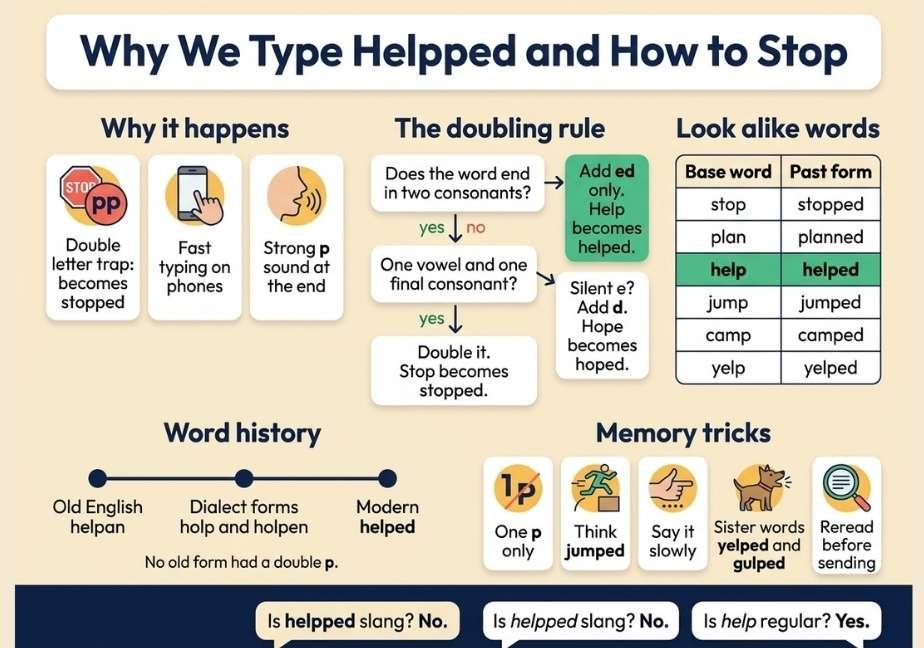
English has a famous pattern. Many verbs double the last letter before ed. For example, stop becomes stopped. Plan becomes planned. Drop becomes dropped. Because of this, the brain starts to expect a double letter at the end. Then it applies the same pattern to help. That is how helpped appears. However, help does not follow that pattern.
Fast Typing on Phones
Phones add another problem. Thumbs move fast and can hit the same key twice. Also, small screens hide the error. Sometimes autocorrect fixes it for you. Other times it does not. So a stray p can slip into a text or an email. In that case, a quick reread solves it.
Sound and Memory
Spoken English also plays a role. The word ends with a firm p sound. Some people feel that a strong sound needs a double letter. Still, sound is a poor guide in English spelling. For instance, jumped and camped end the same way. Neither one doubles the p.
The Spelling Rule Behind Helped
English has a doubling rule. It is simple once you see it. Here are the key points.
- Double the last letter when a short word has one vowel and one final consonant.
- Double it in longer words only when the last syllable gets the stress, as in begin.
- Do not double a letter when the word already ends in two consonants.
- Never double w or x or y, as in played and fixed.
- Words ending in a silent e just take d, as in hoped.
Now apply the rule to help. The word has one vowel, which is e. After it come two consonants, l and p. Because of that, the doubling rule does not apply. Therefore, you add ed and nothing more.
How to Spell Helped in Four Steps
- Start with the base word help.
- Check the ending. Help ends in l and p, which are two consonants.
- Skip the doubling rule, since it needs a single consonant at the end.
- Add ed to get helped with one p.
The same rule explains many look alike words. Jump becomes jumped. Camp becomes camped. Yelp becomes yelped. Gulp becomes gulped. Lift becomes lifted. Ask becomes asked. In each case the word ends in two consonants. So none of them double. Helped belongs to this group.
A Quick Look at Old Forms
English has not always used helped. According to the Online Etymology Dictionary, Old English helpan was a strong verb. Its past tense was healp and its past participle was holpen. The same source dates helped to around 1300 and says holpen survives in biblical and some U.S. dialect use. Meanwhile, Merriam-Webster still lists holp and holpen as chiefly dialectal forms.
Notice one thing. None of those old forms had a double p. So helpped has no roots in history either.
How to Use Helped in a Sentence
Examples make rules easier. So here are clear models you can copy.
Simple Past Examples
- She helped me carry the boxes yesterday.
- They helped the team win the final match.
- My teacher helped me fix the essay.
- He helped his neighbor paint the fence.
Perfect Tense Examples
- I have helped three people today.
- She had helped him before the exam began.
- We will have helped everyone by noon.
Helped With Other Verbs
You can pair helped with another verb in two ways. You can say “She helped me move” or “She helped me to move.” Both are correct. The first sounds more casual. Also, helped works in fixed phrases. For example, “He helped himself to a slice of cake.” Meanwhile, “She could not help laughing” uses the base form. Here help means to keep from doing something. After could or can the verb stays in its base form.
Helped, Helps, Helping and Help: Forms Compared
Many writers mix up the forms of this verb. So here is a simple map.
| Form | Use | Example |
|---|---|---|
| Help | Base form | Please help me. |
| Helps | Present tense for he, she and it | She helps daily. |
| Helped | Past tense and past participle | She helped yesterday. |
| Helping | Present participle | She is helping now. |
Also, helper is a noun for a person who helps. Meanwhile, help itself can be a noun, as in “I need some help.” None of these forms needs a double p.
Helped in Texts, Emails and Social Posts
Is helpped ever correct? No. Helpped is not standard English. The dictionary pages checked for this guide list no slang meaning for it. So if a friend texts helpped, read it as helped. They most likely hit a key twice. There is no hidden message behind it.
Casual messages often shorten words. For example, people write thx for thanks. However, helpped is not a shortcut. It is longer than the right word. So it is a typo and not slang.
Here are natural ways to use the right word in a message.
- Thanks so much. You helped me a lot today.
- That video helped me finally understand the topic.
- Your tip helped. The file opens now.
- Glad I helped. Let me know if you need more.
Notice the tone. Each line sounds warm and short. In professional emails the same rule applies. Write “Thank you for the help” or “Your input helped our team” and you are set. In casual chats a typo is easy to forgive. In formal writing you should fix it before you send.
Helped vs Assisted vs Aided
Writers often swap helped with other verbs. Each has a slightly different feel. Helped is a common and natural choice. It fits casual talk and formal writing. Assisted sounds a bit more formal. Aided can sound official. For example, “The volunteers helped build the shelter” sounds warm. “The charity aided local families” sounds more formal. These are style notes and not strict rules. Whichever you pick, each past form ends in ed and none doubles a letter.
Easy Tricks to Remember the Spelling
Good memory tricks save time. So try these.
- Help has one p. Add ed and keep just one p.
- Think of jumped. Nobody writes jummped.
- Say the word slowly. You will hear one p sound.
- Remember the sister words yelped and gulped.
- Reread every draft once before you hit send.
These tricks work because they link helped to words you already know. Also, they take only a few seconds.
Common Mistakes and Quick Fixes
- Helpped: delete one p to get helped.
- She help me yesterday: change help to helped.
- She has help me: use helped after has, have or had.
Time words like yesterday and last week signal the past form. So check for them whenever you proofread.
FAQs About Helpped or Helped
Is it helpped or helped?
Helped is correct. Helpped is a typo with an extra p. Use helped as the past tense of help in every sentence.
What is the past tense of help?
The past tense of help is helped. Help is a regular verb, so the past participle is also helped, as in “she has helped me.”
Does helpped have a slang meaning?
No. The dictionary pages checked list no slang meaning. If someone texts helpped, they most likely meant helped and made a typing slip.
Why does help not double the p?
Help ends in two consonants, l and p. English only doubles a final consonant after a single short vowel, as in stop.
Is helped spelled the same in British and American English?
Yes. Both varieties use helped for the past tense and the past participle. The ed ending adds no extra letter.
Conclusion: Write Helped Every Time
The takeaway is clear. Helped is the only correct spelling. Helpped is a typo and not a word. Help is a regular verb that ends in two consonants. So it takes ed and nothing else.
Here is your next step. Search your latest drafts for helpped and fix it. Then try the jumped trick the next time you doubt a word. So the next time the helpped or helped question pops up, trust the rule and not your hunch.