

Homey and homie are two accepted spellings of the same slang word for a close friend. Homey has a second unrelated meaning as an adjective describing a cozy comfortable place.
If a friend just texted you calling you their homie and you noticed someone else spells the exact same word as homey you are probably wondering which one is actually right. Homey or homie is a search that trips up a lot of people because both spellings show up constantly online and both are technically correct when the word means a close friend. This article breaks down exactly what each spelling means how they overlap and why homey also carries a totally different definition that has nothing to do with friendship at all.
By the end you will know exactly when to use homie when to use homey and how to avoid mixing up the friendly slang term with the cozy home related adjective that shares the same spelling. We will look at where the word came from how hip hop culture shaped its modern meaning and how regional habits shape which spelling people reach for first.
What Do Homey and Homie Actually Mean
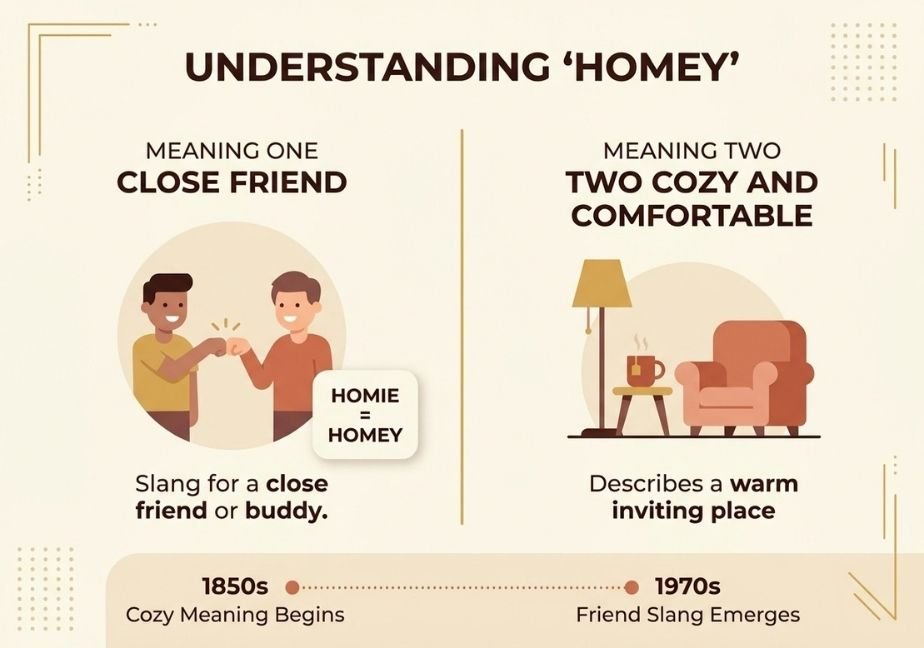
As slang both homie and homey describe a close friend someone from your neighborhood or a person you consider like family. You might hear someone say this is my homie Marcus or greet a friend by saying what is up homey. Both spellings carry the exact same warm familiar tone and both work as a friendly term of address or a way to describe someone in conversation.
The slang term is a shortened form of homeboy or homegirl. According to Dictionary.com the word is strongly associated with urban and hip hop culture and is commonly used within African American and Latino communities in the United States to describe a close friend from the same neighborhood. Over the decades the meaning softened from its earlier gang associated use into the mainstream friendly term people hear in music movies and everyday conversation today. Some etymologists even trace an earlier root of homeboy back to military slang from soldiers who bonded over sharing the same hometown, which shows just how far the word traveled before landing in its modern casual form.
Homie and homey function as a noun in this slang sense. The plural forms are homies and homeys and both appear often in casual writing song lyrics and social media captions. Neither spelling is considered more correct than the other when the word refers to a friend which is exactly why so many people end up searching homey or homie hoping for a clear answer.
Is Homey The Same Word As Homie
In the friend sense yes homey and homie are the same word with two accepted spellings. Dictionary.com lists homey as a direct variant of homie and treats the two as interchangeable when the meaning is a close friend. You will see homie used more often in hip hop lyrics and homey pop up more in everyday casual writing but neither spelling changes the meaning of the word itself.
This is different from a simple typo situation like confusing two completely unrelated words. Homey and homie are what linguists call variant spellings which means both forms are recognized as legitimate ways to write the same slang term. English has plenty of similar examples like gray and grey or theater and theatre where regional habit rather than strict grammar rules decides which spelling a writer reaches for.
The Other Meaning Of Homey
Here is where things get a little more interesting. Homey also exists as a completely separate adjective that has nothing to do with friendship. This older sense of homey describes a place that feels cozy comfortable and inviting the same way your own home does. A small candlelit restaurant might get called homey. A guest room decorated with soft blankets and warm lighting might feel homey too.
This adjective use of homey dates back much further than the friend slang. Word history records place its first known use around the 1850s describing homelike comfort long before homie ever entered American slang in the twentieth century. Because both meanings share the exact same spelling context becomes the only real clue for figuring out which one a writer means. A homey little inn is clearly talking about coziness while my homey just called me is clearly talking about a friend.
Homie on the other hand only carries the friendship meaning. It never gets used to describe a cozy room or a comfortable space. If you are ever unsure which spelling fits a sentence about warmth and comfort homey is always the safer and more traditional choice.
Where Homie And Homey Come From
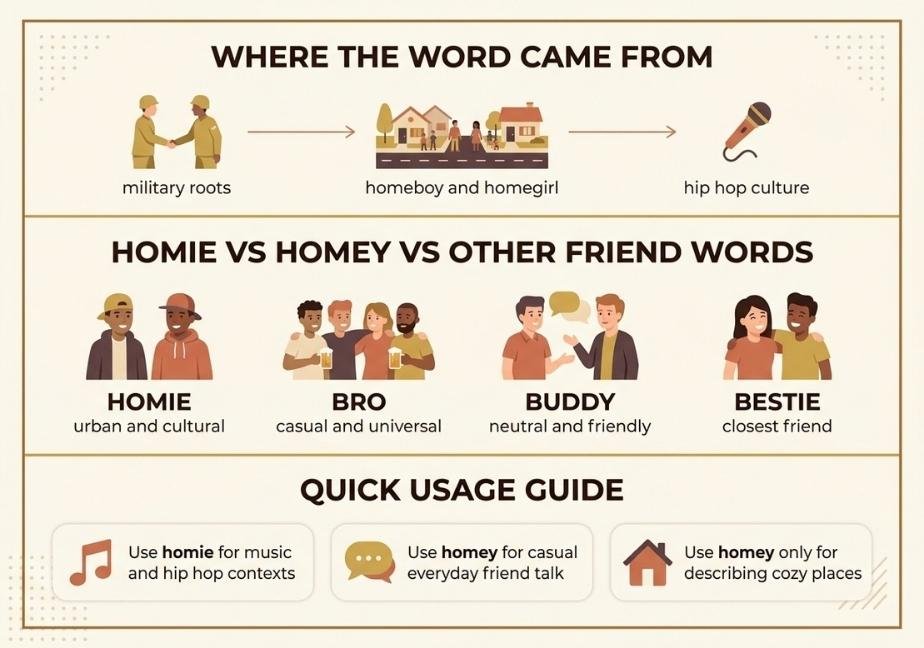
The slang sense of the word traces back to homeboy and homegirl which described a friend from the same hometown or neighborhood. Some language historians link the earliest roots to Spanish influenced slang among Mexican American communities in the late nineteenth century. Others trace a parallel path through military slang where soldiers who discovered they were from the same hometown began calling each other homeboy which later shortened into homie.
By the 1970s the shortened form homie had become common within Black American communities and it gained massive mainstream visibility through hip hop music starting in the 1980s and continuing through today. Songs movies and television shows built around hip hop culture carried the word far beyond its original neighborhoods and turned it into one of the most recognized friendship slang terms in modern English.
The adjective version of homey followed a completely separate path. It grew naturally from the word home combined with the common suffix y which turns a noun into a descriptive adjective the same way rain becomes rainy or luck becomes lucky. That simple pattern explains why homey sounds so natural when describing a cozy space even though it looks identical to the slang word for a friend.
Homey Or Homie In Everyday Writing
Seeing both meanings in real sentences makes the difference much easier to keep straight.
Friend meaning: Call me later homie I need your advice. Friend meaning: She brought her homies along to the cookout. Cozy meaning: The cabin felt warm and homey after a long hike. Cozy meaning: Soft lighting made the small cafe feel homey.
Notice how context instantly signals which meaning applies. Sentences about people friendship and greetings point to the slang meaning while sentences describing a room a house or an atmosphere point to the cozy adjective. Reading a sentence back before posting is usually enough to confirm which meaning you actually intended.
Which Spelling Should You Use
If you mean a close friend either homie or homey works correctly and neither spelling will confuse a reader familiar with the slang. That said a few small habits can help you choose with more confidence.
Use homie when writing anything connected to hip hop culture or music lyrics. Use homey when writing casual everyday text messages among friends. Use homey any time you mean cozy comfortable or homelike. Stick with one spelling consistently within the same piece of writing. Check the surrounding sentence for context before publishing anything public.
Consistency matters more than which specific spelling you pick. Switching between homie and homey in the same article or caption can look careless even though both are technically valid so choosing one and sticking with it throughout a piece of writing keeps things looking polished.
Regional And Generational Differences
Usage patterns shift a little depending on where you are and who you are talking to. Homie tends to dominate in hip hop centered media music lyrics and content aimed at younger audiences online. Homey shows up more often in general casual conversation text messages and everyday internet slang outside of a specifically music focused context.
Neither pattern is a strict rule though and plenty of writers use the two spellings interchangeably without any real distinction in mind.
Older generations who grew up around the earlier Australian and New Zealand sense of homey meaning a British immigrant may recognize a completely different historical use of the word that has nothing to do with American slang at all.
That older regional meaning has mostly faded from everyday use but it explains why some dictionary entries list unexpected definitions alongside the modern friendship sense.
Social media has also blurred regional lines considerably. Because slang spreads instantly online through captions comments and short video content both homie and homey now appear side by side across nearly every English speaking region regardless of where each spelling originally took hold.
How Homie And Homey Compare To Other Friend Slang
English has no shortage of casual words for a close friend and homie sits comfortably alongside terms like bro dude buddy and bestie. What sets homie and homey apart is the specific cultural weight the word carries. Where bro often signals a general casual friendliness and bestie usually points to one single closest friend, homie carries a stronger sense of shared background, neighborhood loyalty and hip hop culture that the other terms simply do not carry in the same way.
Bro tends to work well in almost any casual setting including workplaces and sports environments where a slightly more universal tone fits. Buddy leans a bit more neutral and even shows up in children’s media and family friendly writing. Homie by contrast keeps a distinctly urban and music influenced identity even as it has spread into mainstream slang, which is part of why writers researching the word care so much about getting the spelling and context right.
Choosing between these words often comes down to audience and tone rather than strict correctness. A birthday caption aimed at close friends might use homie for a personal cultural touch, while a more general audience post might reach for buddy or bestie instead. None of these choices are wrong, they simply carry slightly different social signals depending on who is reading them.
Common Sentences Where People Get It Wrong
Most confusion around homey or homie does not come from misunderstanding either meaning. It usually comes from writers second guessing themselves mid sentence, especially when autocorrect suggests one spelling over the other. A phone keyboard might quietly change homie to homey while typing quickly, which can feel jarring if a writer specifically wanted the hip hop associated spelling for a caption or comment.
The reverse also happens. Someone describing a cozy apartment might type homie out of habit from texting friends constantly, even though homey is the traditional spelling for that meaning. Neither mistake causes serious confusion since readers generally understand both spellings, but writers aiming for a polished, professional piece of content still benefit from picking the spelling that matches their intended meaning and sticking with it.
Frequently Asked Questions
Is homey the same as homie? Yes when the word means a close friend. Homey and homie are accepted variant spellings of the same slang term.
Does homey ever mean something other than friend? Yes. Homey also means cozy and comfortable, describing a place that feels warm and inviting like home.
Which spelling is more common, homey or homie? Homie appears more in hip hop and music contexts while homey is common in everyday casual writing.
Is homie a real dictionary word? Yes. Homie is listed in major dictionaries as slang for a close friend, often short for homeboy or homegirl.
Can homey and homie be used for anyone? Yes, both are informal terms of address used casually among friends regardless of gender.
Conclusion
Homey or homie really comes down to context rather than a single strict rule. Both spellings correctly describe a close friend and neither one is wrong when that is the meaning you intend. Homey carries the extra job of describing a cozy comfortable place which homie never does so paying attention to the sentence around the word is the real key to using either spelling with confidence. Once you separate the friendship meaning from the coziness meaning the whole homey or homie question becomes simple to answer every time.






3 Comments