
You type a word into an email and a red line pops up. Should it be suing or sueing? It is a fair question because both versions look right at first glance. Only one of them is correct.
In this guide you will learn which spelling to use and why. You will see the rule behind it and the odd words that seem to break it. You will also get real examples, common mistakes and simple tricks to remember the answer for good.
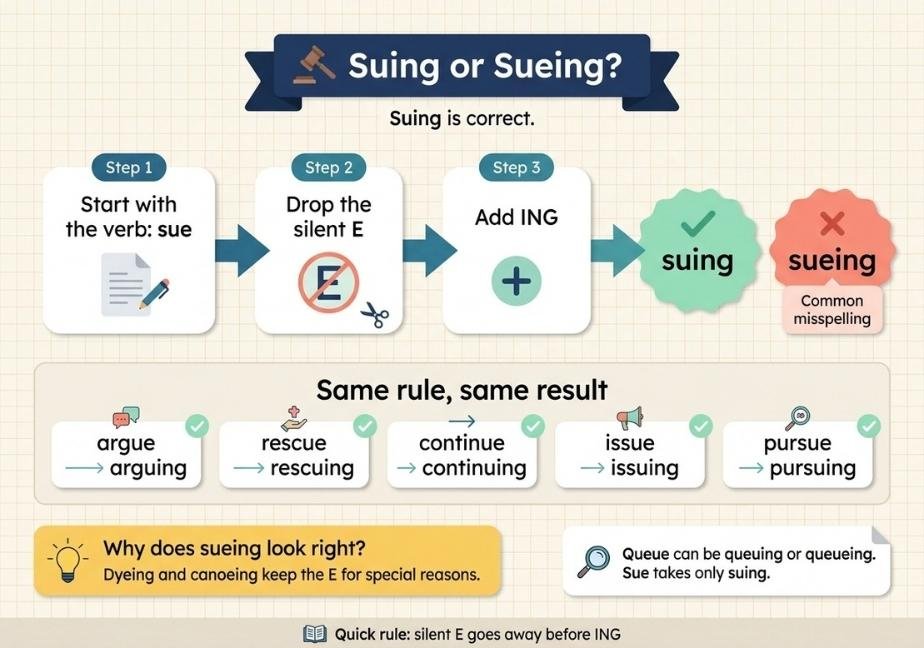
Suing is the correct spelling. Sueing is a common misspelling. The verb sue drops its silent E before adding ING, just like argue becomes arguing and rescue becomes rescuing.
Suing or Sueing: The Short Answer
Suing is the only standard spelling. Dictionaries such as Merriam-Webster list suing as the ING form of the verb sue. You will not find sueing given as a proper form.
The ING form of a verb is called the present participle. It shows an action that is happening now or keeps happening. If someone takes you to court over a debt they are suing you. If a company takes a rival to court it is suing that rival.
So the answer never changes. Use suing every time. Sueing may look reasonable but it is still a spelling error.
Why Suing Is Correct
English has a simple rule for adding ING to verbs. If a verb ends in a silent E you drop the E first. Then you add ING. The E is not needed because the ING ending carries the sound.
The Silent E Rule in Action
Here are some everyday examples of the rule:
- Make becomes making
- Write becomes writing
- Take becomes taking
- Hope becomes hoping
- Love becomes loving
The verb sue follows the same rule. Its final E is silent. The word sounds like the letter S followed by the word you. So you drop the E and add ING. That gives you suing.
Other Verbs That End in UE
Sue belongs to a group of verbs that end in UE. Most of them drop the E before ING. Look at these:
- Argue becomes arguing
- Rescue becomes rescuing
- Continue becomes continuing
- Issue becomes issuing
- Pursue becomes pursuing
- Value becomes valuing
Notice how natural these look. Nobody writes arguEing or rescuEing. The same logic applies to sue. Once you see it as part of this family the spelling feels easy.
There is one rare case worth mentioning. The word queue can be written as queuing or queueing. Dictionaries allow both. Sue is not a case like that. It only takes the short form.
Why Sueing Looks Right but Is Not
Your eyes can play tricks on you. Some English words really do keep the E before ING. That makes sueing seem believable. Those words keep the E for a reason though.
The Dyeing and Canoeing Exceptions
A few verbs hold on to their E. Here are the most common ones:
- Dye becomes dyeing
- Singe becomes singeing
- Canoe becomes canoeing
- Hoe becomes hoeing
- Shoe becomes shoeing
Dyeing keeps its E to stay apart from dying. Dying comes from the verb die and means something very different. Singeing keeps its E to avoid a clash with singing. The words that end in OE keep the E to protect their long O sound.
Sue has no such problem. No other word looks like suing or gets confused with it. So there is no need to save the E. The exceptions exist to prevent mix ups and sue does not have one.
The Role of Spell Checkers and Autocorrect
Most spell checkers flag sueing right away. Word processors underline it in red. Phones often fix it without asking. But not every tool is sharp. Some skip it when you type fast or when a document has many names and legal terms.
Do not rely on software alone. If you know the rule you can spot the error yourself. It is a useful habit for anyone who writes emails or reports for work.
Another reason people make this mistake is the short size of the word. Sue has only three letters. Adding ING makes it look thin. Some writers feel the E should stay to make the word look complete. That is a feeling and not a rule.
Where the Word Sue Comes From
The word sue has a long history. It entered English in the Middle Ages. It came through Anglo Norman and Old French forms such as suer. According to the Oxford English Dictionary those forms trace back to the Latin word sequi. Sequi means to follow.
That link makes sense when you think about it. To sue someone once meant to follow them. Later it meant to chase a claim through the courts. Legal language in England was heavily shaped by French for centuries. That is why so many court words like plaintiff and verdict have French roots.
Early English writers also used sue in a softer way. It could mean to ask or to beg. A person might sue for mercy or sue for peace. Over time the courtroom meaning became the most common one. The other meanings are still alive though. You will see them in older books and formal speech.
All the Forms of the Verb Sue
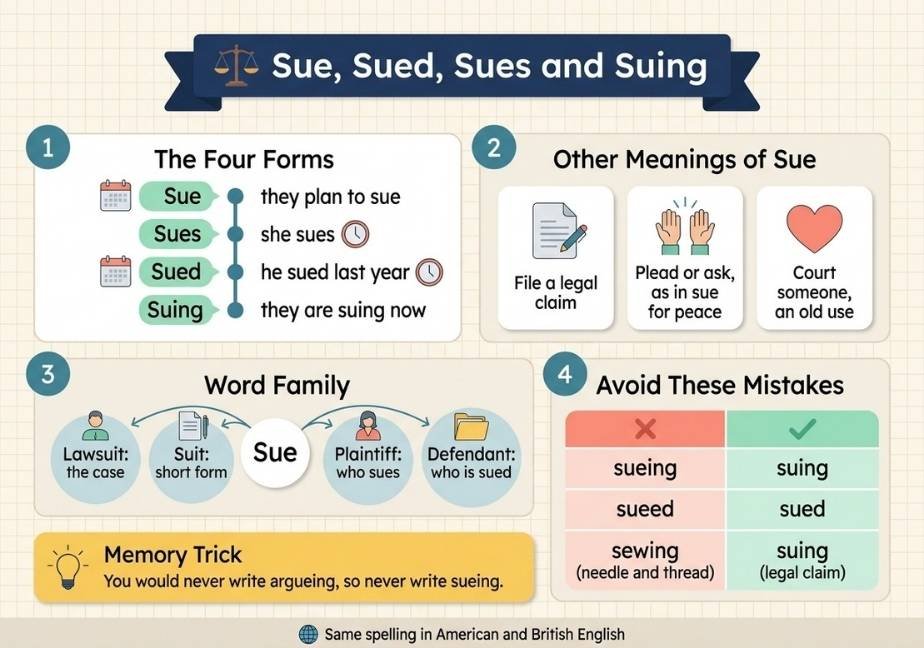
Sue is a regular verb. It has four forms and you only need to remember four short words. Here they are:
- Sue is the base form as in they plan to sue.
- Sues is used with he, she or it as in she sues.
- Sued is the past tense as in he sued last year.
- Suing is the ING form as in they are suing now.
Sued follows the standard rule for verbs ending in E. You add only D. Sues just adds S. Suing drops the E and adds ING. Every form follows a normal pattern once you know it.
How to Use Suing in a Sentence
Suing works in many kinds of sentences. It can describe a current action. It can describe a plan. It can also work as a noun. Here are some real style examples:
- She is suing her landlord over unpaid repairs.
- They are thinking about suing the airline for lost bags.
- Suing can take years and cost a lot of money.
- He talked about suing but never filed a case.
- The team is suing to protect its trademark.
Suing as a Noun
Suing can act like a noun when it names the act. In the sentence Suing is not always the best choice the word works as the subject. Grammar experts call this a gerund. It looks like a verb but acts like a thing.
Suing With Prepositions
You will often see suing paired with small words. You sue someone for something. You sue over a problem. You sue on behalf of a group. You sue to get a result. Each pairing changes the meaning a little but the spelling of suing stays the same.
Other Meanings of Sue Beyond Lawsuits
Most people think of court when they see the word. But sue has other uses. Knowing them makes you a stronger reader.
The first is to ask or plead. Someone can sue for forgiveness. A nation can sue for peace. In these cases the word means to make a formal request. You may meet this meaning in news stories about war or old novels.
The second is to seek to win over. In older English a man might sue for the hand of a woman. That means he courted her. This use is rare now and sounds very old fashioned.
The third is legal action for a right. People sue for divorce or sue for custody. They also sue for damages. In every case they are asking a court to act.
Sue is also a common first name. It is short for Susan or Susannah. When you see Sue with a capital S in a sentence it may be a person. Context tells you which meaning is in play. The ING form of the name is not used since names do not take endings that way.
Sue, Sued and Suit: Related Words to Know
A few close relatives of sue often cause confusion. Here is how they fit together.
A lawsuit is the legal case itself. The word is a noun. You file a lawsuit. You do not file a suing.
A suit is a short form of lawsuit. Lawyers and reporters use it often. A person can bring a suit or drop a suit. It also means a set of formal clothes but the meaning is clear from the sentence.
A plaintiff is the person who sues. A defendant is the person being sued. These two roles appear in almost every court story.
To settle means to end a case with an agreement before a final verdict. Many people who start suing settle in the end. It saves time and money for both sides.
Notice how the family fits together. Sue is the action. Lawsuit is the event. Plaintiff and defendant are the people. If you keep these straight your writing will sound clear and confident.
Simple Tricks to Remember the Spelling
Small memory tricks can help a lot. Try these ideas:
- Think of arguing. You would never write argueing so do not write sueing.
- Say the rule out loud: silent E goes away before ING.
- Picture the word sue losing its E like a coat before it goes out.
- Remember that dyeing keeps the E only to avoid confusion with dying.
- Type suing three times in a row so your fingers learn it.
Repetition is powerful. After a few tries the correct form will feel natural. Your hand will type it without a pause.
Common Mistakes to Avoid
Writers make a few predictable errors with this word. Watch for these:
- Writing sueing instead of suing
- Writing suing when you mean sewing
- Using sued when you need the ING form
- Using sue as a noun for a court case
- Adding the extra E to sued as in sueed
Sewing is a good one to note. Sewing is what you do with a needle and thread. It sounds a bit like suing in some accents but the meaning has nothing in common. Spelling one for the other can make a sentence funny.
Another mistake is to mix up tenses. Sued is for the past. Suing is for right now or for something ongoing. If you say she is sued yesterday you have broken the grammar. It should be she sued him yesterday.
Suing in American and British English
Some words differ between American and British English. Think of color and colour. This one does not. Both varieties use suing. Neither one accepts sueing.
That makes this spelling easy to teach. You do not need to check which country your reader lives in. Writers in the United States and the United Kingdom use it the same way. So do writers in Canada and Australia.
If you write for a global site or a school you can use suing with full confidence. It is one of the steady spellings in the language.
Frequently Asked Questions
Is it suing or sueing?
Suing is correct. Sueing is a misspelling. The verb sue drops its silent E before adding ING, following the same rule as argue and arguing.
Is sueing ever correct?
No. Standard dictionaries do not list sueing. Use suing in all formal and casual writing, including emails, essays and legal documents.
What is the past tense of sue?
The past tense is sued. It adds only a D because sue already ends in E. Example: She sued the company last year.
Why does suing not keep the E like dyeing does?
Dyeing keeps its E to avoid confusion with dying. Suing has no lookalike word, so the E drops as usual.
Is suing a real word?
Yes. Suing is the present participle of sue. It describes a legal claim in progress and works as a verb or a noun.
Conclusion
The debate over suing or sueing has a clear winner. Suing is the right spelling in every setting. The rule is simple. When a verb ends in a silent E you drop the E before ING. Sue is no different.
Sueing looks right because a few odd words like dyeing and canoeing keep their E. Those words have good reasons. Sue does not. Remember that and you will never doubt it again. Keep the four forms in mind and use the memory tricks when you feel unsure. Then write your next email or essay with confidence.