
Address or adress? You pause with your fingers on the keys. One spelling looks wrong. Maybe both do. Many people hit this wall when they fill out a form or write an email. So let’s settle it fast.
In this guide you will learn the right spelling and the full meaning. You will also see why the mistake is so common. Besides that, you will get easy tricks to remember the double d and double s. Finally, you will see how the word works in mail, tech and speech.
Address or Adress?
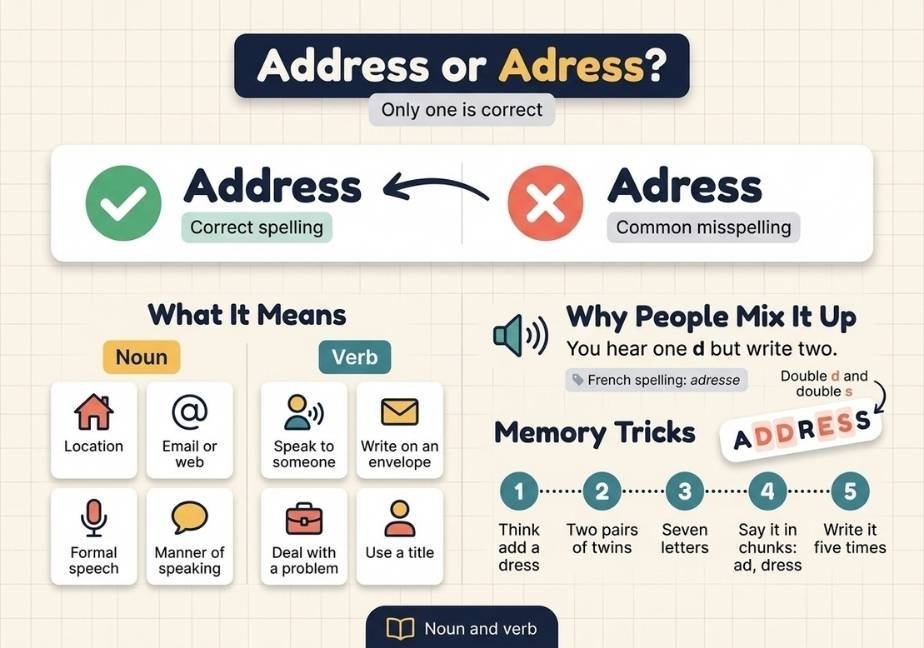
Address is the correct spelling. Adress is a common misspelling and is not a real English word. Address is a noun that means the place where someone lives or gets mail. It is also a verb that means to speak to someone or to deal with a problem.
What Does Address Mean?
Address has many meanings. However, most of them fit into a few groups. First, it names a place. Second, it names a way to reach someone online. Third, it means a formal speech. It also works as a verb. So the word does a lot of work.
Dictionaries agree on this. Merriam-Webster lists many senses for both the noun and the verb. In short, the word always points to a target. That target can be a house or an inbox. It can also be an audience or a problem.
Address as a Noun
As a noun the word names a thing. Here are the main uses:
- Location: the street and number where a person lives or works.
- Online: an email or web address that points to a spot on the internet.
- Speech: a formal talk that someone gives to a group.
- Manner: the way a person speaks or behaves.
For example, you might say, “My address is on the form.” Likewise, a leader might give an address to a crowd. In both cases the noun names something you can point to.
Address as a Verb
The word also works as a verb. In that role it shows action. Here are the main uses:
- To speak to someone or to a group directly.
- To write a name and place on an envelope.
- To deal with a problem or question.
- To use a certain title when you speak to someone.
For instance, “The manager will address the issue today.” That means she will deal with it. Similarly, “Please address the letter to Ms. Lee” means write her name and place on it.
Why Do People Type Adress?
Many people type adress. The reason is simple. English spelling does not follow clear rules. Besides that, the sound of the word hides the double letters. Say it out loud. You hear “uh-DRESS.” You do not hear two d sounds. So your brain writes one.
Other words add to the mix. Take the words dress and press. They end in the same sound. However, address starts with a prefix and keeps both letters. As a result, the word looks longer than it sounds.
Foreign languages also play a part. The French word is adresse. It has one d and two s letters. Many French speakers carry that pattern into English. Meanwhile, Spanish speakers use direccion, which looks very different. So the double d trips up learners from many places.
Autocorrect helps most of the time. Still, it can miss errors in names and short notes. The fact that you searched for address or adress is a good sign. You checked before you hit send. That is a smart habit.
Where Does the Word Address Come From?
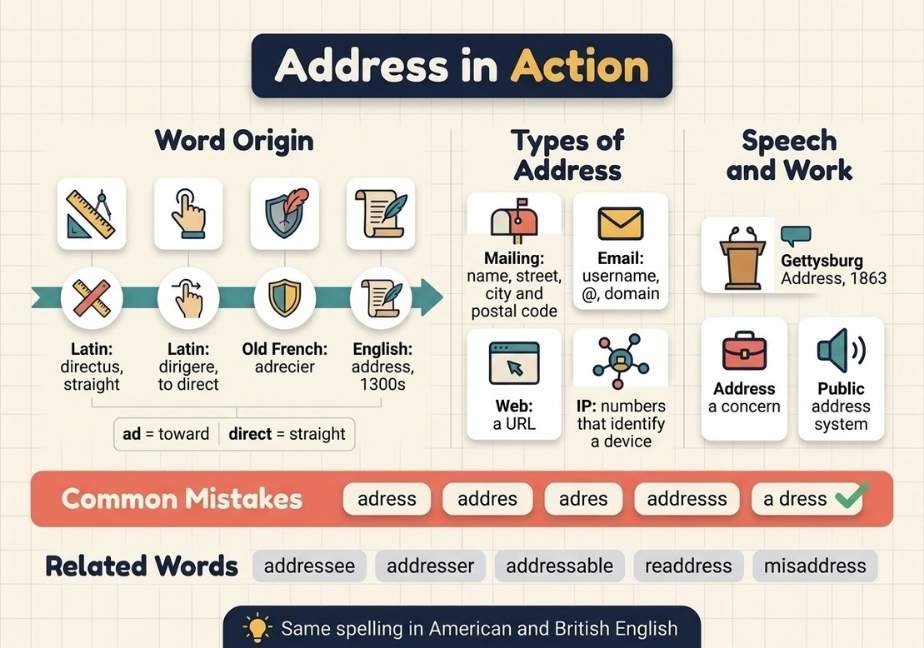
The word has deep roots. It comes from Latin. The Latin word directus means “straight.” From it came the Latin verb dirigere, which means “to direct.” Later, Old French shaped it into adrecier. That word meant “to straighten” or “to aim at.”
English then borrowed the word in the 1300s. At first it meant to direct words or actions toward someone. Over time it grew. By the 1500s people used it for speaking to a person. Later it took on the sense of a place where someone lives. The word that once meant aiming now names a target for your mail.
For a deeper look at the history, the Online Etymology Dictionary traces each step. It shows how the sense of direction stayed inside the word. That also explains the double d. The prefix ad means “toward.” The root comes from the Latin direct. So the letters join and double up.
How to Spell Address Correctly
Spell it A D D R E S S. That makes seven letters. The key is the double d and the double s. Remember both pairs and you will not slip.
Easy Memory Tricks
Tricks work better than rules. Try these:
- Think “add a dress.” The word starts with add and ends with ress.
- Picture two pairs of twins: dd in the front and ss in the back.
- Count the letters. Seven letters, with two pairs of doubles.
- Say it in chunks: ad, dress.
- Write the word five times by hand.
Pick the trick that clicks for you. Then use it each time you doubt yourself.
Related Words That Cause Trouble
Some close cousins also confuse writers. Check them here:
- Addressee: the person who gets a letter or message.
- Addresser: the person who sends it.
- Addressable: able to be reached or dealt with.
- Readdress: to write a new address or deal with something again.
- Misaddress: to write the wrong address on something.
Notice the shared base. Therefore if you can spell address you can spell all of these. Just add the new ending.
Types of Address You Use Every Day
The word shows up in many settings. Each setting adds a small twist. Let’s look at the most common ones.
Mailing and Street Address
This is the classic meaning. A mailing address tells the post office where to send your mail. It usually has a name, a street, a city, a state and a postal code. For example, an American address ends with a ZIP code. A British one ends with a postcode.
Several kinds exist. A billing address is where your card company sends the bill. A shipping address is where a package goes. A return address sits in the corner of an envelope. A forwarding address tells the post office where to send mail after you move.
Email Address
An email address has two main parts. First comes the username. Next comes the @ symbol. Last comes the domain name. For example, name@example.com has all three. Each part has a job. The username picks the person. The domain picks the mail service.
People often ask about spelling here too. Always write the full word in forms that ask for your email address. A small typo in the address can send your message to the wrong person.
Web Address and IP Address
A web address is the text you type into a browser. Experts call it a URL. It tells the browser which page to open. Think of it as a street address for a website.
An IP address works in a different way. IP stands for Internet Protocol. It is a string of numbers that identifies a device on a network. Your phone has one. So does your laptop. Together these numbers let devices find each other and share data.
Address in Speech and Business
Address also appears in speech and work. Here the word carries a formal tone.
In public life an address is a formal speech. A president may give an inaugural address. A guest may deliver a keynote address at a conference. One of the most famous examples is the Gettysburg Address. Abraham Lincoln gave it on November 19 in 1863. It is short but still taught in schools today.
At work the verb is just as common. Managers address concerns. Teams address risks. Customer service teams address complaints. The meaning is the same each time. Someone faces a problem and deals with it head on.
There is also the phrase “form of address.” That means the title you use when you speak to a person. For example, you may say Doctor, Professor or Ms. Choosing the right form shows respect. Moreover, it sets the right tone in a formal setting.
One more phrase deserves a mention. A public address system is a set of speakers that lets one person talk to a large crowd. People often shorten it to PA system. You hear it in schools, stadiums and airports.
Pronunciation and Regional Differences
Good news here. Address has the same spelling in American and British English. No regional version exists. Only the wrong version changes from person to person. So you can relax about this one.
Pronunciation does vary. The verb is said “uh-DRESS” everywhere. The noun is where speakers split. Many Americans say “AD-dress” for a home location. Many speakers in Britain say “uh-DRESS” for the noun too. Both ways are fine. Neither one changes the spelling.
Common Mistakes With Address
Writers repeat the same few errors. Spot them below:
- Writing adress with one d and two s letters.
- Writing addres with only one s at the end.
- Writing adres with one d and one s.
- Writing addresss with three s letters.
- Mixing up address and a dress as two words.
Here is how that looks in real sentences. Wrong: “Please send it to my adress.” Right: “Please send it to my address.” Wrong: “We must adress this problem.” Right: “We must address this problem.”
Pay attention to the last mistake in the list. A dress is a piece of clothing. Address is the word for a location. Spell checkers will not flag “a dress” because both words are real. So read your sentence out loud before you hit send.
Tips to Spell Address With Confidence
Tools help. A spell checker flags adress right away. However, it may miss other errors that look like real words. So read your text out loud. Moreover, keep a short list of your tricky words. Review it often. Over time the right spelling becomes automatic.
Spelling also affects trust. A small typo can make a reader doubt you. This is true on resumes and in emails. It is also true in business letters and school papers. In a mailing address the stakes get higher. A wrong letter can send your package to the wrong place. So a few seconds of checking pays off.
Finally, trust the pattern. Two d letters sit at the start. Two s letters sit at the end. Hold that picture in your mind and the word will stop feeling strange.
Frequently Asked Questions
Is it address or adress?
Address is correct. Adress is a common misspelling and does not appear in standard dictionaries.
What does address mean?
Address means the place where someone lives or gets mail. It also means a formal speech or to deal with a problem.
How do you spell address?
Spell it A D D R E S S. It has two d letters and two s letters.
Is address a noun or a verb?
It is both. As a noun it names a place or a speech. As a verb it means to speak to or deal with.
Why is address spelled with two d letters?
The prefix ad means toward. It joins with the root from Latin directus, so the d doubles. The double letters come from the word’s history.
Final Thoughts on Address or Adress
Let’s wrap it up. Address is the only correct spelling. Adress is a mistake that comes from the sound of the word. The meaning is rich. It names a place and an online spot. It also names a speech and an action.
Remember the key points. The word has two d letters and two s letters. It works as both a noun and a verb. It comes from Latin through Old French. Now you can spell it with ease and use it in any setting. Next time you write it, trust the double d and double s and move on.

![A dynamic sports photo shows a male volleyball player in mid-air, spiking a ball over a net in an indoor arena[cite: 13]. Behind him, a massive image of an elephant is dramatically rendered in explosive golden dust and bright light[cite: 13]. Golden script text at the bottom reads "Flying Elephant Memoirs[cite: 13]."](https://tastimer.com/wp-content/uploads/2026/10/flying-elephant-memoirs-768x539.jpg)