

Gitty or giddy? You may have typed one of them in a hurry and wondered which was right. Here is the quick answer. Giddy is the standard word for feeling dizzy or thrilled. Gitty is usually a typo. It is also a rare regional word with a very different meaning. So the two are not twins.
In this guide you will learn what each word means and where each one comes from. First you will see clear dictionary facts. Next you will get easy examples for texts and emails. Finally you will pick up simple tricks that keep the spelling straight.
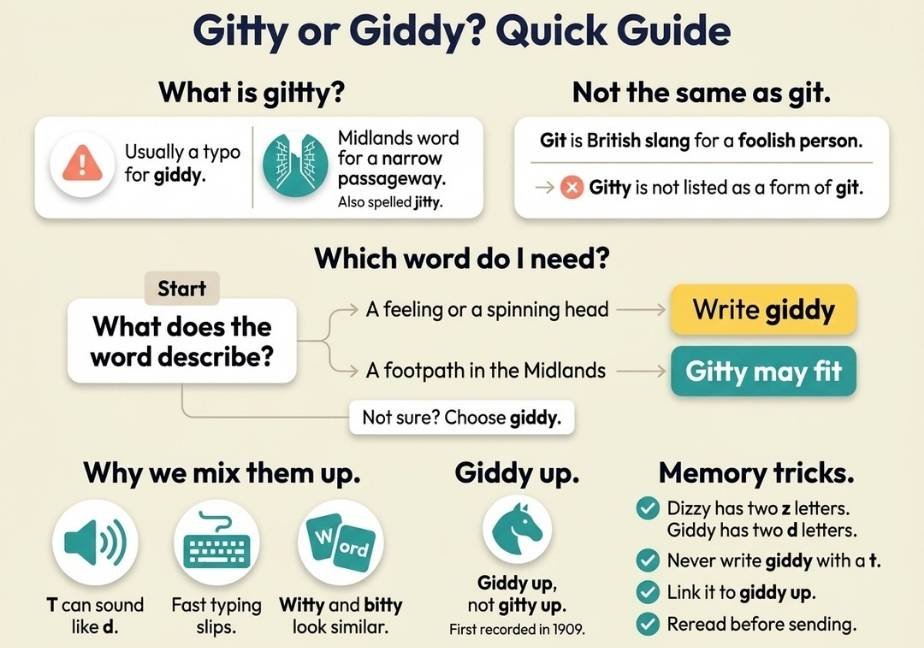
Giddy is the correct spelling. It means dizzy or lightheaded. It also means joyfully excited or lightheartedly silly. Gitty is usually a typo for giddy. It is also a rare regional word, such as a Midlands term for a narrow passageway between walls or fences. Write giddy for any feeling of dizziness or joy.
Gitty or Giddy: Which Spelling Is Correct?
Giddy is the correct spelling for the feeling of being dizzy or very happy. Gitty is usually a typo for giddy. It also exists as a rare regional word. Choose giddy for emotions and dizziness. Choose gitty only when you mean one of its local senses.
| Word | Meaning | Use it for |
|---|---|---|
| Giddy | Dizzy or joyfully excited or silly | Feelings and spinning heads |
| Gitty | Typo for giddy or a rare regional noun | Midlands footpaths only |
According to Merriam-Webster, giddy is an adjective. It can mean dizzy or lightheartedly silly or joyfully elated. The same dictionary says the first known use of giddy dates to the 14th century. So giddy has a long and solid record in English. Meanwhile, that entry does not list gitty as a spelling of giddy.
So when you see gitty in a message about feelings, treat it as a likely typo. The writer almost always meant giddy.

What Does Giddy Mean?
Giddy has three main senses. It can mean dizzy. It can mean joyfully excited. It can also mean lightheartedly silly. Context tells you which one the writer has in mind.
Giddy as Dizzy
The first sense is physical. A giddy person feels whirled about or unsteady. For example, “I felt giddy after I stood up too fast.” Giddy can also describe a place that causes dizziness, such as a giddy height. Likewise, it can describe something that whirls rapidly.
Giddy as Joyfully Excited
The second sense is emotional. Here giddy means so happy that you feel a little dizzy with joy. For instance, “He was giddy with joy after the good news.” Fans can be giddy after a big win. A child can be giddy on the last day of school. In each case the feeling is bright and bubbly.
Giddy as Silly or Frivolous
The third sense is playful. Giddy can describe silly and lighthearted behavior. For example, “The room filled with giddy laughter.” According to Vocabulary.com, people have used giddy for someone easily excited or unable to think seriously since the 16th century. The same page says the Old English source gidig meant insane or god possessed. So the word has traveled far from its darker roots.
Giddy has close cousins too. Dizzy and lightheaded fit the physical sense. Elated and thrilled fit the emotional sense. Silly fits the playful sense. Giddy covers all three. That is why it feels so flexible.
What Does Gitty Mean?
Gitty is not a spelling of giddy in the dictionaries checked. In most texts it is a typo for giddy. As a real word it has two small regional uses. In the English Midlands it names a narrow passageway between walls or fences. In Scots it was a nonsense word used to an infant.
Gitty as a Typo
Most people who type gitty want giddy. The two words sound almost the same in everyday speech. So the wrong letters slip in. Fast typing adds to the problem. A quick reread fixes it.
Gitty as a Midlands Word
Wiktionary lists gitty as a Midlands noun. It means a narrow pedestrian passageway in a residential area. Such a path often runs between high brick walls or wooden fences or hedges. Some writers spell the same word jitty.
Here is an example. “We cut through the gitty behind the shops.” This use is local. Many readers outside that area may not know it. So if you use it, add a short hint for your reader.
Gitty in Scots
The Scottish National Dictionary lists gitty as a nonsense word used to an infant. Its sample comes from a book printed in 1847. So this sense is old and rare. You are unlikely to meet it in a modern text.
Gitty vs Git
Another source of confusion is the word git. Dictionary.com lists git as British slang for a foolish or contemptible person. It says the word was first recorded between 1945 and 1950 as a variant of get. So you might wonder if gitty is an insult built from git. The entries checked for this guide do not list it that way. Therefore, do not read an insult into gitty.
Tech readers may also know Git, the version control tool. That name has nothing to do with feeling giddy.
Why Do People Mix Up Gitty and Giddy?
The mix up has simple causes. Let us look at each one.
First, sound plays a big role. In American English a t between two vowels often sounds like a quick d. Say city and giddy out loud. The middle sounds come close. So a writer who hears giddy may reach for a t.
Next, English spelling gives few clues. Words like pretty and little use tt. Words like giddy and middle use dd. The ear cannot tell them apart. Only memory can.
Also, gitty looks natural next to words like witty and bitty. Those words end in ty. So the brain says gitty feels right. However, giddy follows a different pattern.
Finally, phones add typos. Small keys sit close together. Autocorrect does not always catch the slip. So a gitty can slide into a text.
How to Spell Giddy and Its Forms
Giddy has two d letters in the middle. That is the whole secret. Now let us look at the family of forms.
| Word | Type | Example |
|---|---|---|
| Giddy | Adjective | She felt giddy. |
| Giddier | Comparative | He felt giddier than before. |
| Giddiest | Superlative | It was her giddiest day. |
| Giddily | Adverb | They laughed giddily. |
| Giddiness | Noun | Giddiness hit him on the ride. |
Merriam-Webster also lists giddy as a verb. It means to become giddy. The forms are giddied and giddying. You will see them rarely. Still, none of them uses a t.
How to Use Giddy in a Sentence
Examples make meaning clear. So here are models you can copy.
- The news made her giddy with delight.
- He felt giddy after the roller coaster ride.
- The kids burst into giddy laughter.
- I stood up too fast and felt giddy.
Notice the small words after giddy. People often say giddy with joy or giddy with excitement. They also say giddy from spinning. With tells you the feeling. From tells you the cause of the dizziness.
Giddy Up or Gitty Up?
Giddy up is the usual spelling of the call that tells a horse to go faster. Gitty up is a nonstandard spelling of the same sound. Neither form has anything to do with the feeling of being giddy.
According to Etymonline, giddy up was recorded in 1909. It is probably an extended form of giddap from 1867. That form likely comes from get up. Dictionary.com lists giddyap and giddap as American forms. Wiktionary lists giddyup as one word. So you will see giddy up and giddyup in print. Neither one uses a t.
Giddy in Texts and Social Posts
Giddy is a warm word. When someone says they feel giddy, they usually mean happy and excited. It often follows good news or a fun plan. For example, “I’m so giddy about the trip.” It can also mean a little dizzy after a ride.
Does the meaning change when a guy or girl says it? No. Nothing in the dictionary entries ties giddy to one gender or to a hidden code. So read it at face value.
What if a text says gitty? Most likely the sender meant giddy. They hit the wrong key or trusted the sound. Here are natural ways to use the right word in a message.
- I am giddy about Friday. Cannot wait.
- We were giddy after the surprise party.
- That ride made me giddy. I need to sit down.
- Your good news made my whole day giddy.
Notice the tone. Each line sounds light and short. In work emails you can use giddy sparingly. It fits friendly notes best. For formal reports pick a plainer word such as excited or pleased.
Easy Tricks to Remember the Spelling
Good memory tricks save time. So try these.
- Dizzy has two z letters. Giddy has two d letters.
- Never write giddy with a t.
- Link giddy to giddy up. Both use dd.
- Say it slowly as gid dee. You will hear the d.
- Reread every draft once before you hit send.
Common Mistakes and Quick Fixes
- Gitty for a happy feeling: change it to giddy.
- Gitty up for the horse call: change it to giddy up.
- Giddyness: use giddiness, since the y becomes i.
Check the meaning before you fix the spelling. If the word describes a feeling or a spinning head, use giddy. If it names a footpath in the Midlands, gitty can be right.
FAQs About Gitty or Giddy
Is it gitty or giddy?
Giddy is correct for feeling dizzy or excited. Gitty is usually a typo. It is also a rare regional word.
What does giddy mean?
Giddy means dizzy or lightheaded. It also means joyfully excited or lightheartedly silly. Context shows which sense the writer intends.
Is gitty a word?
Yes but only as a rare regional word. It names a narrow Midlands passageway. In most texts it is just a typo for giddy.
Is it giddy up or gitty up?
Giddy up is the usual spelling of the call to a horse. Gitty up is a nonstandard spelling.
What does giddy mean from a guy or girl?
It means the same thing from anyone. It describes feeling dizzy or very happy and excited.
Conclusion: Write Giddy for Feelings and Spinning Heads
The takeaway is simple. Giddy is the word for dizziness and joy. Gitty is mostly a typo and sometimes a small regional noun. Giddy has a long record in English that goes back to the 14th century. Gitty has a narrow and local life.
Here is a rule you can use today. The next time the gitty or giddy question comes up, ask what the word describes. If it describes a feeling or a spinning head, write giddy. If it names a footpath in the Midlands, gitty may fit. When in doubt, pick giddy and keep the double d.