
Ever stopped mid sentence and asked yourself if it is writing or writting? You are not alone. The word looks easy. Yet the double t trips up thousands of people every day. One small letter can make a big mess.
Here is the good news. Only one spelling is right. In this guide you will learn which one it is and why. You will also see the spelling rule behind it. Next you will get clear examples and easy memory tricks. Finally you will learn how to stop making this mistake for good.
Writing or Writting?
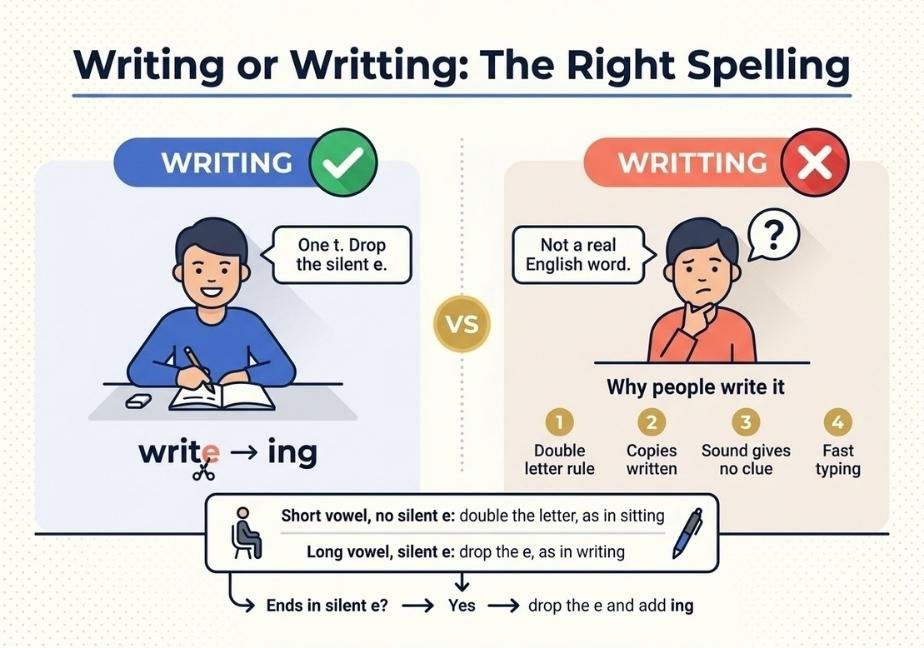
Writing is correct. It is the present participle and gerund of the verb write. It has one t. Writting is not a real English word. It is a common misspelling caused by the double letter rule.
What Does Writing Mean?
Writing has a few close meanings. Each one ties back to the verb write.
First, writing is the act of putting words on a page or screen. For example, “Writing takes practice.” Second, writing is the text itself. For example, “I can’t read your writing.” Third, writing is a job or craft. For example, “She works in writing and editing.”
Merriam-Webster lists writing as a noun and as the present participle of write in its main entry. So the word can work as a noun or as part of a verb phrase. That range makes it very common.
Here are the main uses at a glance:
- Noun: the act of writing, as in “Writing is fun.”
- Noun: handwriting or text, as in “Her writing is neat.”
- Adjective: used for tools, as in “a writing desk.”
- Verb form: “I am writing a letter.”
Is Writting a Real Word?
No. Writting does not appear in any major dictionary. A spell checker will flag it. An editor will fix it. It is simply a wrong spelling.
Some people think writting might be a rare variant. It is not. It has no history and no meaning. It has no place in school work or business emails. If you see it in print, it is a typo.
Why People Write Writting
Most people do not choose writting on purpose. A few simple things cause it.
First, English has a well known doubling rule. Words like running, sitting and getting all double the last letter. So the brain expects the same here. It adds a second t to write and gets writting. That feels logical. It is just not correct.
Second, the word written has a double t. That form sits very close to writing in daily use. As a result the two blur together. Many people copy the double t from written into writing by mistake.
Third, the sound is no help. Writing sounds like “RY ting.” The “y” sound comes from the long i. Speakers do not hear a doubled letter. So the ear gives no clue about the spelling.
Finally, fast typing plays a part. A finger can hit the t twice. Autocorrect does not always catch it. Then the error slips through.
The Rule Behind One T in Writing
Now for the part that solves the whole puzzle. The spelling rule is short and easy. It comes down to the vowel sound.
Start with the base word write. It ends in a silent e. Under a standard English rule you drop that silent e before adding ing. So write becomes writ and then writ plus ing gives writing.
Other verbs follow the same path. Here are some examples:
- Make becomes making.
- Take becomes taking.
- Bake becomes baking.
- Hope becomes hoping.
- Write becomes writing.
Notice that none of these double the last letter. The silent e is the clue. The vowel before the last consonant is long. So the consonant stays single.
Compare that with words like sit. Sit has a short vowel and no silent e. So it doubles the t and becomes sitting. Likewise run becomes running. The short vowel is what triggers the double letter.
Here is the simple contrast:
- Short vowel, no silent e: double the letter, as in sitting.
- Long vowel, silent e: drop the e, as in writing.
Write has a long i and a silent e. Therefore it follows the second pattern. One t is all it needs.
Writing vs Written vs Writer
Many mix ups come from a small word family. Each member has its own job. Keep them apart and the spelling gets easier.
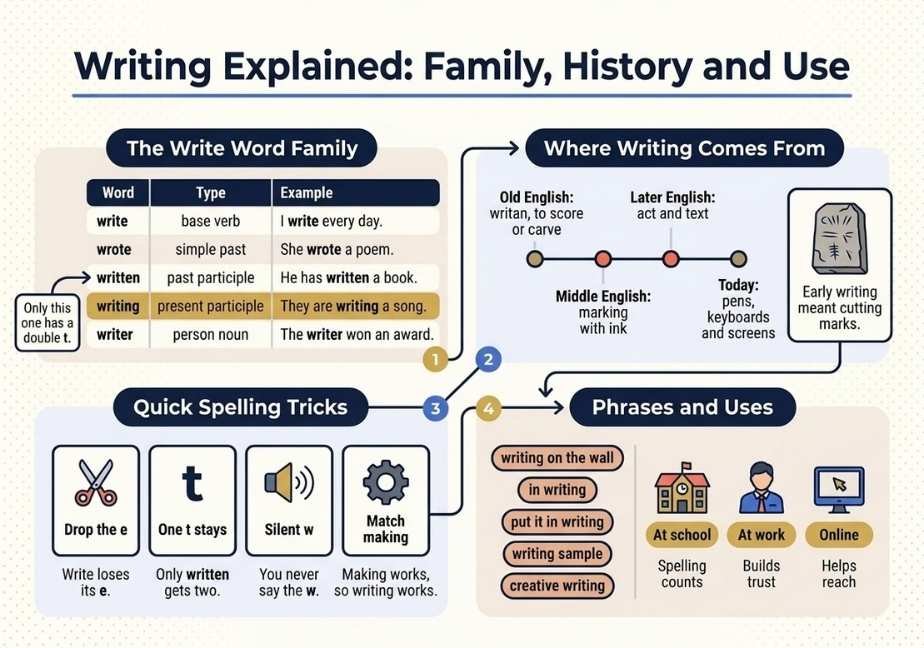
| Word | Type | Example |
|---|---|---|
| Write | Base verb | I write every day. |
| Wrote | Simple past | She wrote a poem. |
| Written | Past participle | He has written a book. |
| Writing | Present participle | They are writing a song. |
| Writer | Person noun | The writer won an award. |
Only written has a double t. Every other form has one. That is why writting looks so tempting. The double t belongs to just one member of the family.
Here is a quick check you can use. Ask if a helper word like has or had comes before it. If yes, you probably need written. If a helper like is or are comes before it, you need writing.
Where Does the Word Writing Come From?
Language history helps the spelling stick. The verb write is very old. According to Etymonline, write goes back to Old English writan. In early English that word meant to score or to carve. People once cut marks into wood or stone to record ideas.
Over time the meaning moved from carving to marking with ink. Later it came to mean forming letters on any surface. The word shares roots with related words in German and Dutch. That family link shows how old the idea is.
Here is a quick timeline:
- Old English: writan means to score or carve.
- Middle English: write shifts toward marking with ink.
- Later English: writing names both the act and the text.
- Today: writing covers pens, keyboards and screens.
The double t in written also has roots. It came from the old participle form. So the doubled letter is a leftover from history. It never spread to writing.
How to Use Writing in Sentences
Writing is flexible. It can act as a noun or as part of a verb. Here are clear examples of both.
Writing as a Noun
As a noun, writing names the act or the result.
- Writing helps you think clearly.
- Her writing is warm and funny.
- The writing on the wall was hard to read.
- Good writing takes patience.
Writing as a Verb Form
As a verb form, writing follows a form of be. It shows an action in progress.
- I am writing an email to my boss.
- She was writing when the power went out.
- They will be writing tests all week.
Notice the pattern. A helper like am, was or will be comes first. Then writing follows. This creates the continuous tenses.
Writing as an Adjective
Sometimes writing describes another noun. It often names a tool or a place.
- She bought a new writing desk.
- He joined a writing group.
- I need a writing pad.
In these cases writing sits before the noun. It paints a quick picture.
Common Phrases and Idioms With Writing
English uses writing in many colorful sayings. Learn a few and your speech gets richer.
- Writing on the wall: a clear sign of coming trouble.
- In writing: recorded on paper or online.
- Put it in writing: make a promise official.
- Writing sample: a short piece that shows your skill.
- Creative writing: fiction, poems and personal stories.
Each phrase keeps the same spelling. You will never see “writting on the wall” in print. If you do, it is a typo.
Common Spelling Mistakes and Fixes
Most errors fall into a few groups. Once you spot them you can fix them fast.
Mistake one: writing it with a double t. Wrong: “I love writting stories.” Right: “I love writing stories.”
Mistake two: dropping the r. People type “wiiting” or “witing.” Both are wrong. Keep the w and the r.
Mistake three: using written alone. Wrong: “I am written a note.” Right: “I am writing a note.”
Mistake four: adding an extra e. Some write “writeing.” That form does not exist. Drop the e before ing.
Here is a simple test. Say “I am” before the word. If the sentence works, use writing. Then check that the word has one t and no e.
Easy Tricks to Spell Writing
Spelling sticks better with a hook. Try one of these.
- Drop the e: write loses its e and adds ing.
- One t stays: only written gets two.
- Wr stays silent: the w is there but you never say it.
- Match making: if making works, so does writing.
The last trick works best. You would never spell making as makking. So you should not spell writing as writting. The same rule covers both words.
Here is one more tip. Picture a pen with a long i in its name. Long vowels do not need double letters. That small image can save you in a rush.
Why Good Writing Matters
Spelling is one small part of a bigger skill. Writing well can shape how people see you. That is why one typo can feel so costly.
At School
Teachers often grade spelling and grammar. A repeated mistake like writting can lower a score. However a quick check fixes it. Students who learn the rule early avoid the trouble.
At Work
Emails, reports and proposals all show your care. Clean writing builds trust with clients and coworkers. In contrast careless errors can weaken a strong message. Therefore proofread before you hit send.
Online
Blogs, posts and product pages all rely on clear text. Search engines also favor well written pages. So correct spelling can help your reach as well.
Frequently Asked Questions
Is it writing or writting?
Writing is correct. It has one t. Writting is not a real English word. It is a common misspelling of writing.
Why does writing have only one t?
Write ends in a silent e. You drop that e before adding ing. The long vowel means the last consonant does not double.
What is the difference between writing and written?
Writing is the present participle and a noun. Written is the past participle and follows has, have or had.
Is writting ever correct in British English?
No. Both British and American English use writing. Writting is wrong in every major English dialect.
How do you spell the word writing correctly?
Spell it w r i t i n g. Drop the silent e from write. Add ing. Keep only one t.
Conclusion
The answer to writing or writting is now clear. Writing is the only correct spelling. Writting is a typo that comes from the double letter rule and the word written. Remember the drop the e rule and you will get it right every time.
Keep the bigger picture in mind too. Good spelling supports good writing. Use the making trick when you feel unsure. Use the helper word check to pick between writing and written. With a little practice the right form will flow without a pause.





2 Comments