
![A photograph in a brightly lit coffee shop showing an attractive South Asian couple seated at a wooden table[cite: 3]. They are looking at each other with warm smiles and holding white ceramic cups[cite: 3]. Background bokeh includes potted plants and hanging lights[cite: 3]. A large, gold embossed calligraphic title "Rapport" is centered across the upper middle[cite: 3]. Directly below the title, smaller metallic gold text reads: "Builds lasting, high-trust client relationships[cite: 3]."](https://tastimer.com/wp-content/uploads/2026/09/rapport-or-repore.jpg)
Have you ever typed rapport or repore into a search bar and hoped for the best? You are not alone. This word looks simple. Yet it hides a double p and a silent letter. The spelling does not match the sound. So many people guess and get it wrong.
Here is the good news. Only one spelling is real. In this guide you will learn which one it is and why. You will also see what the word means and how to say it. Next you will get clear examples and easy tricks. Finally you will learn how to stop mixing it up with report.
Rapport or Repore?
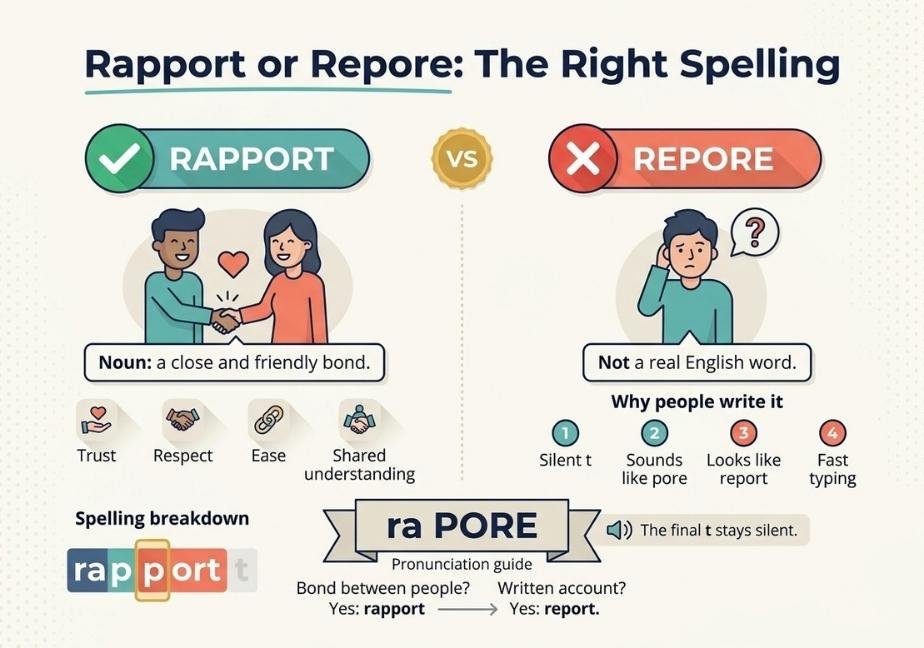
Rapport is correct. It is a noun that means a close and friendly bond where people understand each other. Repore is not a real English word. It is a common misspelling of rapport. Sometimes it is also a slip for report.
What Does Rapport Mean?
Rapport means a warm and easy connection between people. When you have rapport with someone you trust each other. You feel at ease. You get each other quickly.
Merriam-Webster describes rapport as a friendly relationship built on harmony and understanding. That short idea covers a lot. Rapport is more than liking someone. It is the feeling that you are on the same page.
Here are the key parts of rapport:
- Trust: you believe the other person means well.
- Respect: you value what they think and say.
- Ease: talking feels natural and low pressure.
- Shared understanding: you follow each other without effort.
You can often feel rapport within seconds. Think about a first meeting where you click. Time flies. Talk flows. That is rapport at work. Likewise you can feel when it is missing. The chat feels stiff. Every reply takes effort.
Is Repore a Real Word?
No. Repore does not appear in any major English dictionary. A spell checker will flag it. An editor will fix it. It is simply a wrong spelling.
Some people wonder if repore is a rare variant. It is not. It has no history and no meaning. It also has no place in formal writing. If you see it in an email or post, it is a typo.
Why People Write Repore
Most people do not choose repore on purpose. A few simple things cause it.
First, the sound misleads. Rapport ends with a silent t. The last sound is like the word pore. So the ear says “pore” and the hand writes it that way. Then the spelling drifts toward repore.
Second, the word looks and sounds like report. Both start with r and both end in a similar sound. As a result the brain blends them. Many people also learn the word by ear in a meeting or class. They never see it in print.
Third, English borrows words from French and often keeps the French spelling. Because of that, rapport does not follow normal English patterns. The double p and the silent t surprise learners.
Finally, fast typing plays a part. Autocorrect can turn a near miss into the wrong word. Then the error slips through unnoticed.
How to Pronounce Rapport
Say rapport as “ra PORE.” The final t stays silent. The stress falls on the second part.
The first part can vary. Some people say it like “rap.” Others say it more like “ruh.” Both are fine. What matters is the silent t.
Notice something here. The ending sounds just like the word pore. That is the root of the repore mix up. Your ear hears “pore” and your brain wants to spell it that way. So slow down and picture the full word when you write it.
Where Does the Word Rapport Come From?
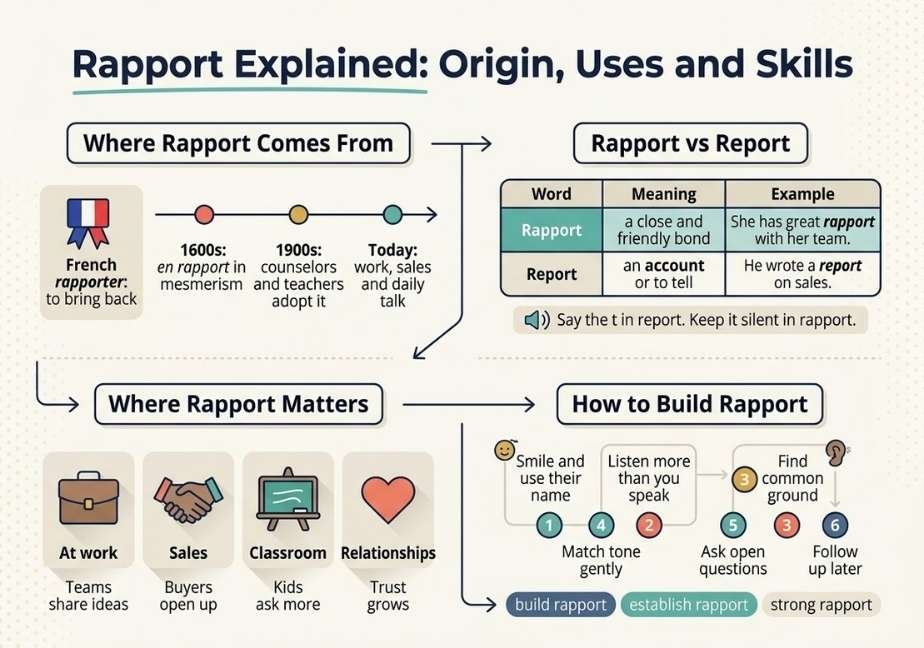
Language history helps the spelling stick. According to Etymonline, rapport entered English from French in the 1600s. In French the word meant a bringing back or a return. It came from the verb rapporter. That verb means to bring back or to report.
Over time the meaning grew. First, rapport meant a relation or link between things. Later it came to describe a link between people. By the 1800s the phrase “en rapport” was common in early hypnosis and mesmerism. It described the bond between a practitioner and a subject. Then in the 1900s counselors and teachers adopted the word. Today it names the trust between two people in almost any setting.
Here is a quick timeline:
- 1600s: rapport enters English from French with a sense of relation.
- 1800s: the phrase en rapport spreads in mesmerism circles.
- 1900s: counselors and teachers use rapport for trust in a relationship.
- Today: rapport is common in business, sales and daily talk.
Here is a fun twist. Rapport and report are distant cousins. Both trace back to the Latin root for carrying. That shared root explains why both words hold the letters “port.” Still, they grew into very different words.
Rapport vs Report: Do Not Mix Them Up
Many searches for repore come from this mix up. Rapport and report look alike. However they have different meanings and jobs.
| Word | Part of speech | Meaning | Example |
|---|---|---|---|
| Rapport | Noun | A close and friendly bond | She has great rapport with her team. |
| Report | Noun and verb | An account or the act of telling | He wrote a report on sales. |
Sound gives you another clue. In report you say the final t. In rapport you do not. So if you can hear the t, you probably mean report.
Meaning gives the best clue of all. Ask yourself one question. Am I talking about a bond between people or a written account? If it is a bond, write rapport. If it is an account, write report.
Here are two wrong sentences and their fixes:
- Wrong: “We need a good report with our clients.” Right: “We need good rapport with our clients.”
- Wrong: “I finished the rapport for my boss.” Right: “I finished the report for my boss.”
How to Use Rapport in Sentences
Rapport is a noun. Most writers use it without “a” or “an.” For example, you say “good rapport” and not “a good rapports.” That said, “a good rapport” also appears and is correct.
Here are clear examples:
- She built strong rapport with her students in the first week.
- The two coaches share an easy rapport.
- Good rapport helps a team solve problems faster.
- I felt instant rapport with my new manager.
- It took months to rebuild rapport after the argument.
Notice the pattern. Rapport often follows a describing word like good or strong. It also follows a verb like build or share. Those pairings sound natural to native speakers.
Common Phrases With Rapport
English uses a few set phrases again and again. Learn these and you will sound confident.
- Build rapport: create a bond over time.
- Establish rapport: start the connection early.
- Good rapport or strong rapport: a solid and trusting bond.
- In rapport with: closely connected to someone.
- En rapport: a French flavored way to say in harmony.
You may also hear “rapport building” in job ads and training. It simply means the skill of forming trust with others.
Why Rapport Matters in Everyday Life
Rapport shows up almost everywhere. The setting changes but the core idea stays the same.
At Work
Rapport makes teams stronger. When coworkers trust each other they share ideas freely. They also admit mistakes sooner. As a result problems get fixed faster. Managers who earn rapport often see better teamwork too.
In Sales and Customer Service
Buyers rarely trust a stranger who rushes. However they open up to someone who listens. Therefore sales trainers teach rapport first and pitching second. A friendly start makes the whole talk easier.
In Classrooms
Students learn more when they feel safe. A teacher with good rapport can guide a class with less stress. Kids also ask more questions. In turn the whole room learns more.
In Close Relationships and Therapy
In counseling, rapport is the base of the work. Clients open up only when they feel safe. Without trust progress stalls. Similarly friends and partners rely on rapport to work through tough moments.
How to Build Rapport
Good news: rapport is a skill. You can grow it with small habits. Try these steps:
- Smile and use the person’s name early.
- Listen more than you speak.
- Find common ground such as shared interests.
- Match their tone and pace in a gentle way.
- Ask open questions that show real curiosity.
- Follow up on what they told you last time.
Let us look at two of these more closely. First, listening. People can tell when you wait for your turn to talk. Instead, nod and reflect back what you heard. That small act shows care.
Second, matching. Psychologists call gentle matching of body language mirroring. It can help people feel understood. However keep it subtle. If it looks fake people notice fast. Also avoid forced flattery. Real interest beats empty praise every time.
Above all, be patient. Rapport rarely appears in one chat. It grows through steady and honest contact.
Easy Tricks to Spell Rapport
Spelling sticks better with a hook. Try one of these.
- Split it: rap plus port.
- Double p sits in the middle.
- Silent t ends the word.
- Two p letters mean two people connecting.
The split trick works best. Picture two friends who rap at a busy port. They get along great. That silly image holds all the letters. Now repore looks strange because it has no double p and no t.
Here is one more tip. Say the word slowly as “rap port” in your head while you type. Then say it fast when you speak. Your ear and your hand will learn two separate jobs.
Common Spelling Mistakes and Fixes
Most errors fall into a few groups. Once you spot them you can fix them fast.
Mistake one: writing repore. Wrong: “We have great repore.” Right: “We have great rapport.”
Mistake two: dropping one p. People write “raport” or “rapor.” Both are wrong. Use two p letters and end with rt.
Mistake three: adding extra letters. Some write “rappor” or “rapporte.” Neither exists in English. Stick with rapport.
Mistake four: swapping in report. This changes the meaning. Use report only for an account or to tell something.
Here is a quick check. Ask if you mean a bond or a document. Bond means rapport. Document means report. Then check for two p letters and a final t.
Frequently Asked Questions
Is it rapport or repore?
Rapport is correct. Repore is not a real English word. It is a common misspelling caused by the silent t and the sound of the word pore.
What does rapport mean?
Rapport means a close and friendly bond between people. It includes trust and easy understanding. You can feel it when talk flows without effort.
How do you pronounce rapport?
Say “ra PORE” with the stress on the second part. The final t stays silent. The first part can sound like “rap” or “ruh.”
What is the difference between rapport and report?
Rapport is a bond between people. A report is a written or spoken account. Also, you say the t in report but not in rapport.
How do you build rapport with someone?
Listen closely and use their name. Find common ground and ask open questions. Match their tone gently and follow up later. Be patient and stay honest.
Conclusion
The answer to rapport or repore is now clear. Rapport is the only correct spelling. Repore is a typo that comes from the silent t and the sound of the word pore. Remember the double p and the final t. Then you will spell it right every time.
Keep the bigger picture in mind too. Rapport is not just a word. It is a skill that shapes work and school and friendship. Use the split trick to spell it. Use the listening habit to earn it. Once you do both you will write it well and live it well.






2 Comments