

Absence or absense? You start to type the word and then you pause. Something looks off. The word seems fine, yet you doubt it. That moment happens to many writers. So let’s clear it up fast.
In this guide you will learn the right spelling and the real meaning. You will also see why so many people mix it up. Besides that, you will get simple tricks to remember it. Finally, you will see how the word works in school, at work, in texts and even in medicine.
Absence or Absense?
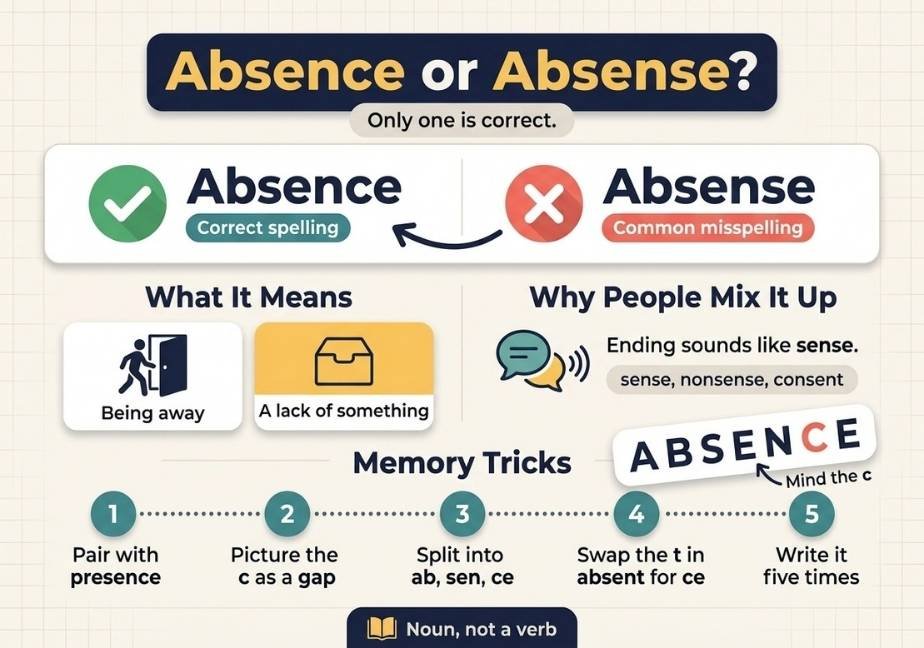
Absence is the correct spelling. Absense is a common misspelling and is not a real English word. Absence means the state of being away from a place or person. It also means a lack of something, like the absence of noise.
What Does Absence Mean?
Absence has two main meanings. First, it means the state of being away. Second, it means a lack of something. Both meanings show up daily. For example, a teacher marks a student’s absence from class. Likewise, a doctor may note the absence of a fever.
Dictionaries agree on this. According to Merriam-Webster, the word covers a state of being away and a period of being away. It also covers a lack. In short, the idea is simple. Someone or something is not there.
Absence as a Noun
Absence is a noun. It names a state or a gap. However, you cannot use it as a verb. You cannot absence a class. Instead, you can be absent from it. Here are some quick examples:
- Her absence from the meeting surprised everyone.
- The absence of rain hurt the crops.
- He returned after a long absence.
- Absence makes the heart grow fonder.
Common Phrases With Absence
Many set phrases use this word. Learning them helps you spot the right spelling. Also, they make your writing sound natural.
- In the absence of: when something is missing.
- Absence of mind: a lapse in attention.
- Leave of absence: approved time away from work or school.
- Conspicuous by its absence: missing in a way people notice.
- Absence without leave: time away with no permission.
These phrases show how flexible the word is. Moreover, you see the correct spelling each time you read them. That repeat exposure builds memory.
Why Do People Type Absense?
Many people type absense. The reason is simple. English spelling is tricky. Besides that, the sound of the word misleads you. Say it out loud. The ending sounds like “sense.” So your brain wants an s there.
Other words add to the mix. Think of sense, nonsense and consent. They all have an s sound near the end. However, absence belongs to a different family. It ends in ence like presence and silence. In fact, a long list of English words use that same ending.
Autocorrect also plays a part. Sometimes it fixes the error. Other times it does not. As a result, the wrong spelling can slip into emails and posts. Still, the fact that you searched for absence or absense tells us something good. You checked before you hit send. That is a smart habit.
Where Does the Word Absence Come From?
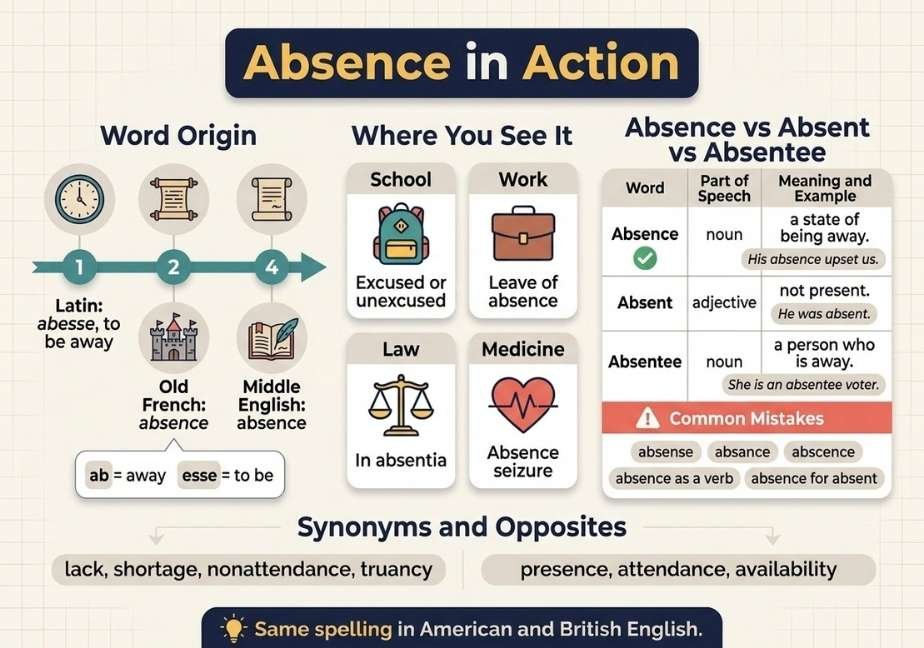
The word has deep roots. It comes from Latin. The Latin word absens means “being away.” It grew from abesse, which means “to be away.” Later, the Latin form absentia moved into Old French as absence. English then borrowed it during the Middle English period.
Now look at the Latin pieces. The prefix ab means away. The root esse means to be. So the word literally says “to be away.” That also explains the spelling. The ending comes from the Latin entia. French shaped it into ence. Therefore the c is not random. It has history behind it.
For more on usage, the Cambridge Dictionary gives clear example sentences. Use it when you want to see the word in context.
How to Spell Absence Correctly
Spell it with the letters A B S E N C E. That makes seven letters. The key is the c near the end. Remember that and you will not slip.
Easy Memory Tricks
Tricks work better than rules. Try these:
- Pair it with presence. Both words end in ence.
- Picture the c as a small gap. It shows something is missing.
- Split it into three chunks: ab, sen and ce.
- Start with absent and swap the t for ce.
- Write the word five times by hand.
Pick the one that clicks for you. Then use it each time you doubt yourself.
Related Words That Cause Trouble
Some close cousins also confuse writers. Check them here:
- Absent: an adjective meaning not present.
- Absentee: a person who is not present.
- Absently: in a distracted way.
- Absenteeism: a habit of missing work or school.
- Absentia: the Latin form used in the phrase in absentia.
Notice the shared root absent. Therefore if you can spell absent you can spell absence. Just swap the t for ce.
Is There a British or American Difference?
Good news here. Absence has the same spelling in American and British English. No regional version exists. Only the wrong version changes from person to person. So you can relax about this one.
Absence in Everyday Life
The word shows up in many settings. Each setting adds a small twist. Let’s look at the most common ones.
At School and Work
Absence is most common in school and work. A school tracks attendance and records each absence. Likewise, employers track sick days and leave. Many places split absences into two types. An excused absence has a valid reason such as illness. An unexcused absence does not. Because rules differ, always check your own policy.
Employers also watch absenteeism. That term means a pattern of missing work. A single absence is normal. A steady pattern gets attention.
If you need time off, you may write a short note. For example, you might say, “I request a leave of absence from June 1 to June 15.” Keep it short and clear. Also add the dates and the reason if you wish.
In Relationships and Texting
Absence also carries emotional weight. For instance, a friend may say, “I felt your absence at the party.” That means they missed you. Similarly, couples talk about absence during long distance times. The old saying about the heart growing fonder fits here.
In texting, people rarely write the full word. Still, it appears in longer messages. For example, someone might write, “Sorry for my absence lately.” It sounds polite and a little formal. Meanwhile, a casual text may just say “been MIA.” MIA stands for missing in action. It means the same thing in a looser way.
In Law and Medicine
Specialized fields use the word too. In law, in absentia means a person is not present in court. A trial can happen in absentia in some cases. Also, absence of malice is a legal phrase tied to defamation cases in the United States.
In medicine, an absence seizure is a brief lapse of awareness. The person stares and does not respond for a few seconds. Doctors once called these petit mal seizures. Today most use the term absence seizure. If you notice these signs often, see a doctor.
Synonyms and Opposites of Absence
Variety keeps your writing fresh. So here are some options.
- Synonyms: lack, shortage, nonattendance, truancy and departure.
- Opposites: presence, attendance, availability and existence.
Context matters when you choose a word. For example, truancy fits school skipping only. Lack fits things, not people. Shortage fits supplies. Meanwhile, nonattendance fits formal reports. Pick the one that matches your sentence.
Common Mistakes With Absence
Writers repeat the same few errors. Spot them below.
- Writing absense instead of absence.
- Writing absance with an a near the end.
- Typing abscence with an extra c.
- Using absence as a verb.
- Mixing up absence and absent.
Here is how that looks in real sentences. Wrong: “The absense of rain hurt the crops.” Right: “The absence of rain hurt the crops.” Wrong: “He was absence from class.” Right: “He was absent from class.” See the pattern? A noun follows “the.” An adjective describes a person.
Absence vs Absent vs Absentee
These three words share a root. Yet each does a different job. Absence is a noun. Absent is an adjective. Absentee is a noun for a person.
If you can put “the” before the word, use absence. If you describe someone, use absent. For example, “His absence upset us” uses a noun. In contrast, “He was absent” describes his state. Likewise, “Absent students must bring a note” uses absent as an adjective.
An absentee is a person who is away. For instance, an absentee ballot is a vote cast by someone who cannot come in person. Many countries use them. So the word fits civic life too.
Tips to Use Absence With Confidence
Tools help. A spell checker flags absense right away. However, it may miss errors that look like real words. So read your text out loud before you hit send. Moreover, keep a short list of your tricky words. Review it often. Over time the right spelling becomes automatic.
Tone matters as well. Absence can sound formal. In casual talk, words like away or gone may fit better. For example, “I was away last week” feels warmer than “During my absence last week.” Choose the form that fits your reader.
Spelling also affects trust. A small typo can make a reader doubt you. This is true in resumes and emails. It is also true in blog posts and school papers. So a few seconds of checking pays off.
Frequently Asked Questions
Is it absence or absense?
Absence is correct. Absense is a common misspelling and does not appear in standard dictionaries.
What does absence mean?
Absence means being away from a place or person. It also means a lack of something, like the absence of noise.
How do you spell absence?
Spell it A B S E N C E. It ends in ence, just like presence.
Is absence a noun or a verb?
It is a noun. You cannot use it as a verb. Use the adjective absent to describe someone who is away.
What is the difference between absence and absent?
Absence is a noun naming the state of being away. Absent is an adjective describing someone who is not there.
Final Thoughts on Absence or Absense
Let’s wrap it up. Absence is the only correct spelling. Absense is a mistake that comes from the sound of the word. The meaning is simple. It describes being away or lacking something.
Remember the key points. The word ends in ence like presence. It is a noun and not a verb. It comes from Latin and reached English through French. Now you can spell it with ease and use it in any setting. Next time you write it, trust the c and move on.





One Comment