

Advisers vs advisors: what’s the difference? You see both spellings everywhere. Your spellchecker flags one today and the other tomorrow. So you stop and wonder which one is right. The short answer is that both are.
This guide gives you the full picture fast. First, you will learn what each word means. Next, you will see where the spellings came from. Then you will learn how AP Style, dictionaries and finance rules treat them. Finally, you will get simple steps to choose one and stay consistent.
Advisers vs Advisors:
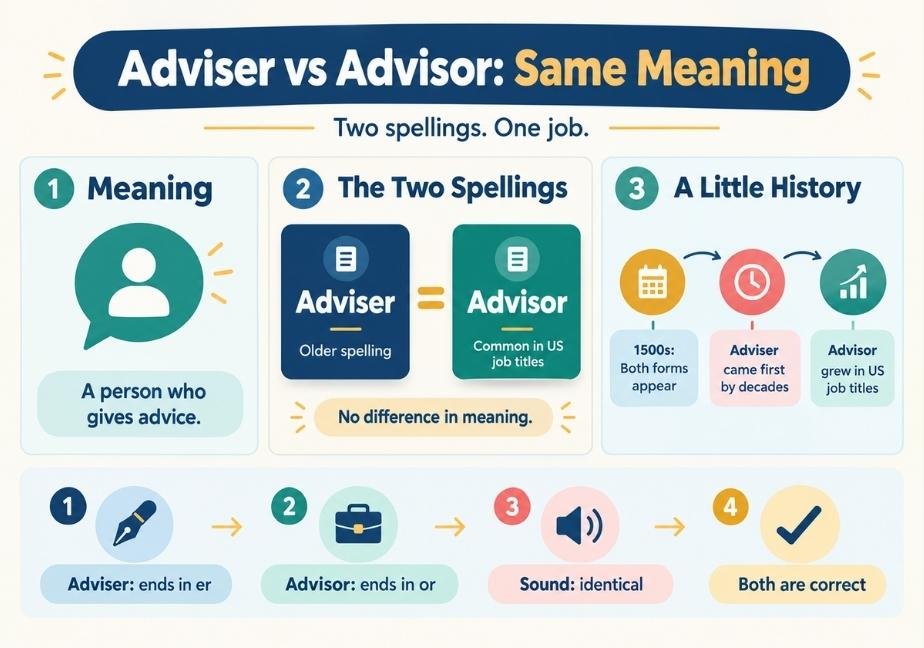
Adviser and advisor mean the same thing: a person who gives advice. The only difference is spelling. Adviser is older and matches AP Style and US investment law. Advisor is common in American job titles. Dictionaries such as Merriam-Webster accept both. Pick one spelling and use it consistently.
| Feature | Adviser | Advisor |
|---|---|---|
| Meaning | Person who gives advice | Person who gives advice |
| Pronunciation | Same | Same |
| AP Style | Preferred | Not preferred |
| Merriam-Webster | Accepted | Accepted |
| US investment law | Spelling in the Act | Common in job titles |
| Best use | News, legal, regulatory | Job titles, brand copy |
What Do Adviser and Advisor Mean?
An adviser or advisor is a person or firm that gives advice or guidance on a subject. Both words are nouns. A teacher can be one. A banker can be one. So can a coach or a lawyer.
Merriam-Webster says adviser and advisor are both correct, no matter what your spellcheck tells you. You can read the entry on Merriam-Webster. In short, the meaning never changes. merriam-webster
Plural forms follow the same split. You write advisers or advisors. The possessive works the same way. You write adviser’s or advisor’s. Pronunciation stays identical too. Nobody can hear the spelling when you speak. That’s why this debate lives only on the page.
Where the Two Spellings Come From
Both spellings grow from the verb advise. English adds an ending to a verb to name the person who does the action. People who dance are dancers and those who translate are translators. By that logic, people who advise are advisers. Others use the or ending, which looks more formal to some readers.
The history is old. Both forms trace back to the 1500s. Grammarly’s usage guide calls adviser the older and preferred spelling. Meanwhile, advisor grew popular later. Today you see it often in American business writing.
So the two spellings are cousins. They share a root and a meaning. They only differ in the last two letters.
Adviser or Advisor in AP Style and Dictionaries
Style guides are where the real split happens. Some pick a side. Others let you choose. So your answer may depend on who you write for.
What AP Style Says
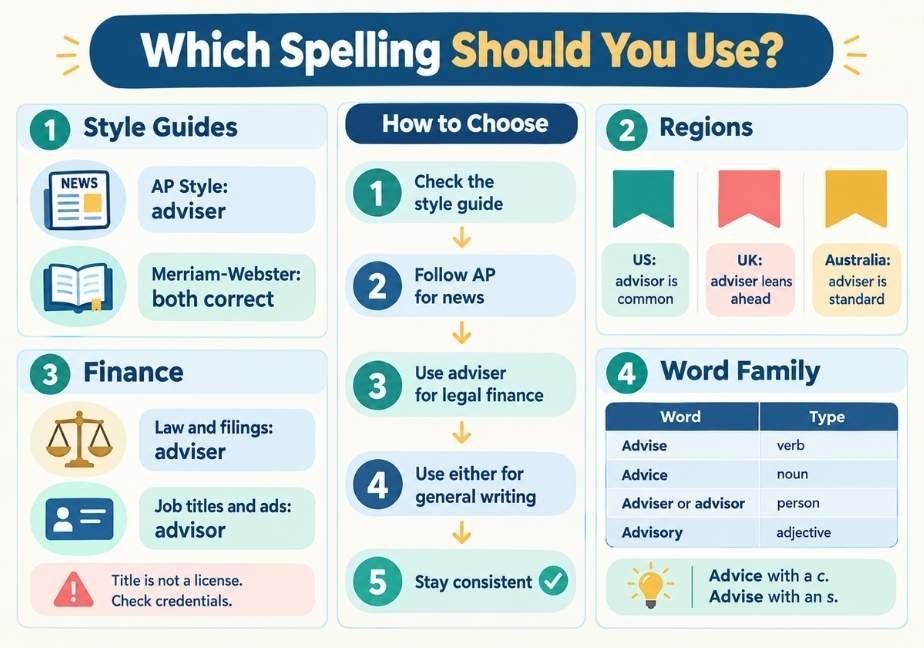
The AP Stylebook says adviser is the correct spelling. Journalists and news writers follow this rule. Many PR teams follow it too. Therefore, if you write for a newsroom, use adviser.
Still, AP Style is a house rule. It keeps news copy uniform. Outside that world, you have more freedom.
What Dictionaries Say
Dictionaries take a softer view. Merriam-Webster lists both spellings as equally correct with no difference in meaning. So neither spelling counts as an error. Some people feel advisor looks more formal. That’s a matter of taste. It is not a rule.
Does Region Change the Spelling?
Slightly, but not as a rule. Advisor appears more often in US English than UK English and often signals an official job position. Even so, you will find both spellings in every English speaking country.
Therefore, do not rely on region alone. Instead, follow the style guide of your school, employer or client. If none exists, choose one spelling and keep it.
Adviser vs Advisor in Finance
Finance is where this topic gets serious. The spelling here can carry legal weight. That’s why so many people search for the difference.
The Law Uses Adviser
The main US law is the Investment Advisers Act of 1940. It uses the spelling “adviser” with an e. Firms that give investment advice register under it. They are called registered investment advisers, or RIAs.
Because of this, legal documents and regulatory filings use adviser. Financial planning experts at Kitces note that this distinction is built into regulation. If you write a compliance document, use the e spelling.
Job Titles Use Both
Marketing is a different story. Many US firms print “financial advisor” on websites and business cards. Others print “financial adviser.” Both appear in ads.
Here is the catch. FINRA explains that “financial advisor” is a generic term that usually refers to a registered financial professional. You can read more on FINRA’s investor page. So the title alone does not tell you which rules apply.
Always check a person’s background before you hand over money. FINRA’s BrokerCheck tool shows whether an investment professional is registered with the SEC or a state. The SEC also runs a public database for investment advisers. Spend two minutes there first.
Other Fields Where You See Both Spellings
The same choice shows up outside finance.
Education. Colleges use “academic advisor” or “academic adviser” for staff who guide students. PhD students have a thesis advisor or adviser. Both are correct. The school’s style guide usually decides.
Politics. Newsrooms that follow AP Style write “national security adviser.” Meanwhile, some offices use advisor in their own titles. So you may see both in one news cycle.
Business. Companies hire strategic advisors and board advisers. Startups form an advisory board. Again, the brand’s style decides.
Advise, Advice and Advisory
Now for a related mix up. These words look alike. But each has a job.
- Advise is a verb. It means to give guidance.
- Advice is a noun. It means the guidance itself.
- Adviser or advisor is a noun. It names the person.
- Advisory is an adjective. It describes something that gives advice.
For example: My adviser will advise me on the project. I took her advice. Then I joined the advisory board.
Advisory is the only accepted adjective spelling and advisery is not acceptable. So if you type “advisery,” fix it right away. Also, remember this trick. Advice with a c rhymes with “ice.” Advise with an s rhymes with “wise.”
How to Choose Between Adviser and Advisor
Follow these steps. They take only a minute.
- Check if your school, employer or client has a style guide.
- Follow AP Style if you write news or PR copy.
- Use adviser for legal or regulatory finance documents.
- Use either spelling for blogs, emails and general writing.
- Stick with your choice from start to finish.
Consistency matters most. Readers notice when a page flips between spellings. It looks sloppy. If your audience may search for both, mention the other spelling once. For example, write “Financial advisors (also spelled advisers) help clients plan.”
Common Mistakes to Avoid
Even careful writers slip up. Watch for these errors.
- Switching spellings in the middle of an article.
- Calling one spelling wrong when both are accepted.
- Mixing up advice and advise.
- Writing “advisery” instead of advisory.
- Trusting spellcheck blindly.
- Treating a job title as proof of registration.
Here are correct sentences to copy:
- She met her academic advisor before choosing classes.
- The president spoke with his chief adviser last night.
- My financial adviser explained the new tax rules.
Each one is correct. They only differ by spelling choice.
FAQs About Advisers vs Advisors
Is it adviser or advisor?
Both are correct. Adviser is older and fits AP Style. Advisor is common in US job titles. Pick one and stay consistent.
Is it financial advisor or financial adviser?
Both work in general writing. Legal documents and SEC filings use adviser. Many US firms use advisor in job titles.
Is advisor more formal than adviser?
Some people think so. Dictionaries say there is no difference in meaning.
What is the adjective form of adviser?
Advisory is the only accepted adjective. Advisery is not a word.
Does a financial advisor have to be registered?
Not always by title. Check BrokerCheck or the SEC’s adviser database to confirm a person’s registration.
Conclusion
So what’s the final word on advisers vs advisors? The two spellings mean the same thing. Adviser is older and fits AP Style and US investment law. Advisor is popular in American job titles. Dictionaries accept both.
Your takeaway is simple. Check any style guide you must follow. If none applies, choose one spelling and use it every time. In finance, look past the title and verify the person’s registration. Next time your spellchecker complains, you will know exactly what to do.