
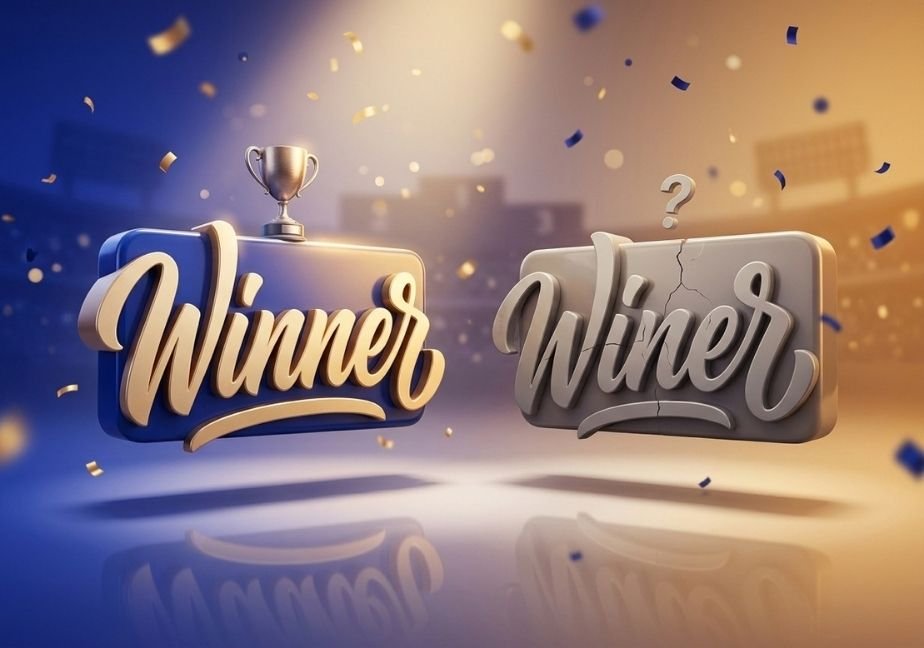
The correct spelling is winner with two n’s. Winer is a common typo that drops one letter and it is not a recognized English word on its own.
If you have ever typed a message in a hurry and paused halfway through the word winner you are not alone. Winner or winer is one of those small spelling mix ups that trips up even confident writers especially on a phone keyboard where one missed tap changes the whole word. This article breaks down exactly why the confusion happens what winner actually means and why winer never became a standard English word.
By the end you will know the correct spelling for good and you will understand the simple rule behind it. You will also pick up a few memory tricks that make the mistake almost impossible to repeat. We will look at where this typo tends to show up most from text messages to social media captions and how autocorrect plays a role in the confusion. We will also cover a handful of similar double letter words that trip people up in the exact same way.
|Also read this article: LMY Meaning in Text: What This Popular Slang Really Means
What Winner Actually Means
Winner is a noun that describes a person a team or a thing that wins a contest a competition a game or any situation where there is a clear victor. It comes from the verb win combined with the agent suffix er which turns an action into the person who performs it. Someone who wins a race is a winner. A company that outperforms its rivals becomes the market winner. Even a recipe that turns out especially well earns the label winner in casual conversation.
The word has been part of English for centuries. It traces back to Middle English forms like wynner and wynnere. According to Merriam-Webster’s tracking of the word’s history winner has kept the same core meaning since the 1300s. Its tone shifted over time as it picked up informal uses like calling a good idea or a great meal a winner.
Grammatically winner is a countable noun. It has a plural form winners and it slots into sentences the same way any person noun does.You can say “the winner is announced,” “the winners received trophies,” or “she is a natural winner” without changing the spelling in any of these cases. The word also appears in set phrases like winner take all which describes a contest where the top finisher claims the entire prize while everyone else walks away with nothing.
Winner shows up constantly outside of formal writing too. Sports commentary leans on it heavily when describing a match result. Marketing copy uses it to describe a standout product. Reality television hosts announce a winner at the end of nearly every competition format. Because the word touches so many everyday situations getting the spelling right matters more than most people realize.
Why People Write Winer Instead of Winner
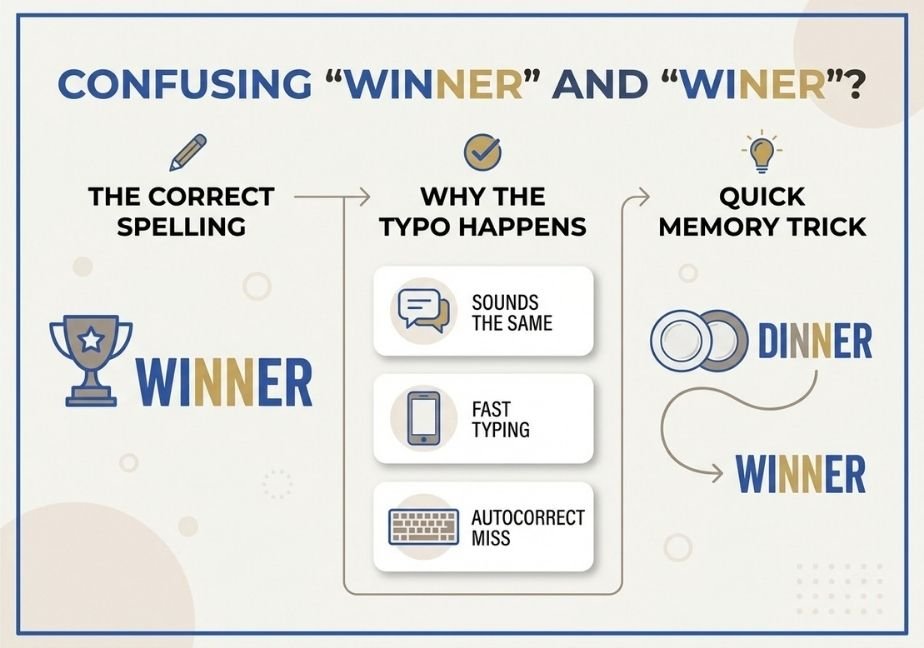
The mix up almost always comes down to speed and pronunciation rather than a real misunderstanding of the word. Here is what typically causes it.
Fast typing drops the second n before the writer notices the mistake. Autocorrect sometimes fails to catch a single missing letter in short words. Spoken English blends the double n into one soft sound. Texting shorthand habits carry over into words that should stay standard. Visual similarity to words like miner or diner makes winer look plausible.
Because winner is pronounced with a single audible n sound in fast speech the brain sometimes types what it hears instead of what it sees written down. This is a common pattern with double letter words in English and it explains why so many people search for winner or winer to double check themselves before hitting send. Linguists sometimes call this kind of slip a phonetic spelling error since the writer is following the sound of the word rather than its accepted written form.
Mobile keyboards make the problem slightly worse.Predictive text sometimes finishes a word before you type the second n, and you may not notice the difference between “winner” and “winer” when you quickly glance at the screen. Add in the pressure of a fast paced group chat or a live comment section and the typo slips through even for people who know the correct spelling perfectly well.
|Also read this article: EMP Meaning in Text: All the Definitions You Need to Know
Is Winer Ever a Real Word
Merriam-Webster, Dictionary.com, and Collins English Dictionary do not list “winer” as a standard word. It has no accepted definition no formal pronunciation guide and no dictionary entry of its own. In almost every case where you see winer online it is a straightforward typo for winner. In a small number of informal contexts some writers use winer as a playful nickname for someone who drinks wine similar to how foodie describes someone who loves food or gamer describes someone who plays video games.
That second use is extremely rare and it never appears in formal writing style guides or professional publications. According to Dictionary.com’s own entry standards a word only earns a listing once it shows consistent widespread usage across a range of sources and winer has never reached that threshold. If you are writing anything for school for work or for a public audience winer should not appear at all. The safe and correct choice in every standard context is winner.
It is worth noting that English already has a real word that looks similar called winter which refers to the cold season. Some writers confuse winner and winter when typing quickly since both words share the same first four letters and a similar rhythm. That mix up is different from the winner or winer question but it comes from the same root cause of fast typing outrunning careful spelling.
Winner vs Winer in Everyday Writing
Seeing both spellings side by side makes the difference easy to remember for good.
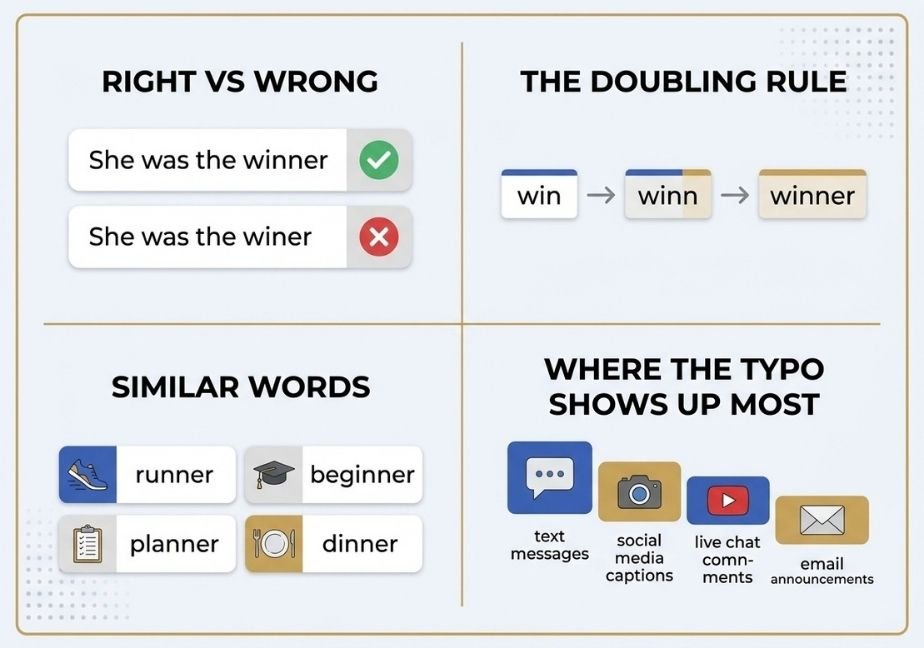
Correct: She was the winner of the spelling bee. Incorrect: She was the winer of the spelling bee. Correct: The winners will be announced tonight. Incorrect: The winers will be announced tonight. Correct: This recipe is a real winner with my family. Incorrect: This recipe is a real winer with my family. Correct: He walked away as the winner of the raffle. Incorrect: He walked away as the winer of the raffle.
Notice that winer never fits naturally into a sentence the way winner does. Reading a sentence back out loud usually makes the error obvious which is one of the simplest ways to catch it before publishing or sending a message. This trick works particularly well for social media captions and email subject lines since those are the two places where a small typo tends to get noticed fastest by readers.
How to Remember the Correct Spelling
A few small tricks make this an easy mistake to avoid going forward.
Think of the base word win then simply add ner to build winner. Picture the double n like two people tied for first place together. Say the word slowly out loud and count both n sounds as you type. Compare it to dinner which also doubles its middle consonant the same way. Use a spelling or grammar checker before posting anything public online.
The dinner comparison works especially well because most people already spell dinner correctly without giving it a second thought. Winner follows the exact same double consonant pattern so linking the two words in your memory removes the guesswork almost immediately. Other familiar double letter words like runner planner and beginner follow the identical rule of doubling the final consonant of the base word before adding er. Once that pattern clicks the winner or winer question tends to disappear from your writing for good.
Teachers sometimes describe this as the doubling rule for short vowel words. When a one syllable base word like win ends in a single vowel followed by a single consonant the final consonant usually doubles before a suffix that starts with a vowel. Win becomes winner the same way run becomes runner and plan becomes planner. Recognizing this pattern helps with far more than just one word since it applies across a wide range of everyday English vocabulary.
Where This Typo Shows Up Most
The winner or winer mix up tends to appear most often in fast informal writing rather than edited content. Text messages and group chats are common spots since replies get typed quickly and sent without a second look. Social media captions and comments follow closely behind especially on posts announcing a contest a giveaway or a competition result. Live chat during sports broadcasts and gaming streams also produces the error often since viewers are typing in real time while reacting to what just happened on screen.
Search engines see this pattern clearly too. People frequently search winer meaning or winner or winer spelling right after typing the word themselves and noticing it looks wrong. That instinct to double check is a good habit and it is exactly why a clear answer matters more than a long grammar lecture. Content creators running giveaways online should pay special attention to this spelling since a misspelled winner announcement can look unpolished on a public post that many people will see.
Customer facing writing deserves an extra proofreading pass for the same reason. Emails announcing a contest result a press release naming an award recipient or a company blog post recapping an event all put the word winner in front of a wide audience at once. A single dropped letter in a headline or a subject line can undercut an otherwise professional piece of writing so a quick final check before publishing is always worth the extra minute.
Does Winner Or Winer Change Across Regions Or Generations
The spelling of winner does not change across English speaking regions. British American Australian and Canadian English all use the same double n spelling and none of them recognize winer as an alternate form. Pronunciation shifts slightly from place to place with some British speakers softening the final r sound while American speakers keep it more pronounced. Neither variation affects how the word should be written.
Generational habits do play a small role in how often the typo appears. Younger writers who grew up texting on smartphones tend to type faster and rely more heavily on autocorrect which can let a dropped letter slide through unnoticed. Older writers who learned to type on a full keyboard sometimes catch the mistake sooner simply because they type at a slower steady pace. Neither group is more likely to actually believe winer is correct. The difference mostly comes down to typing speed and how often each group proofreads before sending a message.
Online gaming communities and esports commentary have also popularized fast paced typing where words get shortened or slightly misspelled on purpose for speed. Winner sometimes gets caught up in that casual typing culture even though the word itself was never meant to be shortened. This is another reason the winner or winer search remains common even among people who already know the correct answer and just want quick confirmation.
Frequently Asked Questions
Is winer a real word?
No. Winer is not a recognized English word. It is almost always a typo for winner.
Why do people spell winner with one n?
Because winner is pronounced with a soft single n sound in casual speech leading to the common typo winer.
What is the correct spelling of winner?
Winner spelled with a double n is the only correct and dictionary recognized spelling.
Does autocorrect fix winer automatically?
Not always. Short words like winer sometimes slip past autocorrect since it can resemble other valid words.
Is winer ever used to mean a wine drinker?
Very rarely and only informally. It never appears in standard dictionaries with that meaning.
Conclusion
Winner or winer really comes down to one simple rule. Winner with its double n is the only standard and dictionary approved spelling while winer is a typo that has never earned a place in formal English. The confusion mostly comes from how quickly people type and how softly double consonants get pronounced in everyday speech. Once you link winner to a familiar word like dinner in your memory the correct spelling becomes automatic. That one small habit is enough to move past this common stumbling block for good.




8 Comments