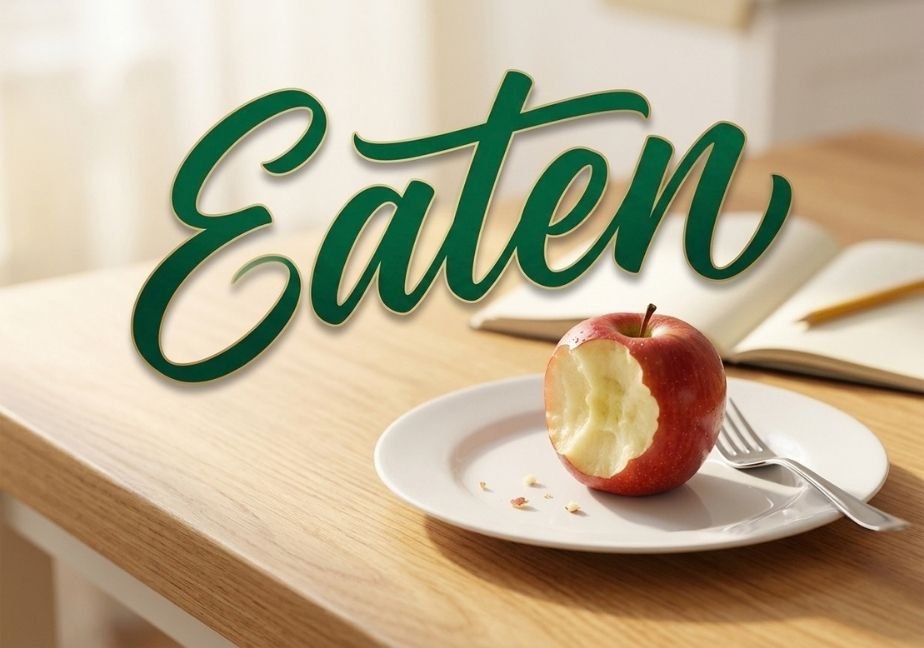
Have you ever stopped mid sentence and wondered about eaten or aten? You are not alone. Many people type both words and then stare at the screen. One looks right. The other looks close enough. Only one of them is a real English word.
In this guide you will learn which spelling is correct and why. You will also see how eaten differs from ate. Then you will get easy examples and memory tricks. By the end you will never second guess this word again.
Eaten or Aten?
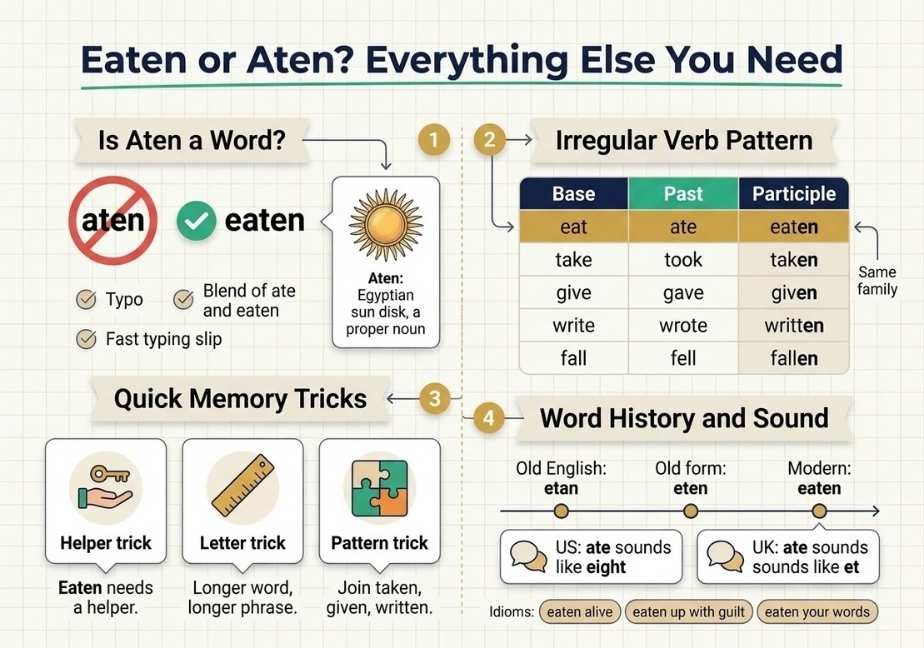
Eaten is correct. It is the past participle of the verb eat. You use it after have, has, or had. Aten is not a standard English word. It is usually a typo or a mix of ate and eaten.
What Does Eaten Mean?
Eaten means that food has been taken in through the mouth. It shows that the action of eating is finished. The word comes from the verb eat.
Eat is an irregular verb. That means it does not follow the usual “add ed” rule. Regular verbs are simple. You walk, walked, and have walked. Irregular verbs change shape in odd ways. Eat is one of them.
Here are all five forms of the verb:
- Base form: eat
- Third person: eats
- Simple past: ate
- Past participle: eaten
- Present participle: eating
So eaten is not a mistake or a rare form. It is a core part of the verb. Merriam-Webster lists eaten as the past participle of eat in its main entry. Dictionaries across the English speaking world agree on this point.
Is Aten a Real Word?
Not in everyday English. You will not find aten as a form of eat in any major dictionary. If you write “I have aten lunch,” a spell checker will flag it. A teacher will mark it wrong too.
That said, aten does show up online. People search for it every day. So it helps to know why it appears.
Why People Type Aten
Most people do not type aten on purpose. It happens for a few simple reasons.
First, the words ate and eaten sound alike in some accents. The brain blends them together. The result is aten.
Second, English has many odd spellings. Learners often build a word by pattern. They see “ate” and add “n” to make a past participle. That feels logical. It is just not correct.
Third, fast typing causes slips. The letter “e” at the start of eaten can drop out. Then you get aten. Autocorrect does not always catch it.
Finally, some writers guess. They know ate is one form. They know eaten is another. So they invent a middle option. It is a common habit when a rule feels unclear.
The Other Meaning of Aten
Here is a fun twist. Aten is a real word in one setting. It is the name of an ancient Egyptian sun disk. Britannica explains that Aten was worshiped as the sun god during the reign of Pharaoh Akhenaten. He even changed his own name to honor it.
So if you searched for aten and saw pictures of the sun, that is why. The word has a strong history. It just has nothing to do with food or grammar.
Aten can also appear as a surname or a brand name. Those uses are rare. They are also proper nouns. They always start with a capital letter.
Eaten vs Ate: The Core Difference
Now for the part that trips up most people. Ate and eaten are both real. They are just used in different ways.
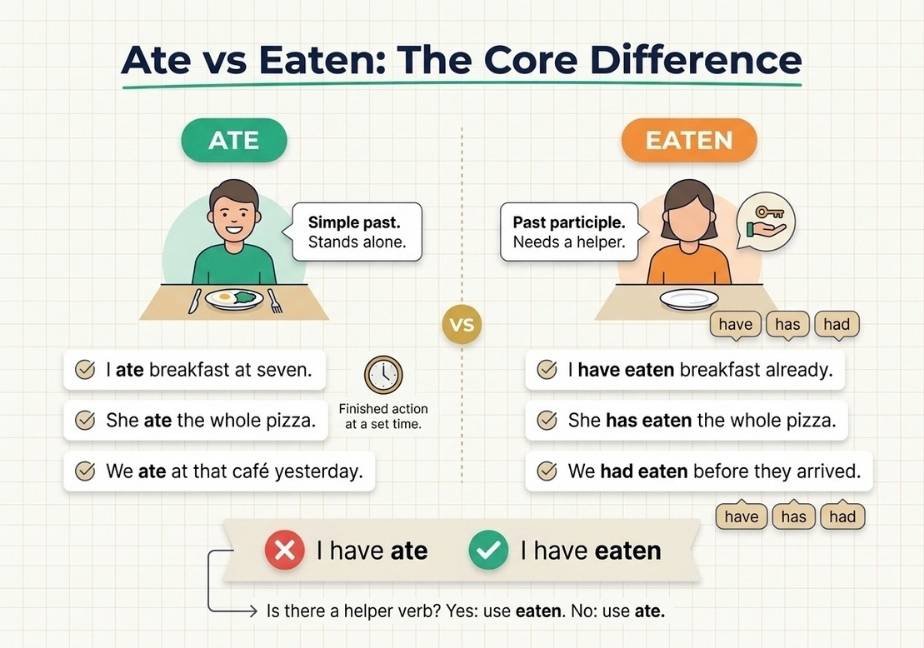
The key idea is simple. Ate stands alone. Eaten needs a helper.
Ate: The Simple Past
Ate describes a finished action at a set time in the past. It works by itself. It never needs a helper verb.
Here are some examples:
- I ate breakfast at seven.
- She ate the whole pizza.
- We ate at that café yesterday.
In each case the action is done. Also, the time is clear. Nothing else is needed.
Eaten: The Past Participle
Eaten works with a helper verb. That helper is usually have, has, or had. Together they form the perfect tenses.
Here are some examples:
- I have eaten breakfast already.
- She has eaten the whole pizza.
- We had eaten before they arrived.
Notice the pattern. The helper comes first. Then eaten follows. You cannot swap eaten for ate here. “I have ate” sounds wrong to most native speakers. That is because it is wrong.
A Side by Side Look
| Form | Helper needed | Example |
|---|---|---|
| Ate | No | He ate lunch. |
| Eaten | Yes | He has eaten lunch. |
This small table holds the whole rule. Keep it in mind and you will rarely slip.
How to Use Eaten in Sentences
Eaten fits into three main patterns. Learn each one and you will feel confident.
With Have, Has, and Had
This is the most common use. It builds the perfect tenses.
Present perfect links the past to now. For example, “I have eaten too much.” The feeling still lasts today.
Past perfect shows one past action before another. For example, “They had eaten by the time I got there.” The eating came first.
Future perfect looks ahead. For example, “By noon I will have eaten twice.” The action will be done by a set time.
In Passive Sentences
Eaten also appears in passive voice. The subject receives the action. You use a form of “be” plus eaten.
Here are some examples:
- The cake was eaten in minutes.
- Rice is eaten daily in many countries.
- The leftovers will be eaten tomorrow.
Passive voice has its place. Still, active voice usually reads better. “The kids ate the cake in minutes” feels stronger and shorter.
As an Adjective
Sometimes eaten acts like a describing word. It tells you the state of something.
Here are some examples:
- She left a half eaten sandwich on the desk.
- The garden was full of eaten leaves.
- Look at that partly eaten apple.
In these cases eaten sits before a noun. It paints a quick picture.
Common Mistakes and Easy Fixes
Most errors fall into a few groups. Once you spot them you can fix them fast.
Mistake one: using ate after have. Wrong: “I have ate dinner.” Right: “I have eaten dinner.”
Mistake two: using eaten alone. Wrong: “I eaten dinner.” Right: “I ate dinner” or “I have eaten dinner.”
Mistake three: writing aten. Wrong: “She has aten already.” Right: “She has eaten already.”
Mistake four: adding extra letters. Some people write “eated” or “eatened.” Neither one exists. Stick with eaten.
Here is a quick check you can run. Say the sentence with “have” in front. If it sounds natural, use eaten. If it sounds odd, try ate.
Easy Tricks to Remember the Rule
Grammar rules stick better with a hook. Try one of these.
The helper trick. Eaten needs a helper. Ate goes solo. If no helper is in the sentence, pick ate.
The letter trick. Eaten has more letters than ate. It also needs more words around it. Longer word, longer phrase.
The pattern trick. Many irregular verbs end in “en” in the participle. Think of taken, given, written, and fallen. Eaten belongs to that family.
Here is the pattern in action:
- Take, took, taken
- Give, gave, given
- Write, wrote, written
- Fall, fell, fallen
- Eat, ate, eaten
See the link? Once you notice it, aten looks out of place. The “en” ending needs the full “eaten” shape to match the group.
Where Does the Word Eaten Come From?
Language history explains a lot. The word eat is very old. It goes back to Old English, where it was etan. That word is much older than English itself. It shares roots with related words in German, Dutch, and Old Norse.
In Old English the past participle was eten. Over centuries, the spelling shifted. Scribes added an “a” to match the long “e” sound in the base word. That gave us eaten.
The simple past changed too. It moved from “æt” to the modern ate. So the two forms drifted apart over time. That is why they now serve different jobs.
This history also explains why aten never took hold. There was never an old form that looked like it. It has no roots in the verb at all.
Pronunciation and Regional Differences
Sound is where much of the confusion begins. Eaten is said as “EE-tuhn.” The middle letter is soft. Many speakers barely voice it.
Ate is trickier. In American English it sounds like “eight.” In British English many people say “et.” Both are accepted. Neither changes the spelling.
Because “et” sounds a bit like the start of eaten, some writers blend the two. That can produce aten. Knowing the difference in sound and spelling helps you avoid it.
Some regional dialects also use “et” as a past form in speech. You may hear “I et it already” in parts of the American South or rural England. That is spoken dialect. In formal writing you should still use ate or eaten.
Eaten in Idioms and Everyday Phrases
English uses eaten in many colorful sayings. Knowing them will help you use the word with flair.
- Eaten alive means overwhelmed or attacked badly.
- Eaten up with guilt means consumed by a strong feeling.
- Eaten out of house and home means a guest ate too much.
- Eaten your words means you had to take back something.
- Eaten like a bird means you ate very little.
Each phrase keeps the same spelling. You will never see “aten alive” in print. If you do, it is a typo.
Frequently Asked Questions
Is it eaten or aten?
Eaten is correct. It is the past participle of eat. Aten is not a standard English word and is usually a typo.
Is aten a word in English?
Aten is not a form of eat. It is only a proper noun, such as the name of the Egyptian sun disk.
What is the difference between ate and eaten?
Ate is the simple past and stands alone. Eaten is the past participle and needs a helper like have, has, or had.
Can I say “I have ate”?
No. Use “I have eaten.” The word have needs the past participle, which is eaten.
Is “I ate” or “I have eaten” correct?
Both are correct. “I ate” states a finished past action. “I have eaten” links that action to the present.
Conclusion
The answer to eaten or aten is now clear. Eaten is the right choice every time you need the past participle of eat. Aten is a misspelling in normal writing. It only works as a name for the Egyptian sun disk.
Remember one simple rule. Ate stands alone. Eaten follows have, has, or had. Use the helper trick when you feel stuck. Then check your sentence once and move on. With a little practice the right form will come to you without a pause.


![A dynamic sports photo shows a male volleyball player in mid-air, spiking a ball over a net in an indoor arena[cite: 13]. Behind him, a massive image of an elephant is dramatically rendered in explosive golden dust and bright light[cite: 13]. Golden script text at the bottom reads "Flying Elephant Memoirs[cite: 13]."](https://tastimer.com/wp-content/uploads/2026/10/flying-elephant-memoirs-768x539.jpg)