
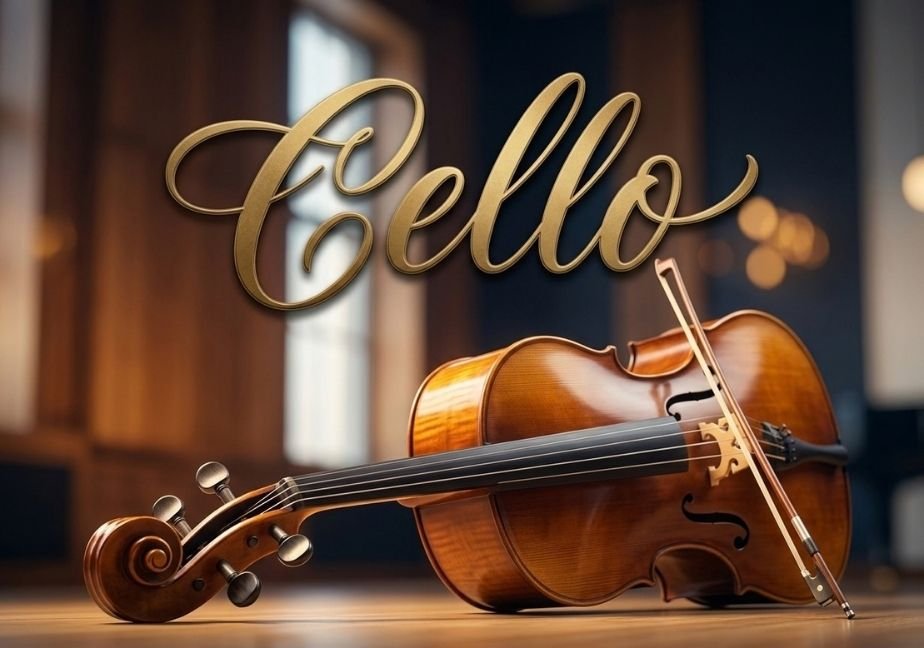
You are typing a message about music class. Then you stop at one word. Is it chello or cello? Your ear says chello. Your eye says cello. The answer is cello, and it has no H.
In this guide you will learn why cello is right and why it sounds like chello. You will also see where the word comes from and how to say it. Next you will get simple tricks and clear examples. Finally you will find quick answers to the questions people ask most.
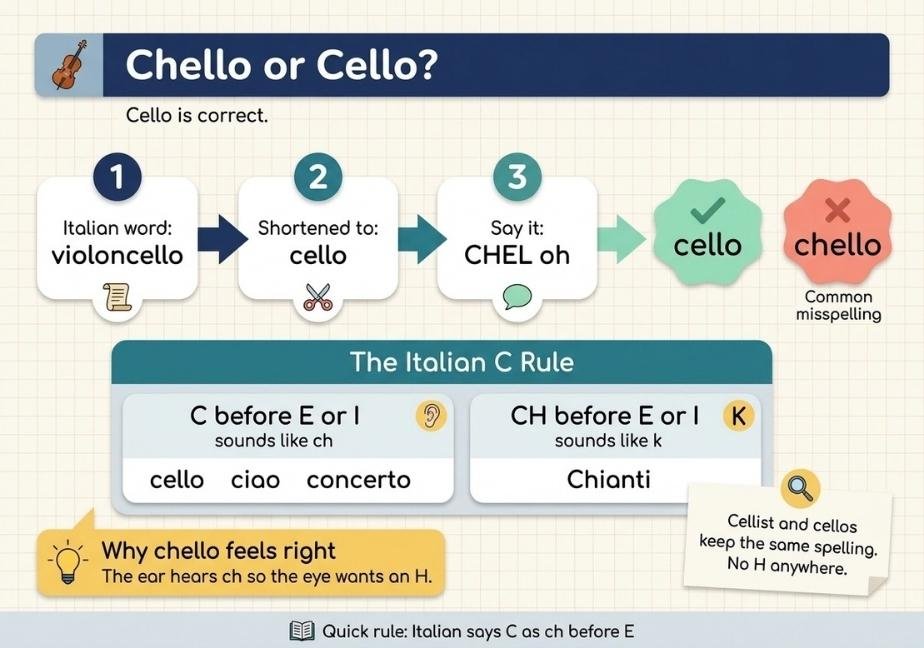
Cello is the correct spelling. Chello is a common misspelling. The word is short for violoncello. It sounds like CHEL oh because Italian words say the letter C as “ch” before the letter E.
Chello or Cello: The Short Answer
Let’s keep this simple. Cello is the only standard spelling in English. You write it with a C and no H. You say it with a “ch” sound at the start.
That mismatch causes the problem. The sound says ch. The spelling says c. So many people add an H to match what they hear. It feels logical. Still it is wrong.
Merriam-Webster lists cello as the standard entry. It shows the pronunciation as CHEL oh and notes that the word is short for violoncello. You will not find chello as a proper word there.
The good news is that the fix is easy. Once you know the Italian rule behind the sound you will never doubt it again.
Why Cello Sounds Like Chello
English borrowed this word from Italian. Italian spelling follows its own rules. Those rules explain everything.
The Italian C Rule
In Italian the letter C changes with the letter after it. Before E or I it says “ch.” So “ce” sounds like “che” in cheese. That is why cello starts with a ch sound.
Now here is the twist. In Italian “ch” does not say ch at all. It says “k.” So if an Italian reader saw chello they would say KEL lo. That would be wrong for the instrument. The H would ruin the sound.
So the spelling cello does the job in Italian. English kept the spelling. It also kept the sound. Only the H is missing because it was never needed.
Other Italian Words With the Same Rule
Cello is not alone. Many Italian words in English follow the same pattern. Look at these:
- Concerto sounds like con CHER toh
- Ciao sounds like chow
- Ciabatta sounds like cha BAH ta
- Cappuccino sounds like kap oo CHEE noh
None of them has an H after the C. Yet all of them start with a ch sound. Chello is just another word where our brain wants the H.
Chianti proves the reverse rule. It has ch in the spelling but says a k sound. So Italian uses C for ch and CH for k. It feels backward to English readers.
Where the Word Cello Comes From
The full name of the instrument is violoncello. It comes from Italian. It means “little violone.” A violone was a large early bass instrument. So violoncello is a smaller version of it.
People later shortened the long word. Cello was the result. Merriam-Webster dates the short form to 1855. Dictionary.com places it a little later in the 1870s. Either way the short form has been standard for well over a century.
You may also see the old form ‘cello with a small mark at the start. That mark showed a missing piece of the word. It looks dated now. Most writers drop it. So write cello with no mark and no H.
What a Cello Is
A cello is a large bowed string instrument. It belongs to the violin family. Players sit down and rest it between their knees. A metal spike called an endpin holds it off the floor.
Size and Strings
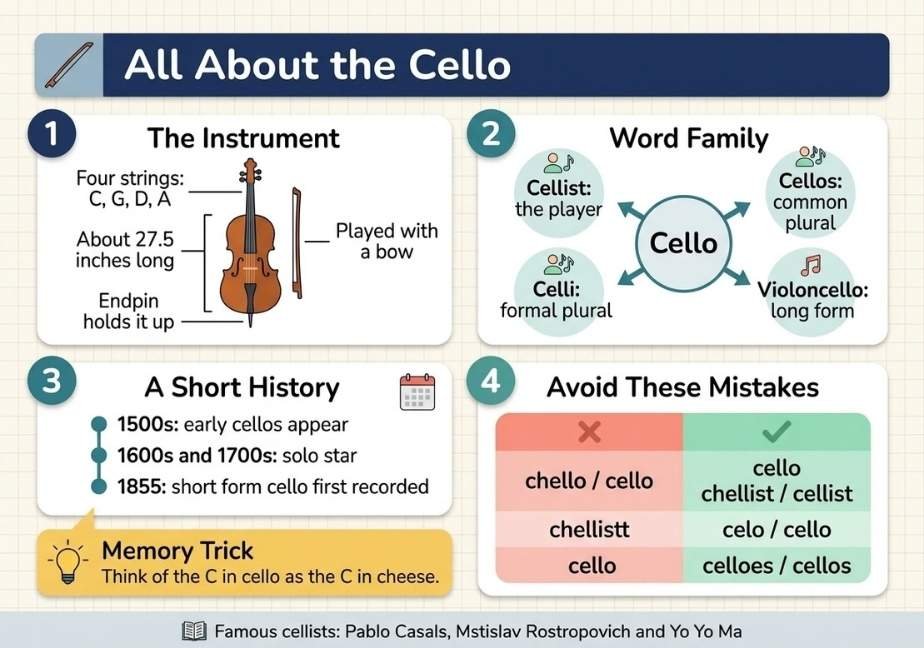
Britannica says the cello has four strings tuned C, G, D and A. The body is about 27.5 inches long. That is roughly 70 centimeters. With the neck the total length reaches about 47 inches.
The strings sit one octave below those of the viola. So the cello sounds deep and warm. Many people say it sounds close to a human voice. Children usually start on smaller cellos. Then they move up to a full size as they grow.
Music and Famous Players
The cello has a long history. Britannica notes that early versions appeared in the 16th century. They often had five strings. Over the 17th and 18th centuries the cello grew from a supporting bass part into a solo star.
Some famous works show how far it has come. J.S. Bach wrote six suites for unaccompanied cello. Beethoven wrote five sonatas for cello and piano. Great players include Pablo Casals and Mstislav Rostropovich. Yo Yo Ma is one of the best known cellists today.
How to Say Cello Correctly
The word has two syllables. Say it as CHEL oh. The stress falls on the first part. The vowel in the middle sounds like the E in “bed.”
Do not say SEL oh. That is a different word. Also do not say KEL oh. That would follow the Italian rule for ch but not the real word. Stick with CHEL oh.
Try this small drill. Say “chess” and “hello.” Then blend them. Chel plus oh gives you cello. Practice it three times and it will feel natural.
Cello Plurals and Related Words
A few related words come up often. Here is a quick guide:
- The plural is cellos in everyday English.
- Celli is also correct and sounds more formal.
- A person who plays the instrument is a cellist.
- Violoncello is the long form and is rare in daily speech.
Notice that cellist keeps the double L. Do not write chellist. The same rule applies. No H appears anywhere in the family.
Other Meanings and Lookalikes
Cello has one more meaning worth knowing. In informal American English it can be short for cellophane. Dictionary.com lists it as a second entry and shows the pronunciation as SEL oh. So the spelling is the same but the sound and meaning change.
Context solves this fast. If the sentence talks about music you say CHEL oh. If it talks about wrapping you say SEL oh. That is rare though. Most people mean the instrument.
You may also see odd spellings online. Some writers type chelo or celo. Others type cellow. None of these is standard. They all come from the same problem. People try to spell what they hear.
Common Mistakes to Avoid
Most errors with this word fall into a few groups. Watch for these:
- Writing chello instead of cello
- Writing chellist instead of cellist
- Writing celo with one L
- Saying SEL oh for the instrument
- Writing celloes as the plural
The plural mistake is less common but real. The word ends in O. Some O words add ES as in potatoes. Cello does not. It adds only S. So write cellos.
Also remember the double L. Cello keeps both letters. One L looks thin and wrong. Two L letters give the word its shape.
Easy Tricks to Remember the Spelling
Small tricks make the spelling stick. Try these:
- Think of the C in cello as the C in cheese.
- Remember that cello is short for violoncello and that word has no H.
- Link cello to concerto because both use C for the ch sound.
- Picture the two L letters as the two sides of the instrument.
- Type cello five times so your fingers learn it.
Here is one more idea for English learners. When you hear a ch sound in an Italian word do not add H automatically. Check the spelling first. Many times it is just C.
Quick Practice
Pick the correct spelling in each pair. Then check the answers.
- Chello or cello: cello is correct.
- Chellist or cellist: cellist is correct.
- Celloes or cellos: cellos is correct.
- Chiaro or ciao for the greeting: ciao is correct.
- Concherto or concerto: concerto is correct.
Did you get them all? If so you have mastered the rule.
Frequently Asked Questions
Is it chello or cello?
Cello is correct. Chello is a misspelling. The word is short for violoncello and the C makes a ch sound in Italian style.
Why is cello pronounced with a ch sound?
Cello comes from Italian. In Italian the letter C sounds like ch before E or I. So the C in cello says ch.
How do you spell the person who plays the cello?
Write cellist with a C and a double L. Do not add an H. The word never takes chello style spelling.
What is the plural of cello?
Both cellos and celli are correct. Cellos is more common in everyday English. Celli is a more formal choice.
Is cello short for something?
Yes. Cello is short for violoncello, an Italian word that means little violone. The long form is rare today.
Conclusion
The answer to chello or cello is clear. Cello is the only correct spelling. The instrument name is short for violoncello. The ch sound comes from an old Italian rule and not from a hidden H.
Now you have a rule that reaches beyond one word. Remember that Italian says C as ch before E or I. Then you can spell concerto, ciao and cappuccino with confidence. So type cello, say CHEL oh and move on with your day.






5 Comments