

Searching for a sitemap generator UploadArticle tool? You likely want a fast way to build an XML sitemap and help Google find your pages. That is a smart goal. A clean sitemap can speed up discovery, especially for new or large sites. But you also want to know if the tool is real and safe.
This guide covers both sides. First, you will learn what a sitemap generator does and how it works. Next, you will see what is reported about the UploadArticle tool and what remains unproven. Finally, you will get a simple test plan and a step by step upload guide.
What Is the Sitemap Generator UploadArticle Tool?
The sitemap generator UploadArticle tool is an online XML sitemap builder linked to UploadArticle.com. It reportedly scans a public website and lists the URLs it finds in a sitemap file. Reviewers say its features are not independently confirmed. So test the output before you upload it to your site.
What Does This Keyword Mean?
This is not slang. It is a tool search. People type it to find a sitemap builder tied to the UploadArticle.com site. UploadArticle.com is described as a content publishing and guest posting site. It covers SEO, digital marketing, and online tools.
Most searchers have the same three questions. What does the tool do? Is it safe? How do I use the file it creates?
Here is the catch. Public information about this tool is thin. A few 2026 articles describe it. They mention URL scanning, page filters, and update settings. However, one reviewer says to treat those features as reported and not confirmed. That is fair advice. So we will cover the basics first and then show you how to test it yourself.
What Is an XML Sitemap and Why Does It Matter?
An XML sitemap is a file that lists the pages on your site. Search engines read it to find your content. Think of it as a menu for crawlers. It tells them what you have and where to look.
Most sitemaps live at one simple address. For example, yoursite.com/sitemap.xml. The file uses a standard format. Each page gets an entry with a URL. You can also add the date it last changed.
What Google Says About Sitemaps
Google explains this well in its Search Central documentation. A sitemap helps Google find pages faster. It matters most for large sites, new sites, and sites with few outside links. You can read the details in the Google Search Central sitemap overview.
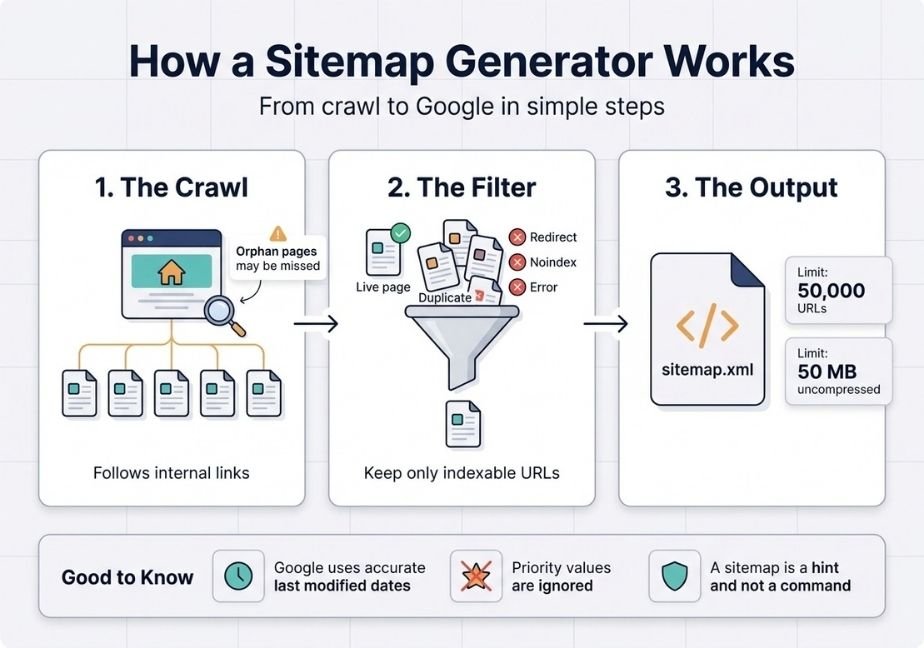
However, Google also sets clear limits. A sitemap does not guarantee that Google will crawl or index a page. It is a hint and not a command. Also, one sitemap file can hold up to 50,000 URLs or 50 MB uncompressed. Bigger sites need several files tied together by a sitemap index.
A Short History of Sitemaps
The idea is not new. According to Wikipedia, Google introduced the Sitemaps protocol in 2005. Yahoo and Microsoft joined in 2006. The shared standard now lives at sitemaps.org. You can read the full story on the Wikipedia page for Sitemaps.
That shared standard is why one file works across search engines. So a tool only needs to follow the format. It does not need special code for each engine.
How a Sitemap Generator Works
A sitemap generator does three jobs. It finds your pages. It filters them. Then it writes the file. Let us look at each step.
Step One: The Crawl
The tool starts at your home page. Then it follows every internal link it can reach. It records each URL along the way. This is called a crawl.
Because it follows links, it can miss orphan pages. These are pages with no links pointing to them. So a crawl based tool may not see everything.
Step Two: The Filter
Next, the tool decides which URLs to keep. A good generator lets you review the list. You can remove duplicates and pages you do not want indexed. One hosting guide advises picking a tool that lets you review the crawl and delete extra URLs.
This step matters more than most people think. A messy list leads to a messy sitemap.
Step Three: The Output
Finally, the tool writes an XML file. You download it and name it sitemap.xml. Some tools also make an HTML version for visitors. Others offer a text list of URLs.
Free tools often cap the number of URLs. So check the limit before you start. A cap can quietly cut off part of your site.
What to Expect From the UploadArticle Sitemap Generator
Now to the tool itself. Let us split what is reported from what is proven.
What Is Reported
Third party write ups describe a few traits:
- It runs in the browser with no software to install.
- You enter your domain and choose a few options.
- It lets you filter pages by type or URL pattern.
- It may let you set priority and update frequency.
- It outputs a standard XML sitemap file.
These traits match what most online generators offer. So they sound reasonable.
What Is Not Proven
Here is the careful part. Reviewers could not fully confirm the tool’s features or safety. One review says to verify that any UploadArticle.com generator page is genuine before use. That is wise. Fake tool pages exist across the web.
Also, take the priority setting with a grain of salt. Google says it ignores the priority and change frequency values in a sitemap. It does read the last modified date if that date is accurate. So these fields will not boost your rankings.
Therefore, judge the tool by its output. A good file lists only the right URLs. It uses correct syntax. It does not hide odd links or scripts.
How to Test the Tool Safely
Never test a new tool on your main site first. Use a small sample site instead. It takes about thirty minutes. Follow these steps.
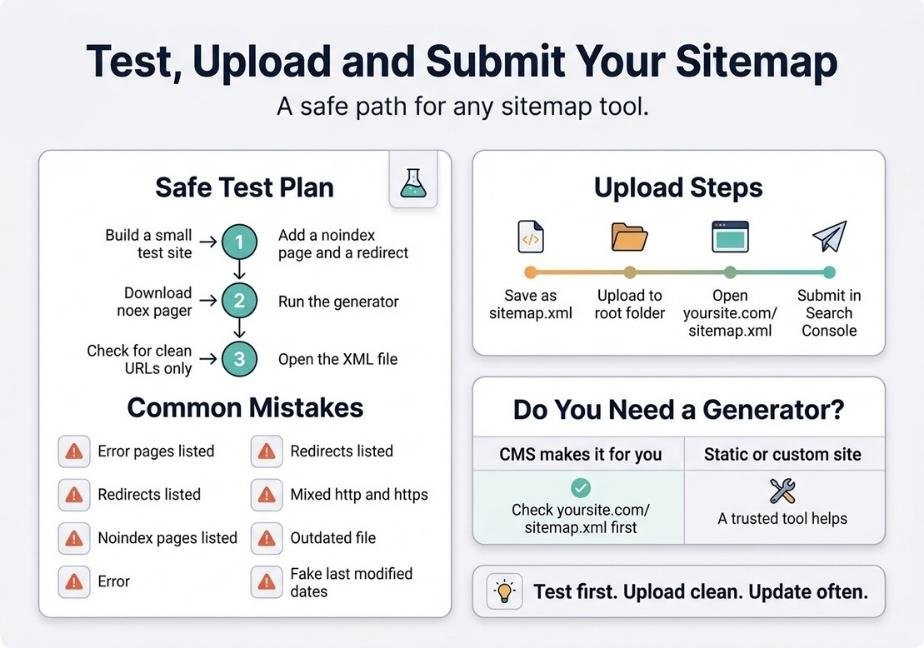
- Build a tiny test site with five to ten pages.
- Add one page with a noindex tag and one broken link.
- Add one redirect and one duplicate page.
- Run the generator on the test domain.
- Open the XML file in a text editor.
- Check that only good, indexable URLs appear.
- Confirm the file has no strange code or outside links.
Next, compare the results with your plan. The file should include your live pages. It should leave out the noindex page, the broken link, and the redirect. If it fails these checks, skip the tool.
Also check the page itself. Look for a secure connection and clear contact details. Avoid tools that ask for passwords or payment for a basic sitemap. A sitemap tool only needs your public domain.
How to Upload Your Sitemap Step by Step
Once you have a clean file, the upload is easy. Here is the simple process.
- Save the file as sitemap.xml on your computer.
- Open your hosting file manager or an FTP client.
- Go to the root folder, often called public_html.
- Upload the sitemap.xml file there.
- Visit yoursite.com/sitemap.xml to confirm it loads.
- Open Google Search Console and select your property.
- Go to the Sitemaps report and enter the file address.
- Click Submit and check the status after a day.
Some platforms work differently. For example, certain website builders let you upload a sitemap inside a settings panel. Others host the file for you. So check your platform’s help pages first.
Also add a line to your robots.txt file. It looks like this: Sitemap followed by the full file address. This helps other search engines find it without a manual submission.
Common Sitemap Mistakes to Avoid
Even a good tool cannot fix a poor plan. Watch out for these errors.
- Listing pages that return errors such as 404 or 500.
- Including URLs that redirect somewhere else.
- Adding pages blocked by robots.txt or tagged noindex.
- Mixing http and https or www and non www versions.
- Forgetting to update the file after major site changes.
- Setting every last modified date to today.
The last point is a big one. If every page claims a fresh date, Google learns to ignore the field. So only update the date when a page truly changes.
Also keep your list lean. Include pages that you want people to find. Skip thin pages, test pages, and internal search results.
Do You Need a Generator at All?
Maybe not. Many platforms build sitemaps for you. WordPress sites often use an SEO plugin to do it. Some hosts, such as real estate website providers, make a sitemap for every site they host. One such provider even advises most users to keep the automatic file.
So check your site first. Visit yoursite.com/sitemap.xml. If a file loads and looks right, you may be set. An extra tool could add duplicates or errors.
However, a generator still helps in some cases. Static sites often lack a built in option. Custom builds may need one too. In those cases, a trusted tool saves time.
When you do use a tool, set a reminder. Rebuild the file after big changes. For example, run it after a redesign or a content push.
Frequently Asked Questions
What is the sitemap generator UploadArticle tool?
It is an online XML sitemap builder linked to UploadArticle.com. Features are reported by reviewers and not independently confirmed, so test before use.
Is the UploadArticle sitemap generator safe?
Safety is unproven. Verify the page is genuine, test it on a sample site and inspect the XML file before uploading.
Where do I upload my sitemap file?
Upload sitemap.xml to your site’s root folder. Then submit its address in Google Search Console.
Does a sitemap improve my rankings?
No. A sitemap helps search engines find pages faster. It does not boost rankings directly.
How often should I update my sitemap?
Update it after major site changes or new content. Many CMS tools do this automatically.
Conclusion
The sitemap generator UploadArticle search points to an online XML sitemap tool tied to UploadArticle.com. The idea behind it is sound. A sitemap helps search engines find your pages. Yet the tool’s features and safety are not independently confirmed.
So take a careful path. Test the tool on a small sample site. Check the XML file by hand. Keep only clean, indexable URLs in the list. Then upload the file to your root folder and submit it in Google Search Console.
Remember one more thing. You may not need a generator at all. Your CMS might already make a sitemap for you. Check that first. In the end, a clean and current sitemap beats any fancy tool.