

You are typing an email at work. Then you stop on one word. Is it transfered or transferred? Plenty of people freeze at this spot. Luckily, the answer is simple. In short, transferred is correct. Meanwhile, transfered is a common typo.
This guide shows why transferred has two r’s. First, you will learn the rule behind it. Then you will see the word in real sentences. You will also get quick tricks to remember it. By the end, you will spell it right every time.
Transfered or Transferred:
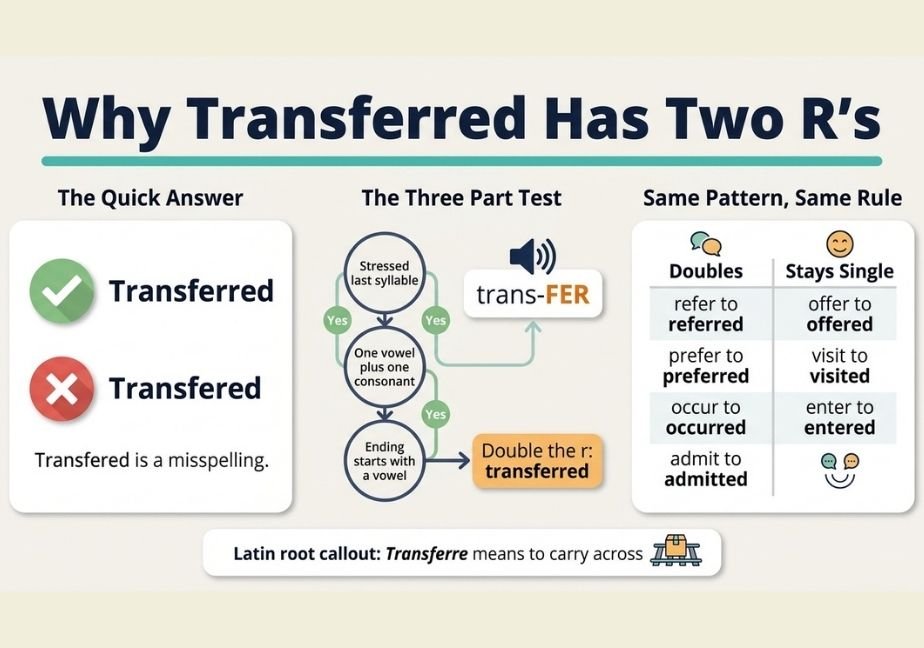
Transferred is the correct spelling. Transfered is a common misspelling. The verb transfer ends in a stressed syllable with one vowel and one consonant. English doubles the final r before ed and ing. So the past tense is transferred and the present participle is transferring.
Next, here is the same answer in a table.
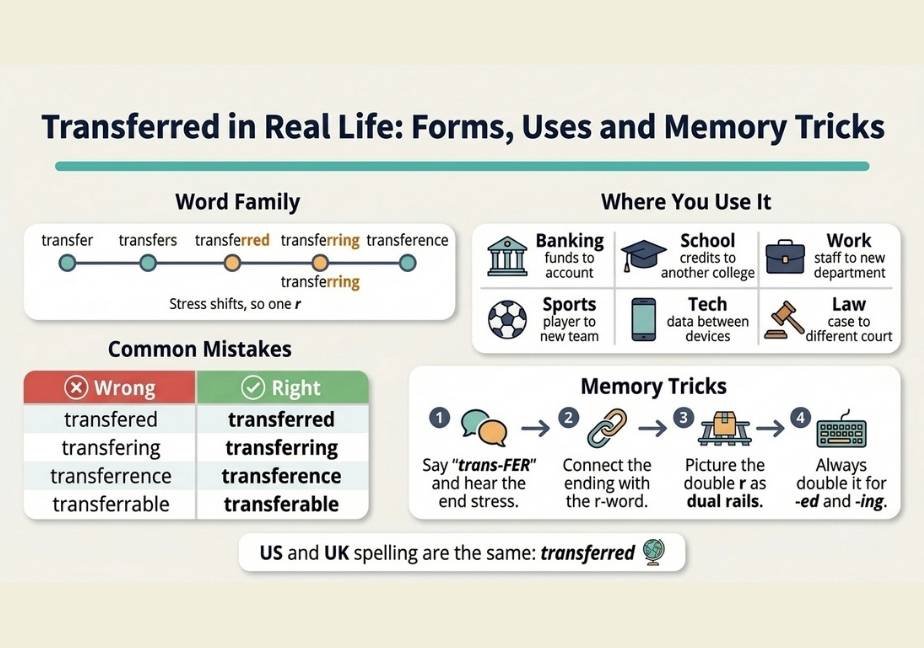
| Word form | Correct spelling | Common mistake |
|---|---|---|
| Past tense | transferred | transfered |
| Past participle | transferred | transfered |
| Present participle | transferring | transfering |
| Noun for the act | transference | transferrence |
| Adjective | transferable | transferrable (less common) |
What Does Transferred Mean?
Transferred is the past tense of transfer. In addition, it is the past participle. Simply put, to transfer means to move something from one place or person to another. Merriam-Webster lists transfer as both a verb and a noun. Moreover, it gives transferred and transferring as the verb forms.
Now think about how the word works. For instance, you can transfer money. You can transfer a student. You can transfer a file or a phone call. In each case, something moves. As a result, the past form tells us the move is done. For example, “She transferred the funds on Monday.” Likewise, “The club transferred its star player last summer.” Both sentences use two r’s.
Noun or Verb?
Transfer can do two jobs. First, as a noun it names the move. Second, as a verb it names the action. For instance, a bank transfer is a noun phrase. “The bank transferred my money” is a verb phrase. Still, the spelling of the base word stays the same. Only the verb endings change.
Why Transferred Has Two R’s
The double r is not random. In fact, English follows a clear rule here. First, look at the stress in the word.
The Stress Rule
First, say the word out loud. Then you hear transFER. The stress lands on the last syllable. That is the key to the whole spelling.
Here is the rule. When a verb ends in a stressed syllable, the last consonant usually doubles. This happens before endings like ed and ing. As a result, transfer becomes transferred and transferring.
The Three Part Test
Next, use this quick test on any verb:
- Does the word end in a stressed syllable? Transfer does.
- Does it end in one vowel plus one consonant? Yes. It ends in e and r.
- Does the ending start with a vowel? Yes. Both ed and ing do.
If all three answers are yes, you double the last letter. Transfer passes each check. Therefore, you write transferred.
Other Verbs That Follow the Same Rule
In fact, you already use this rule all the time. Look at these common verbs:
- Refer becomes referred.
- Prefer becomes preferred.
- Occur becomes occurred.
- Submit becomes submitted.
- Admit becomes admitted.
- Control becomes controlled.
Notice the pattern. Nobody writes refered or occured. Likewise, transfered looks just as wrong.
However, some verbs work differently. They stress the first syllable. Offer becomes offered. Visit becomes visited. Enter becomes entered. The stress sits early, so the last letter stays single. Many writers mix up these two groups. That is why the slip happens.
Where the Word Transfer Comes From
According to Etymonline, transfer comes straight from the Latin word transferre. That word joins two parts. Trans means across. Ferre means to carry. So transfer literally means to carry across.
Interestingly, the ferre part shows up in other words too. Refer, prefer, defer, confer and infer all share it. Their past tense forms double the r. Specifically, they read referred, preferred, deferred, conferred and inferred.
However, do not trust the letters alone. Offer, suffer and differ also end in fer. Yet they stress the first syllable. So they stay single, as in offered, suffered and differed. The rule depends on stress and not on spelling.
Every Form of Transfer
Many readers search for more than the past tense. Therefore, here is the full word family.
Verb Forms
- Base form: transfer
- Third person: transfers
- Past tense: transferred
- Past participle: transferred
- Present participle: transferring
The past tense and past participle match. Fortunately, that makes life easier. You only need to learn one spelling for both. For example, “She has transferred” and “She transferred” use the same word.
Related Nouns and Adjectives
Now things get interesting. Some related words keep a single r. The stress often moves toward the front of the word. As a result, the r no longer doubles.
- Transfer (noun): a move from one place or person to another
- Transference: the act of transferring, also a term in psychology
- Transferal: another noun for the act of transferring
- Transferee: a person who receives a transfer
- Transferor: a person who makes a legal transfer
- Transferable: able to move from one person or place to another
How to Use Transferred in Different Tenses
Transferred shows up in more than one tense. First, it works as a simple past verb. Second, it joins helper words to form other tenses. Here are the main patterns:
- Simple past: She transferred the money yesterday.
- Present perfect: She has transferred the money already.
- Past perfect: She had transferred the money before noon.
- Present continuous: She is transferring the money now.
- Future: She will transfer the money tomorrow.
Notice one detail. The future form drops the ed. After will you use the base word transfer. Likewise, after to you use the base word. For example, “I need to transfer the file.”
Sometimes the action happens to the subject. Then you use was or were plus transferred. For instance, “The case was transferred to another court.” This form is passive. Still, it appears often in news and legal writing. So you should know it.
Which Word Comes After Transferred?
Transferred often pairs with small words. Most of the time it takes to. For example, “She transferred to a new team.” Next, it can take from. For instance, “He transferred from the old branch.” Also, you can say transferred out of or transferred over. In every case, the spelling of transferred stays the same.
Transferable or Transferrable?
Here is a small twist. Both spellings appear in print. Merriam-Webster lists transferable first and calls transferrable less common. Dictionary.com shows both forms as well.
Because of that, most writers choose transferable. For formal writing, pick it too. For example, “transferable skills” is the usual phrase on resumes. In contrast, dictionaries give transferred as the verb form. Transfered is simply wrong.
Why So Many People Write Transfered
Even skilled writers make this slip. Why does it happen? There are a few clear reasons.
- Common words like offered and entered teach the brain to expect one letter.
- The ending ed looks complete after a single r.
- Fast typing hides the missing letter.
- Spellcheck does not always catch the error.
Let’s look closer at the first point. Offered and entered are very common. Because of them, your brain expects a single letter. Also, we read fast. Our eyes skip small errors. Furthermore, some tools flag the word while others do not. Therefore, you need to know the rule yourself.
Besides, a wrong spelling can hurt your credibility. Imagine a bank email with transfered in the subject line. Or picture a resume that says “transfered to a new branch.” Readers notice. In fact, many judge the writer fast. So it pays to get this one right.
Transferred in Real Sentences
Rules help. However, examples help more. Here is how transferred works in different settings.
Banking and Money
- The bank transferred $500 to my savings account.
- I transferred the rent this morning.
- Her employer transferred the salary on Friday.
Money is the most common use. After all, people move funds between accounts every day. So you will see transferred on receipts and apps all the time. Wire transfer and bank transfer are two common noun phrases.
School and Work
- My brother transferred to a new college last fall.
- The company transferred her to the Dubai office.
- The agent transferred my call to billing.
Here the word means a change of place or role. Additionally, it can also mean a handoff on a phone line. Merriam-Webster notes the school sense too. For example, a student can transfer from one institution to another.
Sports
- The club transferred its striker in January.
- She transferred to a bigger team after the season.
For example, football fans know this word well. The transfer window is the period when clubs buy and sell players. So sports news uses the word a lot.
Technology
- I transferred all my photos to a new phone.
- The app transferred the file in seconds.
- Our team transferred the data to a secure server.
Similarly, tech users move files all day. So the word fits their world too. Keep the double r in emails and support tickets alike.
Law and Property
- The seller transferred the title to the buyer.
- The court transferred the case to another judge.
Finally, legal writing needs exact spelling. A typo in a contract looks careless. Therefore, double check this word in any formal document.
Are US and UK Spellings Different?
No. Both use transferred and transferring. However, this differs from words like traveled and travelled. British English doubles the l in travel even without stress. American English usually does not.
Transfer ends in a stressed syllable. Because of that, both styles double the r. As a result, you never need to switch spelling for your audience. That helps global writers.
Easy Ways to Remember the Spelling
Try these quick memory tricks:
- Say the word aloud and stress the last syllable.
- Link it to referred and preferred in your mind.
- Picture two r’s as two rails that carry cargo across.
- Type the word three times to build muscle memory.
- Run the three part test whenever you doubt a verb.
Also, the root helps here. Transfer means to carry across. So imagine two rails carrying the word safely to its end. It sounds silly. Yet silly tricks tend to stick.
A Quick Proofreading Habit
Typos slip through even after careful reading. So build a simple check into your routine. First, search your draft for transfered and transfering. Next, fix each hit. Then search again for transferrence to be safe.
You can also teach your tools. For example, add transfered to your autocorrect list. As a result, your phone or editor will swap in transferred for you. Finally, read important emails aloud. Your ear often catches what your eyes miss.
Quick Practice
Now test yourself. Fill in each blank. Then check the answers below.
- The student ___ to our school in May.
- She is ___ the files right now.
- Those skills are easily ___ to any job.
Answers: transferred, transferring, transferable. Did you get them all? If so, you have the rule down.
Frequently Asked Questions
Is it transfered or transferred?
Transferred is correct. Transfered is a misspelling. The verb transfer doubles its final r before ed because the stress falls on the last syllable.
What is the past tense of transfer?
The past tense of transfer is transferred. The past participle is also transferred, as in “she has transferred.”
Is transfered a word?
No. Transfered is not a valid English spelling. It is a typo of transferred, so always write two r’s.
Is it transferring or transfering?
Transferring is correct. The final r doubles before ing for the same reason it doubles before ed.
Do British and American English spell it differently?
No. Both use transferred and transferring. The stress on the last syllable triggers the double r in both styles.
Is transferable spelled with one r or two?
One r is the standard form. Transferrable appears as a less common variant.
Final Takeaway
Now you know the answer. To sum up, transferred is right and transfered is wrong. The double r comes from one simple rule. A stressed final syllable with one vowel and one consonant doubles its last letter.
Remember the link to referred and preferred. Also remember that stress explains the exceptions. Overall, it is the one idea to keep. It shows why offered stays single and why transference has one r. Next time you type this word, run the quick test. Then hit send with confidence.