

You typed Zvodeps Explained into Google because the word looks odd. It even sounds technical. Yet no dictionary lists it. So what is it? Zvodeps is an emerging internet term. People use it for a flexible way to mix creative freedom with clear structure.
This guide gives you the short answer first. Then it shows where the word likely came from and how people say it works. It also compares Zvodeps with DevOps and Agile. Most important, it separates what is known from what is repeated online. However, many pages treat Zvodeps as settled. In truth, it is not.
What Is Zvodeps?
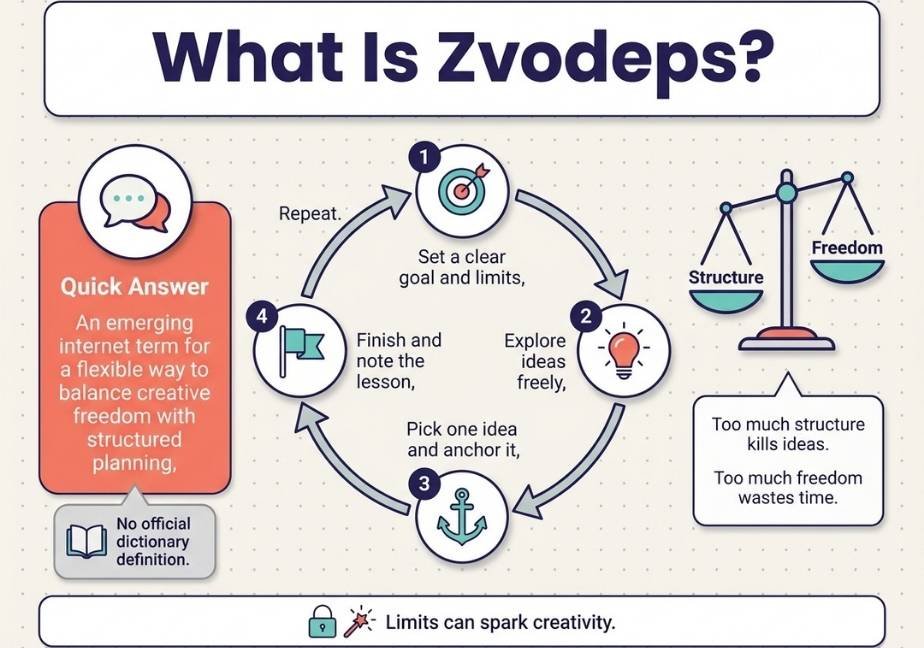
Zvodeps is an emerging internet term for a flexible way to work. It balances creative freedom with structured planning. Most explainers call it a mindset or framework, not an app or company. No dictionary or academic source defines it, so its meaning depends on how each writer uses it.
In plain terms, the habit looks like this. You set a goal and a few limits. Next, you try ideas freely. Then you pick one idea and finish it. That is the whole core. The rest of this guide adds context and cautions.
What Do People Want to Know About Zvodeps?
Most visitors reach this word by accident. For example, they see it in a blog title or hear it in a chat. Then they search. So the intent is informational. The real question is simple: what does Zvodeps mean and is it real?
People usually want one of these answers:
- A plain definition they can repeat in one sentence.
- A clear yes or no on whether it is software.
- A comparison with DevOps or Agile.
- A way to judge whether the idea is worth using.
Where Did Zvodeps Come From?
No one has proven who coined the word. Also, no company or author claims it. Still, a few clues help.
The Origin Is Unproven
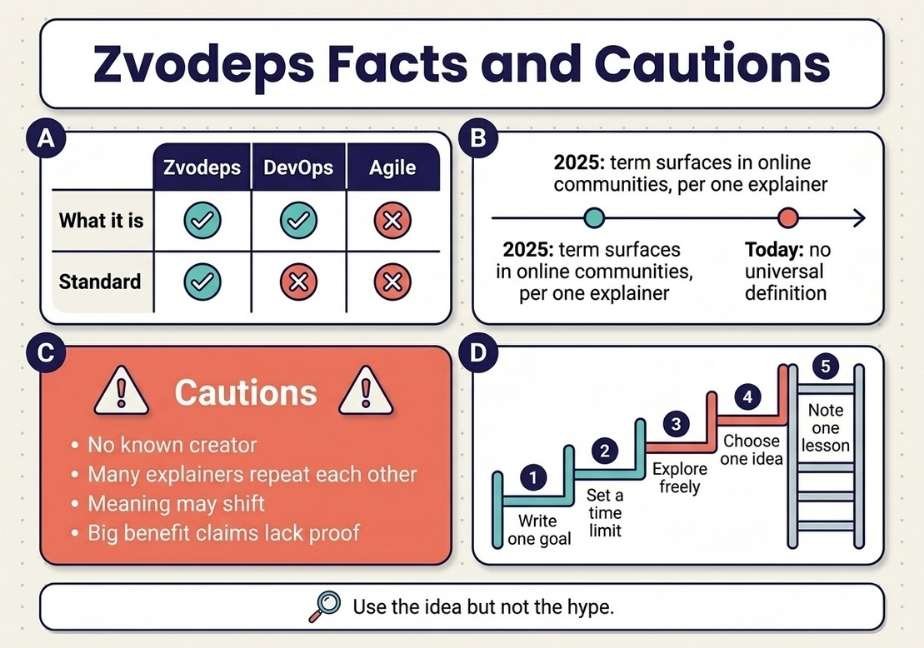
One explainer says the term surfaced across digital communities in 2025. Other pages repeat that story. However, none of them show a first source. So treat the date as a claim and not a fact.
Linguists track new words on a scale. Wikipedia’s entry on neologism describes a “neological continuum.” It starts with a nonce word that someone uses once. Next comes a protologism that a small group uses. After that comes a prelogism that is gaining ground. A true neologism has won wider recognition. Overall, Zvodeps looks closer to the early stages. Many people use it online. Yet no dictionary or institution backs it. Is that a problem? Not really. Every common word started somewhere. Still, an unproven word needs careful handling.
One explainer says the meaning grew through repeated use and talk. That fits how new words spread. People read a term. Then they guess what it means. Next, they repeat their guess to others. Over time, a loose meaning forms. However, a loose meaning is not a verified one. For that reason, two writers can describe Zvodeps in very different ways.
Why the Word Looks Technical
The ending “deps” echoes DevOps. As a result, some readers guess it belongs to software. One explainer notes that people assume it is a flavor of Agile or DevOps because of how the word looks. That guess is natural. However, it is unproven. Meaning comes from use. Right now, use points to creative work and workflow rather than code.
What Ideas Do Explainers Link to Zvodeps?
Writers repeat a few themes. These are not official rules. They are common interpretations.
Structure With Freedom
On one hand, too much structure blocks fresh ideas. On the other hand, too little leaves you stuck. Explainers say Zvodeps aims for the middle. They describe it as a link between structured planning and open ended exploration. Picture a writer with a deadline and a topic. The limits give direction. Inside them, ideas can roam. icon-era
Constraints as a Creative Tool
Limits can spark work. For example, a short deadline forces focus. A fixed format forces choices. One explainer frames this as using constraints to drive creativity instead of caging it. So the point is not to skip rules. Instead, you pick a few smart ones.
Where Explainers Say It Fits
Explainers point to a few settings. They name tech, design, marketing, school and startup work. Another source adds that the term drew attention in SEO circles. These settings share one trait. Each one values fast change. Still, no source shows a named company or school that uses Zvodeps in a documented way.
A Repeatable Loop
Several writers describe the idea as a loop you can run on a project or a single work session. Here is a common version:
- Set a clear goal and a few firm limits.
- Explore ideas without judging them too early.
- Pick one idea and commit to it.
- Finish the work and note one lesson.
You open up. Then you narrow down. After that, you ship and learn. Many people already work this way without a label.
Zvodeps vs DevOps and Agile
Mixing these terms up causes real confusion. So let us pull them apart.
DevOps is a proven software practice. Atlassian describes DevOps as practices that join software development and IT teams. The goal is to build, test and release software faster and more reliably. Agile is a family of step by step methods for software work. Both have written practices and active communities.
Zvodeps has neither. It has no standard and no certification. Likewise, it has no official toolkit. As a result, you cannot study it the way you study DevOps. Traditional project management usually fixes the plan early. Explainers say Zvodeps puts adaptability ahead of fixed planning. icon-era
| Term | What it is | Standard or toolkit |
|---|---|---|
| Zvodeps | Loose idea that mixes creativity with structure | None |
| DevOps | Practices that join software development and IT teams | Established practices and tools |
| Agile | Step by step approach to software work | Written values and methods |
One source warns that Zvodeps should not be confused with established software development frameworks. That advice is sound. If a manager asks for DevOps, offer DevOps. Even so, the mindsets can overlap. All three value feedback and adapting to change.
How Could You Use the Zvodeps Idea?
Zvodeps has no official method. Still, you can borrow the loop. These three scenarios are only examples. They are not real case studies.
For instance, a student sets a due date and a topic. Next, they brainstorm freely for a short time. Then they choose one angle and write.
In another case, a video creator picks a theme and a length. After that, they test a few openings. Finally, they choose the strongest and publish.
Meanwhile, a small team holds a short planning call. Each person then explores options for a day. Later, the team commits to one path and reviews the result.
Here is a worked example. You must send a newsletter on Friday. On Monday, you write one goal and a limit of 600 words. On Tuesday, you list ten possible angles. On Wednesday, you pick one and outline it. On Thursday, you write. On Friday, you send it and note what worked.
To try it yourself:
- Write your goal in one sentence.
- Set a time limit and one firm rule.
- Explore ideas freely for a short block.
- Choose one idea and finish it.
- Write one lesson for next time.
Do you need special software? No. One explainer says teams use the communication and project tools they already have. A notebook works fine.
Benefits and Limits of the Zvodeps Idea
Explainers list several benefits. Keep in mind that these are claims. Nobody has tested them. Still, they show why the idea appeals to people.
Possible Benefits
- Flexibility: plans can change without wrecking progress.
- Balance: it guards against both chaos and rigid control.
- Collaboration: it encourages open talk inside a team.
- Personal fit: people can shape it to their own style.
Notice what is missing. No explainer offers hard numbers. For that reason, this guide treats every benefit as a claim.
Real Limits
The idea has clear weak spots. First, it has no standard. So two people may use the word in different ways. One may mean a work habit. Another may mean a mood or a trend. Second, no one has measured results. As a result, you cannot promise it will raise output.
Another risk is endless brainstorming. One explainer stresses that the loop must end in finished work. Anchoring a choice is not optional. Because of this, set a deadline before you start. Besides that, a label with no shared meaning is hard to teach. New teammates will ask what it means. Then you will explain the loop anyway. So the plain description often works better. Also, tasks with fixed rules, such as safety checks, probably need firmer processes.
Is Zvodeps Real? Facts and Cautions
In one sense, the word is real because people use it. Yet the thing it names is vague. Here is what the available sources support:
- No dictionary or academic source defines Zvodeps.
- One explainer says it is not a registered company or app.
- No creator or owner of the term is known.
- Its online presence is scattered across many similar pages.
Why So Many Pages Cover It
Search results show many pages with near identical headings and claims. For example, many of them define the term in almost the same words. Few cite a first source. The sources do not explain why. So read each claim with care. A confident tone does not equal proof.
What to Avoid
- Treating Zvodeps as software you can download or buy.
- Assuming it equals DevOps because the spelling looks similar.
- Citing it as an official method in a report or class paper.
- Paying for a course that promises a certified Zvodeps system.
- Trusting big benefit claims that show no evidence.
If you share the idea at work, explain it in plain words. Say you want a clear goal with room to explore. That way, it lands faster than a strange label.
How to Check Any New Term Before You Trust It
Overall, Zvodeps is a good test case. You can use the same steps on the next odd word you meet.
- Search trusted dictionaries for an entry.
- Look for a named author or a first source.
- Compare several pages and check whether they merely repeat each other.
- Check the date and look for newer updates.
- Look for an official site or a verified organization.
For Zvodeps, the first check fails. No dictionary entry appears. The second check also fails. No first source appears. The third check shows heavy overlap between pages. So the sensible stance is simple. Treat Zvodeps as a loose idea and not as established knowledge.
Does that mean you should ignore it? No. A word can still carry a useful thought. Here the thought is about balance. You need direction and you need room to explore. That point stands on its own, with or without the label.
Frequently Asked Questions
What does Zvodeps mean?
It is an emerging internet term for a flexible way to balance creative freedom with structured planning. No dictionary defines it.
Is Zvodeps a software tool or app?
No. Explainers call it a mindset or framework. One says it is not a registered company or app.
Is Zvodeps the same as DevOps or Agile?
No. DevOps and Agile are proven software practices. Zvodeps is a loose idea about creativity and workflow with no standard or toolkit.
Where did Zvodeps come from?
No one has proven its origin. One explainer says it surfaced in online communities in 2025 but cites no first source.
Why do so many articles mention Zvodeps?
The sources do not say. Many pages repeat similar claims. Volume is not proof that the term is real.
Can I use Zvodeps at work?
Yes, as a simple habit. Set a goal and limits, explore ideas, pick one and finish. Do not present it as an official method.
Conclusion
Zvodeps is a new internet word with no official definition. In short, people use it for a loop that mixes limits with freedom. You set a goal. You explore. Then you pick one idea and finish.
The takeaway is simple. Use the habit and skip the hype. The idea is sensible. Yet the label is shaky. So do not call it a certified method. Do not confuse it with DevOps or Agile. When you share it, describe the habit in plain words.
A word earns its meaning from use. Zvodeps may fade. Or it may settle into a real term. Either way, the lesson stands. Good work needs structure and room to play. So take the loop, test it on one small project. Then judge it by what you finish.