
![A dynamic sports photo shows a male volleyball player in mid-air, spiking a ball over a net in an indoor arena[cite: 13]. Behind him, a massive image of an elephant is dramatically rendered in explosive golden dust and bright light[cite: 13]. Golden script text at the bottom reads "Flying Elephant Memoirs[cite: 13]."](https://tastimer.com/wp-content/uploads/2026/10/flying-elephant-memoirs.jpg)
Flying elephant memoirs sounds like a bedtime story about a winged animal. Many people who search the phrase soon learn it is not that simple. The results mix a Soviet volleyball star with a Royal Air Force squadron and an old folk tale. So the phrase confuses almost everyone at first.
This guide clears up that confusion. You will learn who Aleksandr Savin is and why friends called him the Elephant. You will also see what we could confirm about the memoir and what we could not. Finally, you will get a simple way to test any book page before you trust it.
What Flying Elephant Memoirs Means
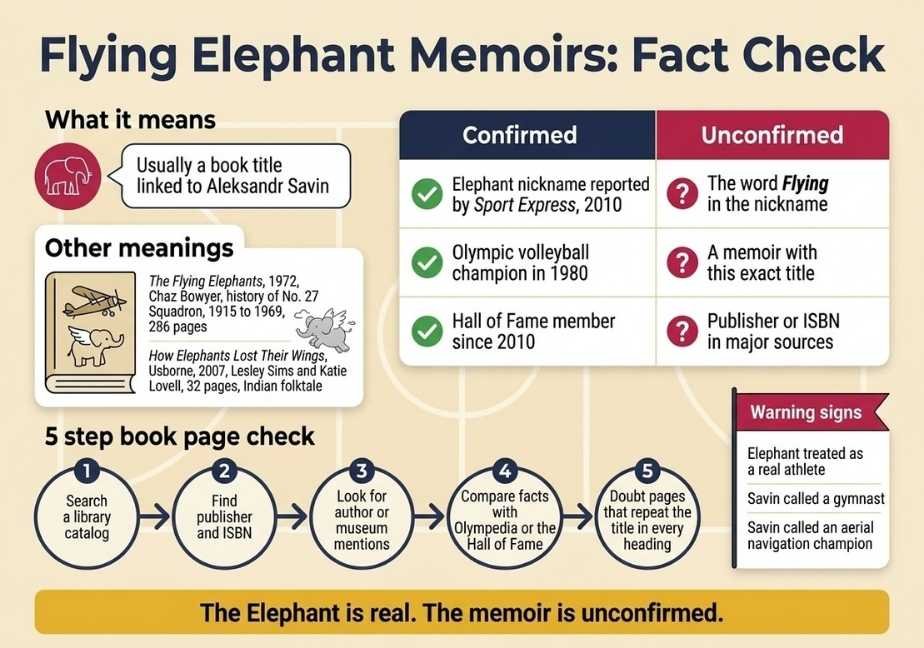
Flying elephant memoirs usually points to a book title tied to Aleksandr Savin. Savin is a Soviet volleyball legend who won Olympic gold in 1980. Friends nicknamed him the Elephant. Many websites say he wrote a memoir with this name. However, none of the major reference pages we checked list such a book.
Who Is Aleksandr Savin?
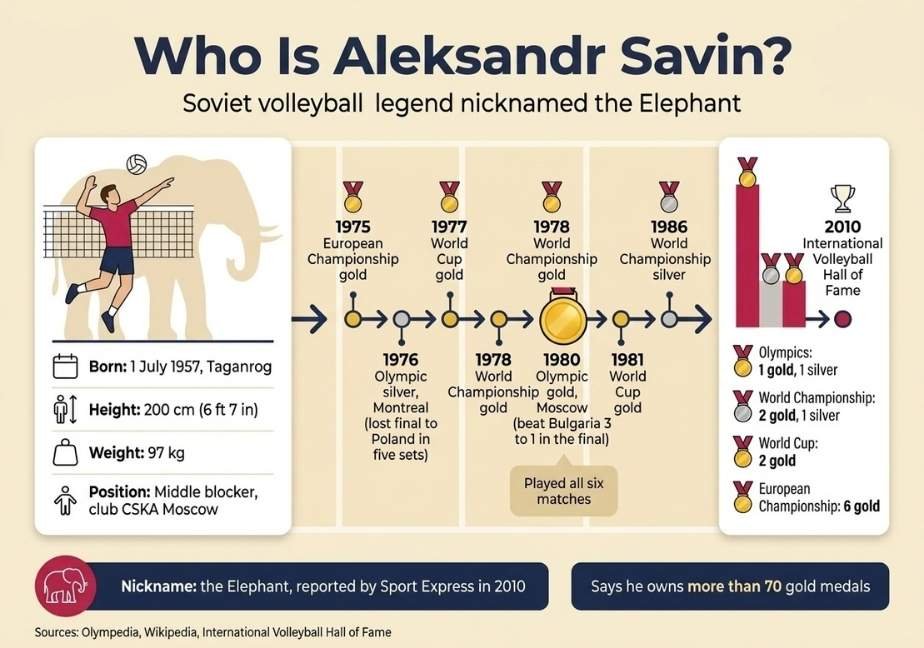
Aleksandr Borisovich Savin is the real person behind this search. He came into the world in Taganrog on 1 July 1957. As a child he moved with his family to Obninsk. There he started playing volleyball as a student. According to Wikipedia, his first coach was Vladimir Pitanov.
Obninsk matters to this story. It is a city in the Kaluga region where Savin grew up. He joined the local youth team there in 1967. Wikipedia adds that the team later became a sports school. Today that school carries his name. So his hometown still honors him.
Size, Position and Club
Savin stood 200 centimeters tall. That is about 6 feet 7 inches. Olympedia lists his weight at 97 kilograms. He played as a middle blocker. In that role he guarded the net against the strongest attackers.
A middle blocker works at the center of the net. This player jumps to stop attacks from every side. The job also includes quick attacks. So height and timing matter more than almost anything else.
Meanwhile, he played club volleyball for CSKA Moscow. That army club shaped many Soviet stars. Savin later said that CSKA taught players how to live and not only how to play.
The Olympic Story
The International Volleyball Hall of Fame tells this part well. First came Montreal in 1976. Savin played all five matches there. The Soviets won every pool game without dropping a set. Then they beat Cuba in the semifinal. In the final, however, Poland won a tight five set match. So Savin took home silver.
That loss only made the team hungrier. Four years later the Games came to Moscow. The Soviets opened with a 3 to 1 win over Czechoslovakia. Next they shut out Italy, Bulgaria and Cuba in pool play. Then they swept Romania. Finally they beat Bulgaria 3 to 1 in the final. Savin played all six matches. Gold on home soil sealed his place in history.
Honors followed. Wikipedia says he became an Honored Master of Sports in 1976. He received the Order of the Badge of Honour in 1980. He also earned the Order of Friendship of Peoples in 1985. Then in 2010 the Hall of Fame inducted him. The ceremony took place on 22 October in Holyoke, Massachusetts.
Where the Elephant Nickname Comes From
Now we reach the heart of the keyword. The Elephant part of the phrase is real. In a 2010 interview the Russian paper Sport Express called Savin the famous Elephant. The paper said the nickname stuck during his playing years. It added that colleagues and friends still use it. Teammate Vyacheslav Zaitsev carried a nickname too. Friends called him the Hare.
The paper did not explain the reason. So any story about its origin is a guess. Still, one clue helps. Volleyball coach Mark Lebedew wrote about Savin on his blog At Home On The Court. He compared Savin to basketball legend Julius Erving. Lebedew argued that Cold War isolation and little television coverage made Savin even more of a legend.
He also praised one clip in particular. In it Savin jumps early and reaches over the net with one hand. At full height he nearly attacks the ball with his left hand. A leap like that explains why some writers added the word flying. Even so, it is only a reasonable guess. Neither Wikipedia nor the Hall of Fame profile uses the phrase flying elephant. So the full nickname seems to live mostly on newer web pages.
What the Flying Elephant Memoirs Claim to Be
What Websites Say
Search for flying elephant memoirs of an Olympic champion and you will find many near copies. Most name Savin as the author. They call the book a sports memoir about Soviet training and Olympic pressure. One page lists a Kindle edition. Another says the book holds over 240 rare photos. A third explains the title as a symbol of success that looks impossible until years of work make it real.
Several pages also share one story line. They say a small town boy rose to Olympic gold. That story matches Savin’s real path from Obninsk to Moscow. So some writers may simply borrow his public record.
Where the Story Falls Apart
However, the details do not line up. Older pages on one site treat the flying elephant as a real animal. They say it won an Olympic gold medal. Other pages from the same site call Savin a gymnastics prodigy. One even calls him a champion of aerial navigation. Meanwhile, Olympedia lists him only in volleyball. So at least some of these pages made things up.
Moreover, the pages we reviewed show no publisher or ISBN. Nor do Wikipedia and the Hall of Fame mention a memoir. As a result, we treat the book as unconfirmed. It may exist as a small self published title. It may also exist only as a search phrase. We cannot tell yet.
Savin’s Career at a Glance
Olympedia confirms the Olympic results. Other facts come from Wikipedia and the Hall of Fame. Here are the key points.
- Born 1 July 1957 in Taganrog.
- Played for the Soviet national team from 1975 to 1986.
- Won Olympic silver in Montreal in 1976.
- Won Olympic gold in Moscow in 1980.
- Won World Championship gold in 1978 and 1982.
- Won World Cup gold in 1977 and 1981.
- Won six European titles between 1975 and 1985.
- Won World Championship silver in 1986.
- Entered the Volleyball Hall of Fame in 2010.
Savin also spoke about his medal haul in 2010. He said he owned more than 70 gold medals. He hoped to open a volleyball museum in Obninsk. Wikipedia notes that the sports school there already bears his name.
How the Term Shows Up Around the World
In Russia the nickname is simply the Elephant. The Sport Express writer worried that younger fans no longer know it. In English the longer phrase flying elephant memoirs appears mostly on recent blog style sites. Some pages add the words Kindle edition. That detail suggests many searchers want a place to buy or read the book. So the search often mixes curiosity with shopping intent.
Most searchers want one of three things. Some want a plain definition. Others want to know whether the book is real. A few want to buy it. This guide answers all three. So you can stop clicking through near copies.
Fans abroad often know Savin through short clips. Lebedew wrote that television rarely covered his era. As a result, a few grainy videos carry much of the legend. That gap also explains the hunger for a first hand account.
Other Things People Mean by Flying Elephant
The phrase also matches two real books. Neither one is a sports memoir.
The Flying Elephants (1972)
Chaz Bowyer wrote The Flying Elephants. MacDonald published it in 1972. The book is a history of No. 27 Squadron of the Royal Flying Corps and the Royal Air Force from 1915 to 1969. A rare book dealer lists it at 286 pages with black and white photos. The title nods to the squadron’s elephant badge.
How Elephants Lost Their Wings
Lesley Sims and Katie Lovell made this picture book. Usborne published it in London in 2007. A public library record calls it a retelling of an Indian folktale. In the story elephants once flew. The book runs 32 pages.
Why Search Engines Mix Them Up
Google matches words first. Then it guesses meaning. So a query with flying and elephant and memoirs pulls in anything close. A squadron history and a folk tale both fit part of the phrase. Only context tells you which one you want.
How to Check Any Book Page Before You Trust It
Thin or invented book pages are common. Use these steps to protect your time and money.
- Search the exact title in a library catalog.
- Look for a named publisher and an ISBN.
- Check whether the author or a museum mentions the book.
- Compare names and dates with Olympedia or the Hall of Fame.
- Doubt pages that repeat the title in every heading.
Each step takes a minute. Together they catch most weak pages. For example, a real book nearly always has a publisher record. Also, a real athlete memoir usually appears in the athlete’s own interviews. If both are missing, wait before you buy.
Here is how that works in practice. Take the claim of 240 rare photos. A real photo book would name a photographer or a publisher. It would also sit in a catalog with a page count. If a page gives the photo count but no catalog data, treat the number as marketing.
Why Savin’s Story Still Matters
Savin deserves attention even without a confirmed memoir. The Hall of Fame notes that the Soviets won the first two Olympic volleyball golds in 1964 and 1968. After a bronze in 1972 the team needed fresh talent. Then Savin arrived. The Hall describes a changing of the guard after that. With Savin on court the Soviets began serving notice that they wanted glory back.
Sport Express said Savin and his teammates won an Olympics and two world championships in about ten years. They also took six European titles. Savin added that his Hall of Fame video showed the famous Brazil against USSR match. He said it drew 108,000 fans to the Maracana. Because of such moments, readers want his own words.
A real memoir would fill that gap. Think about what a firsthand book could add. Readers would hear about training under coach Yuri Tchesnokov. They would learn how the team handled the sting of the 1976 final. They would also see daily life at CSKA. Most English sources skip those details today.
Until a confirmed book appears, interviews and official profiles work best. So read the Hall of Fame page and the Olympedia record. Then read the Sport Express interview. If a memoir surfaces later, those sources should mention it.
Frequently Asked Questions
What is flying elephant memoirs?
It is a title linked online to Aleksandr Savin, a Soviet volleyball Olympic champion. Major reference sources do not confirm that a memoir with this title exists.
Who is Alexander Savin?
He is a Soviet volleyball middle blocker born in 1957. He won Olympic gold in 1980 and entered the International Volleyball Hall of Fame in 2010.
Why do people call Savin the Elephant?
Sport Express confirmed the nickname in 2010 but gave no reason. It likely reflects his size and power, though that remains a guess.
Is the flying elephant memoir a real book?
We found no publisher or ISBN in major sources. Check a library catalog or retailer listing before you buy.
Did an elephant ever win an Olympic medal?
No. Stories that say so come from low quality pages. The Elephant nickname belongs to a human volleyball player.
Conclusion
Here is the takeaway. The Elephant is real. The memoir is unconfirmed. Trust records over repeated blog titles. Official profiles give you solid facts about a gold medal career that began in Obninsk and peaked in Moscow.
Your next step is simple. Open the Olympedia record or the Hall of Fame page for facts. Then check a library catalog before you buy any book with this title. If you meant a different book, search by author and publisher instead. That small habit saves money and keeps you away from made up stories.




One Comment