
Tristan meaning in the Bible is a question that pops up often. Maybe you heard the name at church. Or perhaps you want to name your baby boy Tristan. Either way, you want a straight answer. So here it is. The name Tristan never appears in the Bible. However, its story is richer than you might expect.
In this guide, you will learn where the name came from. Then you will see what it means. Next, we will connect it to real Bible themes. Finally, you will find Bible names with similar meanings. Along the way, you will get clear answers to the most common questions. Let us dive in.
Tristan Meaning in the Bible
Tristan is not a biblical name. It comes from a Celtic root linked to the Pictish name Drustan. Over time, people tied it to the Latin word for sad. So the name often carries a meaning of sorrow or tumult. The Bible has no verse about Tristan. However, it has many stories about sorrow turning into joy.
Is Tristan in the Bible?
No, it is not. You will not find Tristan in the King James Version. You will not find it in the NIV or ESV either. In fact, no major English Bible translation lists a person named Tristan.
Why is that? The answer is simple. The Bible was written in Hebrew, Aramaic and Greek. Its names come from those languages. Tristan, on the other hand, has Celtic and medieval European roots. It entered history long after the Bible was complete.
Still, that does not make the name bad. It just means the name has no direct biblical meaning. So any site that claims a Bible verse for Tristan is stretching the facts. Always be careful with those claims.
Here is a quick summary of the facts:
- Tristan does not appear in any major Bible translation.
- The name has Celtic and medieval European roots.
- No Bible verse names or defines Tristan.
- Parents can still choose it as a Christian name.
Where the Name Tristan Comes From
To understand the name, we need to go back in time. The story starts in ancient Britain. Then it moves to medieval France. Let us walk through it step by step.
The Celtic Roots of Tristan
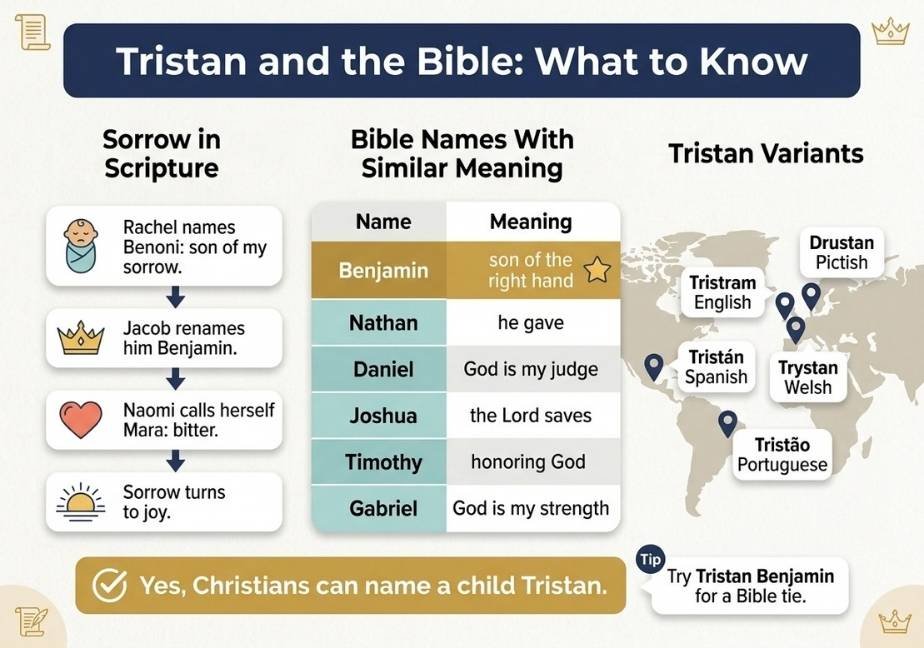
Tristan most likely began as a Pictish name. The Picts lived in what is now Scotland. Their name Drust or Drustan was common among kings. Later, Welsh and Cornish speakers used forms like Drystan and Trystan.
According to Behind the Name, Tristan is a Latinized form of the Celtic name Drustan. That name came from Drust. Some experts link Drust to a word meaning riot or tumult. So the oldest meaning may be noisy or bold.
Scholars still debate the exact root. However, most agree on the Celtic source. That fact alone shows the name has no Hebrew link.
How Tristan Became Linked to Sadness
Here is where things get interesting. Medieval French writers changed the name. They wrote it as Tristan. Then they noticed something. The new spelling looked like the French word triste. That word means sad.
Triste comes from the Latin word tristis. It also means sad or gloomy. As a result, writers started to play with the name. They told stories of a hero born in sorrow. Therefore, the sad meaning stuck.
In other words, the sorrow link grew from wordplay. It was not the original meaning. Even so, it shaped how people see the name today.
The Legend of Tristan and Iseult
The name became famous through a love story. Tristan was a knight of Cornwall. He fell in love with Iseult, an Irish princess. Their tale is full of loyalty and loss. It ends in tragedy.
The legend spread across Europe in the twelfth century. Poets such as Béroul and Thomas of Britain wrote early versions. Later, the story joined the Arthurian tales. According to Encyclopaedia Britannica, the legend inspired many works over the centuries. Composer Richard Wagner turned it into an opera in 1865.
This tale gave the name its romantic and sad feel. Because of it, Tristan became a popular name in English speaking countries. Many parents love its old world charm.
Why People Search for Tristan Meaning in the Bible
Many people type this phrase into Google. So what are they really asking? Usually, they want to know one of three things.
First, some parents want a name with faith roots. They hope Tristan has a Bible link. Second, some people worry about the sad meaning. They wonder if it brings bad luck. Third, some readers simply feel curious. They met a Tristan and want to learn more.
All three reasons make sense. Fortunately, the answers are calm and kind. The name is fine for a believer. Moreover, the Bible gives us strong ideas about sorrow that can bring comfort.
Bible Themes That Match the Sorrow Link
The name Tristan is not in Scripture. Yet the idea of sorrow is everywhere in it. Better still, the Bible never leaves sorrow alone. It always points toward hope. Let us look at four examples.
Rachel and the Name Benoni
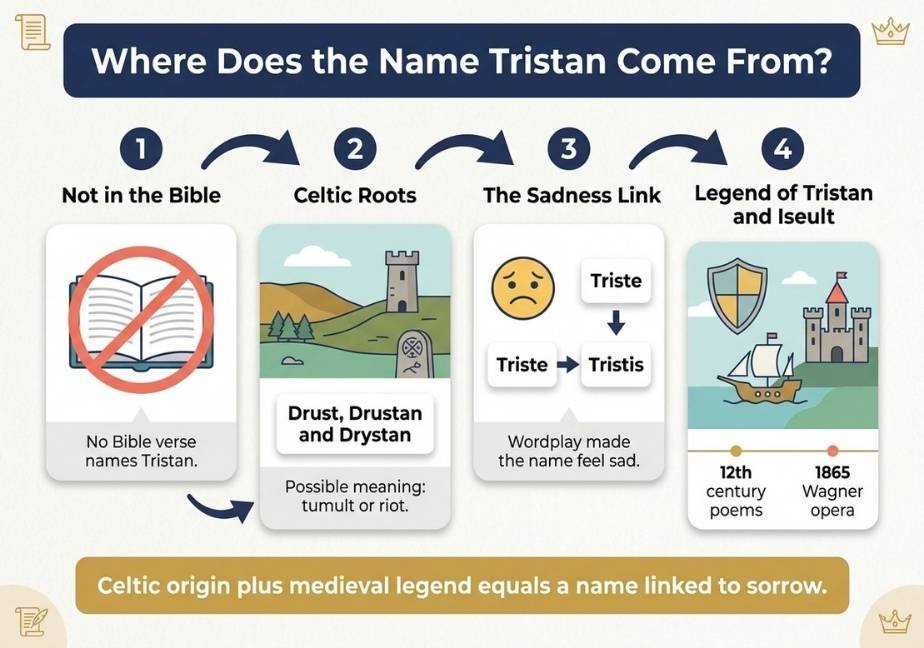
Genesis tells a moving story. Rachel was dying as she gave birth. She named her son Benoni. That name means son of my sorrow. However, her husband Jacob changed it. He called the boy Benjamin instead. That name means son of the right hand.
You can read the scene in Genesis 35:18 on BibleGateway. Notice the lesson. A sad name became a name of strength. So even a sorrowful beginning does not decide the ending.
Naomi and the Name Mara
The book of Ruth offers another example. Naomi lost her husband and her two sons. She came home broken. Then she asked people to call her Mara. That word means bitter.
Yet the story does not end there. God later gave Naomi a grandson. Her neighbors celebrated with her. So her bitter season became a season of joy.
The Man of Sorrows
Isaiah 53 describes the coming Messiah. It calls him a man of sorrows. Christians believe this points to Jesus. He felt pain and rejection. Still, he carried that grief for others.
Because of this, sorrow in the Bible is not shameful. In fact, it connects us to Christ. That view gives the sad meaning of Tristan a deeper and gentler tone.
Sorrow Turned to Joy
Jesus spoke about this too. In John 16 he told his friends they would grieve. Then he promised their grief would turn to joy. Psalm 30 echoes the same hope. It says weeping may last for the night. But joy comes with the morning.
Overall, the Bible treats sorrow as a stop and not a destination. So if someone says Tristan means sad, you can respond with hope. Faith gives every sad story a brighter turn.
Bible Names With Similar or Better Meanings
Maybe you still want a name found in Scripture. That is a fair wish. Many biblical boy names sound strong and modern. Some even have a feel close to Tristan.
Here are some good options:
- Benjamin means son of the right hand.
- Nathan means he gave.
- Daniel means God is my judge.
- Joshua means the Lord saves.
- Timothy means honoring God.
- Jonathan means the Lord has given.
- Gabriel means God is my strength.
- Caleb is often tied to faithfulness.
Benjamin stands out for this topic. It carries the same story of sorrow turned to blessing. So it makes a lovely swap for a parent who loves Tristan but wants a Bible root.
Nathan and Jonathan are also good choices. Both sound smooth and classic. Besides that, both have a clear meaning about God giving a gift.
Can Christians Name a Child Tristan?
Yes, they can. The Bible does not forbid any name that is not in it. Many Christians carry names from other cultures. Think of names like Alexander, Arthur and Patrick. None of them appear as people in the Bible. Yet believers use them with joy.
What matters most is the heart behind the choice. A name can hold a prayer. For instance, you might name your son Tristan and pray that he lives with courage and joy. In this way, you give the name your own faith meaning.
Some families also choose Tristan as a first name and a Bible name as a middle name. For example, Tristan Benjamin or Tristan Nathan. This approach gives you the best of both worlds. It keeps the style you love. At the same time, it adds a clear biblical tie.
Of course, the choice is personal. Talk with your spouse. Pray about it if that matters to you. Then pick the name that feels right.
Tristan Name Variants Around the World
The name travels well. Different languages shape it in their own way. As a result, you can find many forms of Tristan today.
Here are the most common variants:
- Tristram is the older English form.
- Tristán is the Spanish form.
- Tristão is the Portuguese form.
- Drystan and Trystan are the Welsh forms.
- Drustan is the early Pictish form.
Interestingly, Tristram appeared in English literature long before Tristan grew popular. Over time, though, Tristan took the lead. Today it feels fresh and a little bold.
What Makes Tristan a Popular Choice Today
Parents often choose Tristan for its sound. It is short and strong. It has a gentle ending. Also, it fits well with many last names.
Moreover, the name feels romantic without being soft. It brings to mind knights and old stories. For many families, that charm matters more than the dictionary meaning.
Meanwhile, the sad meaning rarely bothers people. Most do not know about it. Those who do often see it as poetic. After all, a name with depth can be a good thing.
So if you love Tristan, do not let the meaning scare you. Instead, look at the full picture. It has Celtic grit and a famous legend. Better yet, it can carry your own hopes for your child.
Common Mistakes When Searching Tristan Meaning in the Bible
Many websites make errors here. Knowing them will save you time. Let us look at the main ones.
First, some sites claim Tristan is a Hebrew name. That is false. The roots are Celtic. Second, a few pages say the name means God is sorrow. No source supports that idea. Third, some lists place Tristan in the Bible without any verse. Always ask for the exact chapter and verse.
Also, be careful with baby name apps. Some blend facts and guesses. Therefore, check at least two trusted sources. A good dictionary of names helps a lot. Besides, a history book on the legend can add useful context.
Frequently Asked Questions
Is Tristan a biblical name?
No. Tristan does not appear in the Bible. It comes from a Celtic root and gained fame through medieval legend.
What does Tristan mean in the Bible?
It has no biblical meaning. However, its sorrow link matches Bible themes where grief turns into hope and joy.
Is Tristan a Christian name?
Yes, many Christians use it. The Bible does not ban non biblical names. Parents can add their own faith meaning.
What does the name Tristan mean spiritually?
Spiritually, people often tie it to sorrow that leads to joy. This idea comes from Bible stories and not from the name itself.
What is a Bible name similar to Tristan?
Benjamin is a strong match. It started as a name of sorrow and became son of the right hand.
Conclusion
Let us wrap up what you learned. Tristan is not a biblical name. It grew from a Celtic root and later picked up a sad meaning through French wordplay. A famous love legend then made it popular across Europe.
Even so, the name fits well with Christian life. The Bible shows again and again that sorrow does not win. Rachel, Naomi and Christ himself all point to that truth. So here is your takeaway. If you love the name Tristan, you can use it with a clear conscience. If you want a direct Bible link, choose a name like Benjamin or Nathan. Either way, you now know the real story.