Your flight gets delayed. Then the airline sends a text. Was it canceled or cancelled? Both spellings look right. That is the whole problem. Canceled or cancelled trips up writers every day.
Here is the good news. Both spellings are correct. They belong to different versions of English. In this guide you will learn the rule, the history and the main exception. You will also see what style guides say. Then you will get easy tricks to pick the right spelling every time.
Canceled (one L) is the standard American spelling. Cancelled (two Ls) is the standard British spelling. Both are correct and both mean the same thing. Use canceled for a US audience and cancelled for a UK audience. The noun “cancellation” has two Ls in both countries.
Canceled or Cancelled: The Short Answer
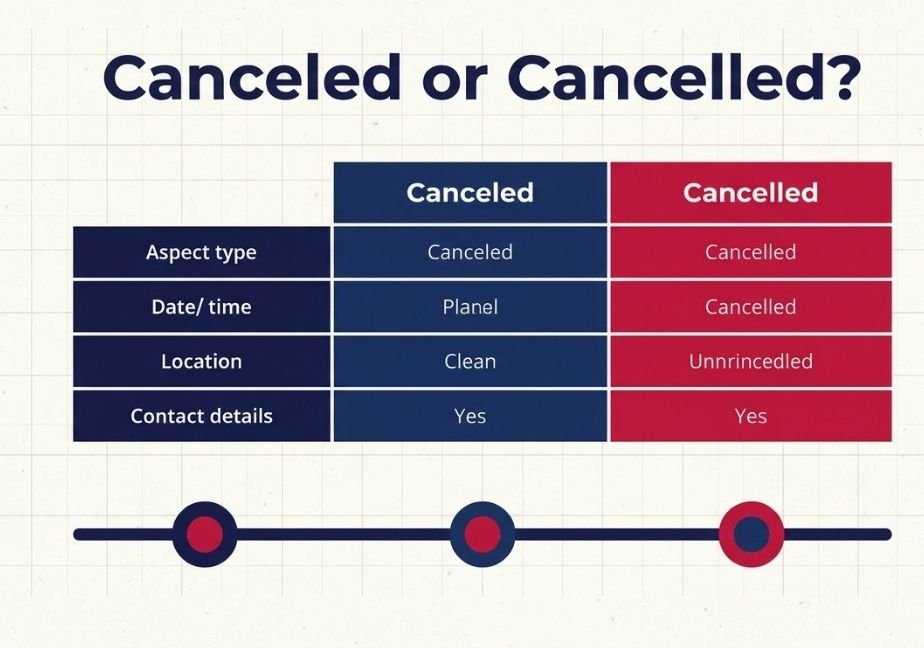
Canceled and cancelled are two spellings of the same word. Canceled, with one L, is the standard American spelling. Cancelled, with two Ls, is the standard British spelling. The meaning, the sound and the grammar stay the same. Neither spelling is a mistake.
Think of it like color and colour. Each country has its own habit. The habit just shows up in the number of Ls.
Here is how the word changes across its forms:
| Form | American English | British English |
|---|---|---|
| Past tense | canceled | cancelled |
| Ongoing form | canceling | cancelling |
| Person who cancels | canceler | canceller |
| Noun | cancellation | cancellation |
Notice the last row. The noun matches in both countries. We cover that exception below.
Still, the split is not a hard and fast wall. Quick and Dirty Tips points to a Google Ngram search of published books. It shows both spellings in use in both countries. Merriam-Webster’s own entry for the verb lists canceled or cancelled. So you will see mixed use in the wild. The safe habit is to match your reader.
Now look at two quick examples. An American writer might say, “Rain canceled the concert.” A British writer would say, “Rain cancelled the match.” Both sentences work. They simply follow different local habits.
Why Two Spellings Exist
Spelling in English has never been tidy. The canceled and cancelled split is a good example. It started with one man and one big book.
Noah Webster Changed the Rule
Noah Webster was an American dictionary maker. He wanted spelling to be simpler and to match sound. He also wanted American English to look different from British English.
According to Merriam-Webster, his 1806 dictionary used cancelled. However, his 1828 dictionary switched to canceled. Merriam-Webster also admits that English spelling is a messy mix of old habits and reforms. So the confusion is not your fault.
Britain kept the double L. Americans followed Webster. Over time, the two versions drifted apart. Today each country treats its own spelling as normal.
The change did not happen overnight. Grammarly notes that canceled did not fully replace the double L spelling in American writing until around the 1980s. So older American books often show cancelled. That is normal for the time.
The Rule Behind the Extra L
Webster used a simple idea. When you add an ending to a verb that ends in L, you may need to double that letter. American English doubles it only when the stress falls on the last syllable. British English doubles it more often.
Take “cancel.” The stress falls on the first syllable. So American English adds the ending with no extra L. That gives canceled. British English adds the second L and writes cancelled.
Compare that with “compel.” The stress falls on the last syllable. So both countries write compelled with two Ls. The rule explains why the two words behave differently.
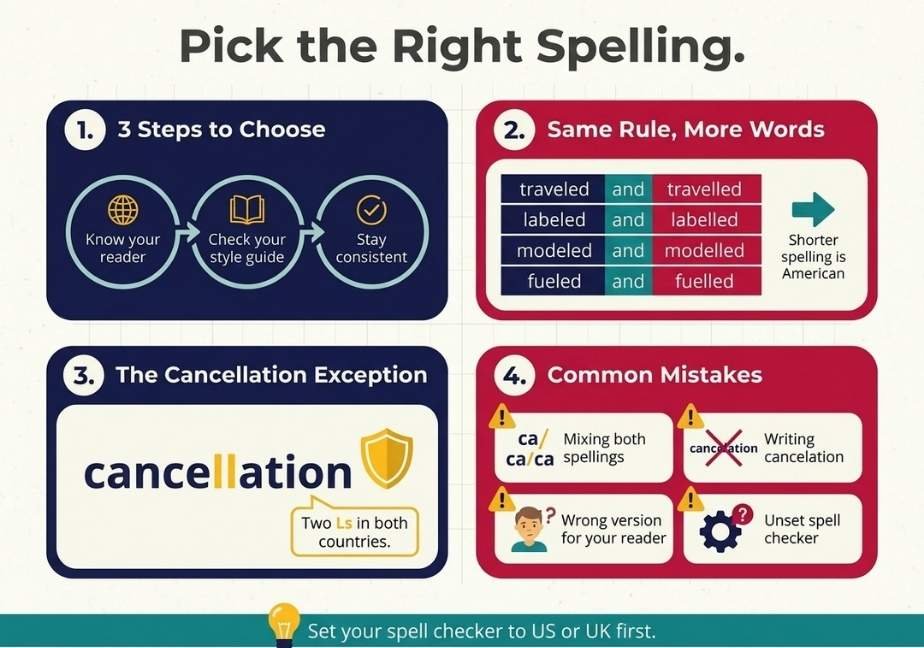
The same pattern shows up in many verbs. Here are a few pairs:
- Traveled in the US and travelled in the UK.
- Labeled in the US and labelled in the UK.
- Modeled in the US and modelled in the UK.
- Fueled in the US and fuelled in the UK.
Once you learn one pair, you know the rest. That saves you a lot of guessing.
How to Choose the Right Spelling
Match your reader, check your style guide and keep one spelling throughout. Those three steps settle the choice in almost every case.
- Match your reader: canceled for the US and cancelled for the UK.
- Check your style guide before you start writing.
- Pick one spelling and keep it from top to bottom.
Match your reader. Start with the person who will read your work. Where do they live? Which version of English do they use every day? Grammarly says cancelled is standard in British English and in other Commonwealth countries. For an American reader, use canceled.
This applies to everyday writing too. In an email, match your recipient. If your client is in Chicago, write canceled. If your client is in London, write cancelled. A website should match its main market. A customer message should stay short and clear. Say “Your order was canceled” or “Your order was cancelled.” Then add the next step. Readers care about the outcome more than the spelling.
Check your style guide. A style guide is a rulebook for spelling and tone. It settles the question for you. The AP Stylebook, which many American news outlets use, recommends canceled with one L. Many other American guides follow the same one L habit. British publishers tend to prefer cancelled. Your employer may also have a house rule. So follow it first.
Keep one spelling. Consistency matters more than the choice itself. A mixed text looks careless. Readers may think you did not proofread. So set your spell checker to English (US) or English (UK) before you start. Then the tool will flag any slip. Also keep a quote exactly as the source wrote it. Do not change its spelling to match yours.
Canceling or Cancelling? Other Forms of the Word
The same rule covers every form of the verb. So you only need to learn it once.
American English writes canceling. British English writes cancelling. For example, “I am canceling my order” is American. “I am cancelling my order” is British. The meaning stays the same.
Next comes the person who cancels. American English uses canceler. British English uses canceller. These words are rare. Still, they follow the same logic.
The adjective works a little differently. Merriam-Webster lists cancelable first and cancellable as a variant. So both forms appear in print. If you want a safe choice, match the rest of your spelling. Use cancelable with canceled and cancellable with cancelled.
Finally, notice the sound. Canceled and cancelled sound exactly the same. You cannot hear the extra L. So the difference only shows up on the page.
The Cancellation Exception
Here is the twist. The noun cancellation has two Ls in both countries. Dictionaries list cancellation as the normal spelling everywhere. American writers do not drop the L in the noun.
This matters in daily life. You will see it on forms and receipts. For example, you may read a “cancellation policy” or a “cancellation fee.” Those phrases look the same in New York and in London. So use cancellation and you are safe in both places.
Many writers make one mistake here. They apply the one L rule to the noun and write “cancelation.” Avoid that. Stick with cancellation.
What Does “Canceled” Mean in Cancel Culture?
You may also see the word in online talk. People say a public figure “got canceled.” Merriam-Webster defines this sense of cancel as withdrawing support for a person or a company publicly, especially on social media. The same dictionary dates the phrase “cancel culture” to 2016.
The spelling rule does not change. An American headline might say a show was canceled. A British headline would say it was cancelled. The same is true when the word means pulling support from a person.
Still, check your tone. This use of the word can be a heated topic. So choose it with care in formal writing. In casual talk, it is common and easy to understand.
Easy Ways to Remember the Difference
You do not need a long memory trick. A few short habits will do the job.
- The shorter spelling is the American one.
- Think of Webster as the man who cut the extra L.
- Remember color and colour. Canceled follows the same shortcut pattern.
- Write cancellation with two Ls in every country.
- Set your spell checker to US or UK first.
Pick the habit that feels easiest. Then use it each time.
Common Mistakes to Avoid
Even careful writers slip on this word. Here are the main errors and how to fix them.
Writing cancelation. As noted above, cancellation is the standard noun. So add the second L.
Using the wrong version for your reader. A UK reader may read canceled as an American spelling. A US reader may read cancelled as a British one. Neither version is wrong. Still, matching the reader looks more polished.
Trusting an unset spell checker. Many tools default to one version of English. So a writer may get false errors. Fix the language setting first.
Changing a quote. If you quote a source, keep its spelling. Do not fix it to match your own style.
Examples in Real Sentences
Seeing the word in context makes the rule easy. Here are short examples for each version.
American English:
- Rain canceled the outdoor concert.
- She canceled her doctor appointment this morning.
- They are canceling the meeting until next week.
- We received a cancellation notice by email.
British English:
- Rain cancelled the football match.
- He cancelled his train ticket last night.
- The airline is cancelling several flights today.
- You can read the cancellation terms online.
Notice the last line in each set. Both use cancellation with two Ls. That one word stays the same on both sides of the Atlantic.
FAQs About Canceled or Cancelled
Are canceled and cancelled both correct?
Yes. They are regional spellings of the same word. Canceled is American English and cancelled is British English. The meaning is identical.
Is cancelled wrong in American English?
No. It is less common in the US. Style guides such as AP recommend canceled, but cancelled still appears in American writing.
Is it canceling or cancelling?
Canceling is the American spelling. Cancelling is the British spelling. Both follow the same rule as canceled and cancelled.
Is cancellation spelled with one L or two?
Two Ls. Cancellation is the standard spelling in both American and British English. Cancelation is not the usual form.
Do canceled and cancelled sound different?
No. They sound the same and mean the same. Only the spelling changes with the region.
What does AP style say about canceled?
The AP Stylebook recommends canceled with one L. It also uses canceling for the ongoing form.
Conclusion
So, canceled or cancelled? Both are right. Canceled with one L fits American English. Cancelled with two Ls fits British English. The meaning never changes.
Remember the key points. Noah Webster simplified the American spelling in 1828. The same rule gives you traveled, labeled and modeled. The noun cancellation keeps two Ls everywhere. The AP Stylebook backs canceled for American news writing.
Now you can write with confidence. Know your reader and check your style guide. Then pick one spelling and stay with it. That is the whole trick.