

Patients or patience? It looks like a tiny question. Yet it trips up smart writers all the time. The two words sound almost the same. They mean very different things. One names people. The other names a quality inside you.
This guide shows what each word means and gives clear examples you can copy. You will also get memory tricks, texting tips and a short quiz. By the end, you will pick the right word every time.
Patients vs Patience
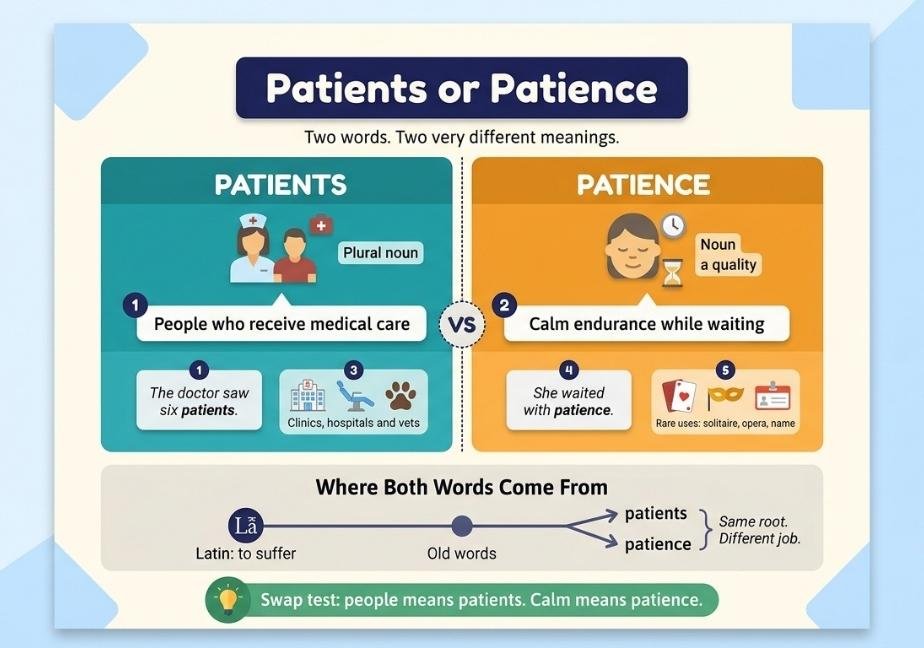
Patients are people who receive care from a doctor, nurse or other health worker. Patience is the calm way you handle waiting, delay or trouble. Use “patients” when you mean people and “patience” when you mean calm. For example, a nurse needs patience to care for patients.
What Does “Patients” Mean?
“Patients” is the plural of “patient.” A patient is a person who receives medical care. Merriam-Webster defines the noun as an individual awaiting or under medical care and treatment. That care can happen in a hospital, a clinic, a dental office or a therapy room. Vets use the word for animals too, so a dog at the vet is a patient.
Patients as a Noun
In most cases, “patients” works as a noun. It names a group of people you can count. You can say “ten patients” or “many patients.” Doctors, nurses and pharmacists talk about patients all day.
Here is a simple test. Swap the word with “people.” If the sentence still makes sense, “patients” is correct. “The clinic sees fifty patients a day” works. “The clinic sees fifty people a day” works too.
Where the Word Comes From
Merriam-Webster traces “patient” to the Latin verb pati, which means “to suffer,” and dates the word to the 14th century. That makes sense. Long ago, a patient was a person who endured pain. Today, the word simply means a person under medical care.
What Does “Patience” Mean?
Patience is the ability to stay calm when things go slowly. It also means staying kind when something annoys you. A person with patience does not rush or snap. That person waits and keeps a steady mind.
Patience as a Quality
Patience is a trait, not a person or a thing. You can have a lot of it or very little. Oxford Learner’s Dictionaries labels the noun as uncountable, so you cannot count it. That is why people say “a lot of patience” and not “many patiences.”
You can also lose it. A long car ride with kids can test anyone. As a result, people often say, “I am running out of patience.”
Where Patience Comes From
English borrowed “patience” from Old French, which took it from the Latin word patientia. That Latin word shares its root with “patient.” So the two words are close relatives, even though they do different jobs today.
Other Meanings of Patience
The word has a few other uses. British English speakers call the card game solitaire “patience.” Gilbert and Sullivan also wrote a comic opera called Patience, which the Gilbert and Sullivan Archive says opened in London in 1881. Finally, Patience is a given name. These uses are rare. In daily writing, you will almost always mean the calm trait.
Patient or Patience? The Adjective Trap
“Patient” has a second job. It can also be an adjective that describes a calm person. That form causes a lot of confusion, because “patient” and “patience” both relate to staying calm.
Here is the rule. Use “be patient” with the adjective. Use “have patience” with the noun. Both versions are correct, and they mean the same thing.
- Please be patient while the page loads.
- Please have patience while the page loads.
Related words follow the same pattern. “Patiently” is the adverb, as in “She waited patiently.” “Impatient” and “impatience” are the opposites.
Patients or Patience: The Key Differences
Seeing the words side by side makes the gap clear. This table covers the main points.
| Word | Type | Meaning | Swap test | Example |
|---|---|---|---|---|
| Patients | Plural noun | People who receive medical care | Swap in “people” | The doctor saw six patients. |
| Patience | Uncountable noun | Calm endurance while waiting | Swap in “calm” | She waited with patience. |
| Patient | Adjective, or singular noun | Calm (adjective) or one person under care (noun) | Swap in “calm” or “person” | Be patient. The patient is resting. |
Both words end with a similar sound, but the spelling differs. “Patients” ends with “ts.” “Patience” ends with “ce.” That small change flips the whole meaning.
Why People Mix Them Up
Many writers swap these words by mistake. Several reasons explain it.
- The two words sound almost identical in fast speech.
- Both words are real, so spellcheck rarely flags the error.
- Both words share the same Latin root.
- Fast typing and autocorrect add more slips.
The shared root matters most. Merriam-Webster lists “patient” as both a noun for a person under care and an adjective for someone who stays calm. One word with two jobs makes “patients” and “patience” feel closer than they are.
Pronunciation adds to the mix-up. Both words open with the same “PAY-shuhn” sound. “Patience” ends with a soft “s,” while “patients” ends with “ts.” In fast speech, that small “t” is easy to miss, so the ear cannot always tell the words apart.
Spellcheck only checks if a word exists. It cannot check if you picked the right one. Therefore, you must check the meaning yourself.
Easy Examples in Sentences
Examples teach faster than rules. Read these lines out loud. Then try making your own.
Examples With Patients
- The nurse checked on her patients every hour.
- Many patients wait in the lobby before their visit.
- The clinic treats about forty patients each day.
- New patients must fill out a short form.
- The dentist calms nervous patients with a gentle voice.
Examples With Patience
- Teaching a child to read takes patience.
- He lost his patience in the long line.
- Thank you for your patience while we fix the issue.
- Her patience paid off when the plant finally bloomed.
- Good coaches show patience with young players.
Examples With the Adjective “Patient”
- The patient teacher explained the rule twice.
- Please be patient with the new staff.
- She waited patiently for her turn.
Examples With Both Words
Sometimes both words fit in one sentence. In that case, each word keeps its own job.
- The nurse showed great patience with her patients.
- Working with patients takes skill and patience.
- Patients value doctors who listen with patience.
Common Phrases and Idioms
Some phrases use these words again and again. Learning them helps you spot the right choice fast.
- “Patience is a virtue” means waiting calmly is a good trait.
- “The patience of a saint” describes someone who never gets upset.
- “Try my patience” means to annoy someone slowly.
- “Patient care” means the help a medical team gives to patients.
- “Patient portal” means a website where patients view test results.
- “Patient rights” means the legal protections people get in healthcare.
In the last three, “patient” stays singular. That is normal. The word works like an adjective that points to the people being treated.

Patients or Patience in Texting and Social Media
Many people land on this topic after seeing a post online. A friend might write “pray for my patients” or “I need more patients today.” So what is going on?
Neither word is slang. Neither one is a texting abbreviation. They are standard English words that people swap in quick messages.
Context decides which spelling is right. A nurse who asks for prayers for her patients is using the word correctly. A parent who types “I need more patients today” about a restless toddler almost certainly meant “patience.”
A common slip looks like this: “Thanks for your patients.” The writer means “thanks for waiting calmly.” The correct word is “patience.”
Some posts swap the words on purpose. A popular joke goes, “You need patience to work with patients.” The wordplay works because the words sound alike. It fits any job that tests your calm, such as teaching or customer service.
Fast typing is the usual cause of the slip. Autocorrect often makes things worse because it does not know your meaning.
Simple Memory Tricks
You do not need to memorize rules. A few quick tricks will do the job.
Trick One: Think of Clients
“Patients” ends the same way as “clients.” Both words name people. Both end in “ients.” So if you mean people, pick the word that looks like “clients.”
Trick Two: Think of Silence
“Patience” ends the same way as “silence.” Both words name a state or quality. Both end in “ence.” So if you mean a calm trait, pick the word that looks like “silence.”
Trick Three: Swap the Word
Try replacing the word with “people.” If it fits, use “patients.” Next, try replacing it with “calm.” If it fits, use “patience.” This swap test works in almost every case.
Trick Four: Say the Rule
Say this line a few times: “Patients need care. Patience needs calm.” It is short. It sticks.
Common Mistakes at Work and School
Errors with these words appear in many places. Some are funny. Others look unprofessional.
A clinic might post a sign that says “Thank you for your patients.” That sign thanks the people in the room instead of their calm waiting. A job seeker might write “I work with great patience in a hospital” when they mean patients. A student might write “The doctor lost his patients” and confuse the whole sentence.
Emails carry the same risk. A line that opens with “Dear patients” suits a clinic newsletter. The same word in a reply to a late customer, such as “Thanks for your patients,” looks like a typo and weakens an otherwise polite message.
Here is how to avoid these slips.
- Read your text out loud and ask what each word means.
- Run the swap test with “people” and “calm.”
- Check your signs, emails and resumes twice.
- Ask a friend to proofread important work.
Grammar apps catch many errors. Still, they can miss this one because both words are spelled correctly.
Quick Practice Quiz
Try these five lines. Pick “patients” or “patience” for each blank.
- The doctor greeted her new ____ with a smile.
- Learning to cook takes time and ____.
- The hospital added more beds for ____.
- Please have ____ while the page loads.
- A good nurse shows ____ and kindness.
Answers: 1. patients. 2. patience. 3. patients. 4. patience. 5. patience.
Did you get all five? If so, you have it down. If not, reread the memory tricks and try again.
FAQs About Patients or Patience
What is the difference between patients and patience?
Patients are people who receive medical care. Patience is the ability to stay calm while waiting or facing problems. One word names people. The other names a trait.
Is it “thank you for your patience” or “patients”?
Use “patience.” You thank someone for waiting calmly. “Patients” would thank people under medical care, which rarely fits the message.
Is patients or patience slang or a texting abbreviation?
No. Both are standard English words. People often confuse them in quick texts because they sound alike and spellcheck accepts both.
Does patience have a plural form?
Rarely. Patience is an uncountable noun, so you say “a lot of patience.” The plural “patiences” is not standard in everyday English.
Is it “have patience” or “be patient”?
Both are correct. Use “have patience” with the noun and “be patient” with the adjective. “Please have patience” and “Please be patient” mean the same thing.
What is the difference between patient’s and patients’?
“Patient’s” shows that one patient owns something, as in “the patient’s chart.” “Patients'” shows that several patients own it, as in “the patients’ charts.”
Conclusion
Use up and down arrow keys to resize the meta box pane.
Patients and patience may sound like twins, yet they do very different jobs. “Patients” names people who get medical care. “Patience” names the calm strength you use when life moves slowly.
When you feel unsure, run the swap test. “People” points to patients, and “calm” points to patience. Check the word once before you hit send, and the right choice will soon become a habit.